Crystals as Objects: Styling a Calm, Meaningful Corner at Home
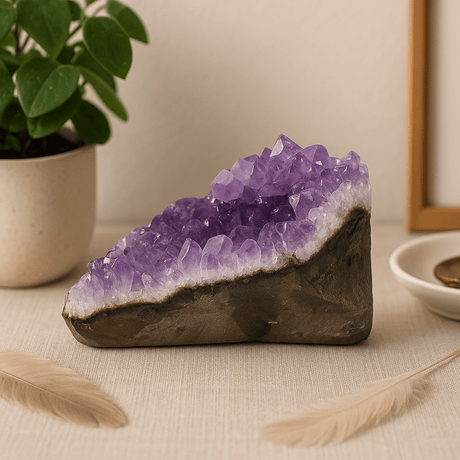
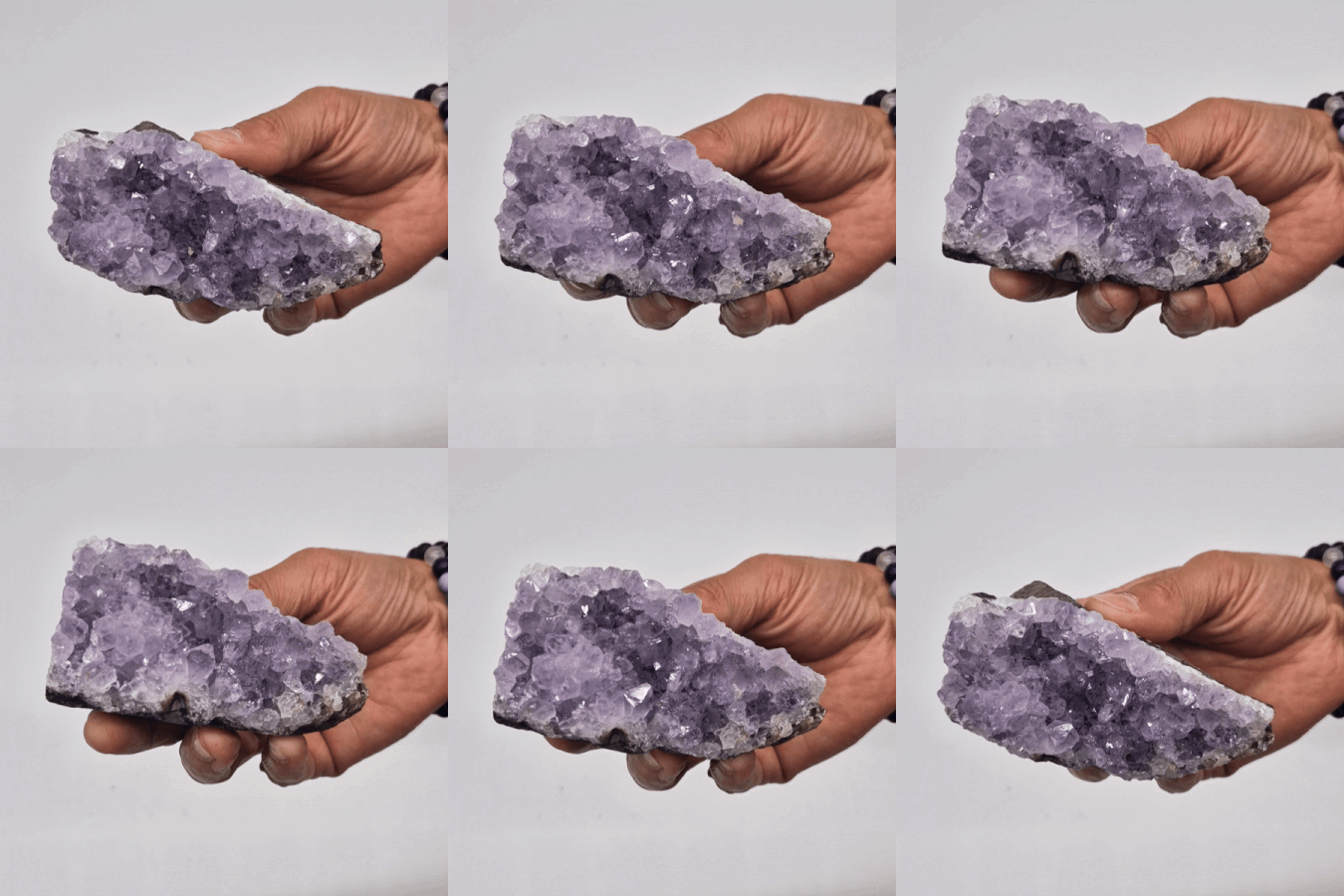
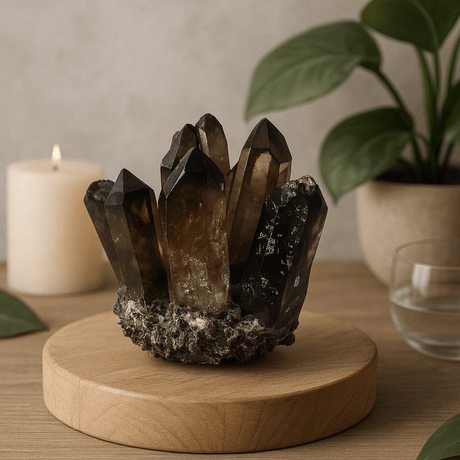
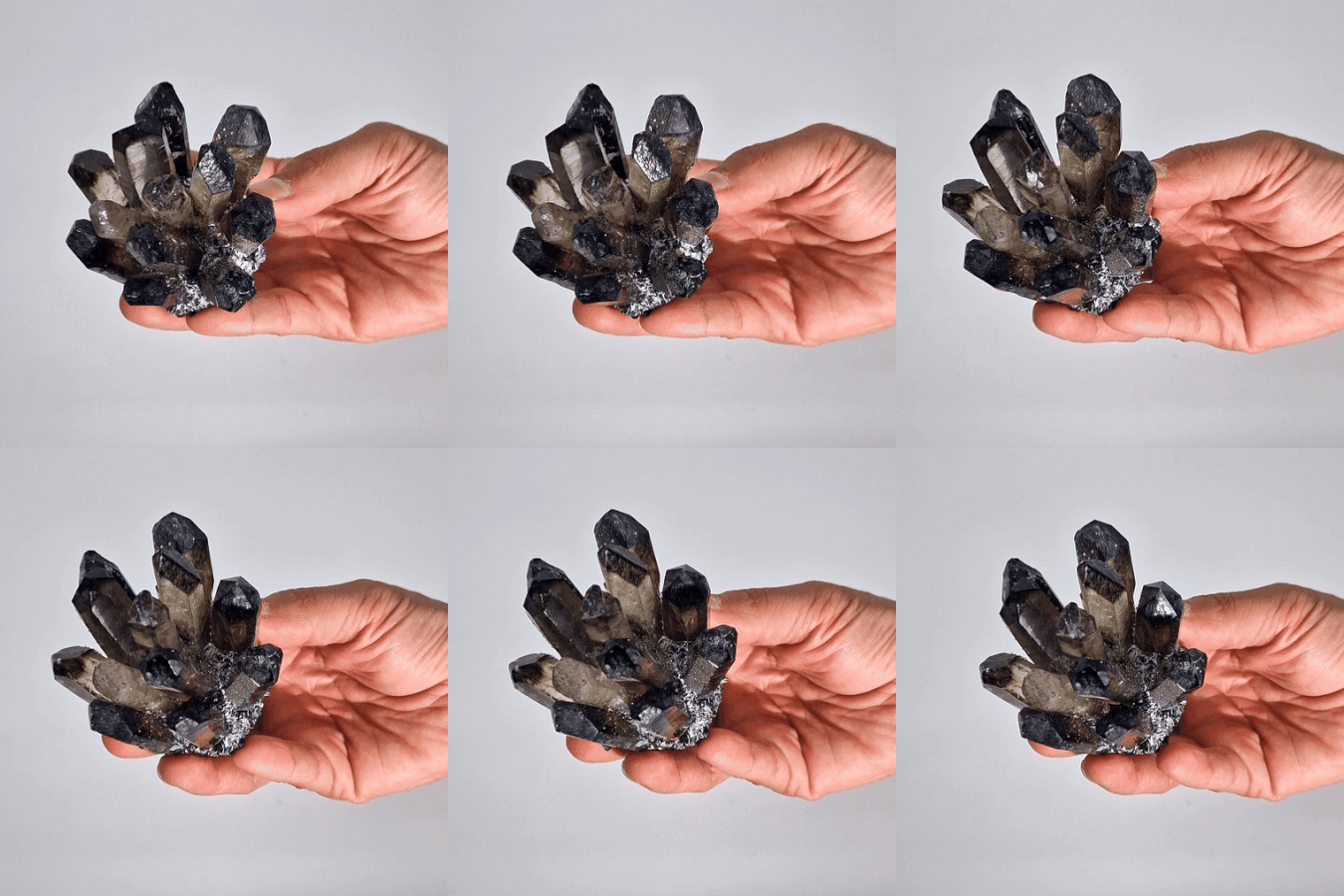
Pick up a good amethyst cluster and the first thing you notice is the weight, then the two faces of it. One side is glassy and purple, ranked with small crystal points catching the light. The other is dull grey stone, unpolished, sometimes still gritty. That grey side is not a flaw to hide. It is the rock the cluster grew inside, and it is the part of the story most home-styling guides skip straight past on the way to telling you which corner of the room it belongs in.
In the hand: what the cluster actually is
Amethyst is not a separate mineral with a mysterious origin. It is a variety of quartz, silicon dioxide, the same substance as the clear crystal on a windowsill or the sand under it, distinguished only by what happened to it while it formed. Trace iron sits within the quartz lattice, and natural irradiation, over a very long stretch of geological time, turns that iron into the purple you see. Quartz also carries a Mohs hardness of 7, which is why ordinary household dust, cloth, even a careless knock rarely scratches it. The name itself comes from the Greek amethystos, "not intoxicated": the ancient Greeks associated the stone with protection from drunkenness, and centuries later amethyst found its way into bishops' rings within the Catholic Church, worn as a mark of sobriety and restraint rather than excess.
A gas bubble in old lava: where it grew

Most of the amethyst that reaches a shelf began as nothing more than a pocket of trapped gas. When ancient basalt lava flows cooled, bubbles of gas inside them left behind hollow cavities, called vesicles. Silica-rich groundwater then moved slowly through the rock, depositing thin layers of crystal along the cavity walls over an immense span of time, layer upon layer, until the hollow filled with what we now cut open as a geode. The basalt flows of Rio Grande do Sul in southern Brazil, and the neighbouring Artigas region across the border in Uruguay, hold some of the largest known deposits formed this way. Zambia is another significant source, and historically the Ural Mountains in Russia produced amethyst prized for its depth of colour. The grey rind on a cluster is simply the last trace of that original cavity wall, the boundary between rock and crystal.
From chisel to shelf: the craft and the journey

Geodes are still largely hand-mined and hand-sorted in the regions where they form, opened carefully so the crystal faces inside are not damaged in the process. A workshop step then decides the shape a piece will take on: which faces are ground and polished to show their clarity, and which are left rough, keeping the natural geometry of the original cavity visible. It is this decision, more than anything, that separates a cluster with genuine character from one polished into anonymity. From there the stone travels outward through a trade in mineral specimens that has moved crystal from southern Brazil into homes worldwide for generations, arriving eventually as something as unremarkable and as extraordinary as an amethyst standing cluster set down on a low shelf.
Living with it: placement, light and care

The instruction to keep amethyst out of strong sunlight is usually given without explanation, which is a shame, because the reason is the same mechanism that gave the stone its colour in the first place. The purple comes from iron plus irradiation; prolonged UV light and heat can slowly reverse that process, fading the colour it took nature so long to build. Taken further, heat treatment is a well-documented way to turn amethyst into citrine, and much of the citrine sold today began life as amethyst before a kiln changed it. None of this means treating the stone as fragile. Quartz's hardness makes it largely indifferent to dust and handling; it only asks to be kept from direct, sustained sun and from harsh chemical cleaners, a wipe with a soft cloth being all the care it generally needs. As for where to put it: not necessarily the "wealth corner" any decorating formula assigns it, but wherever morning light falls gently rather than directly, a spot the eye returns to rather than one dictated by a diagram.
The corner it earns
A crystal placed with attention does not need to be explained to work as an object in a room. It works the way any object with a real history works: because you know something of where it came from, and that knowledge changes how you see it sitting there. I keep returning to the idea that a cluster like this rewards curiosity more than instruction. Learn how it formed and the placement stops being decoration and starts being a small daily choice, to keep something slow and old somewhere you will actually look at it. If amethyst carries an association with clarity or calm for you, that meaning travels with the stone as much as the geology does; the two are not in competition. Keeping it out of the sun, wiping it now and then with a soft cloth, is a small, ordinary act of attention, and attention, more than any corner of the house, is what turns an object into part of a life.