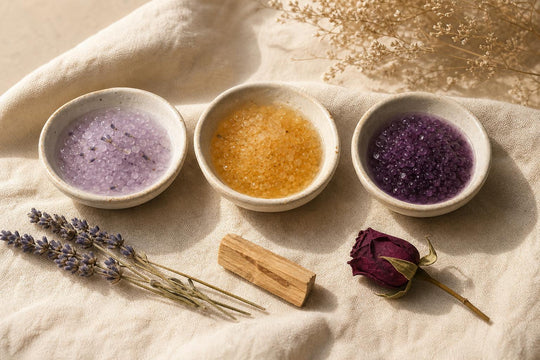
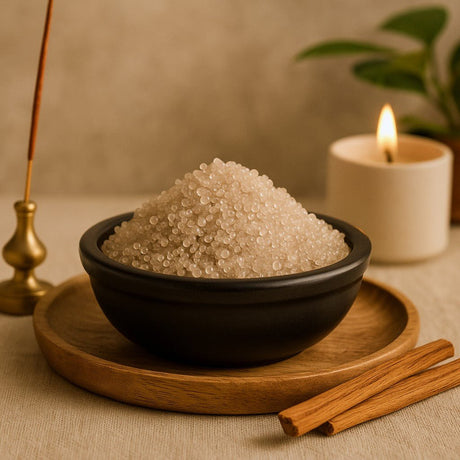
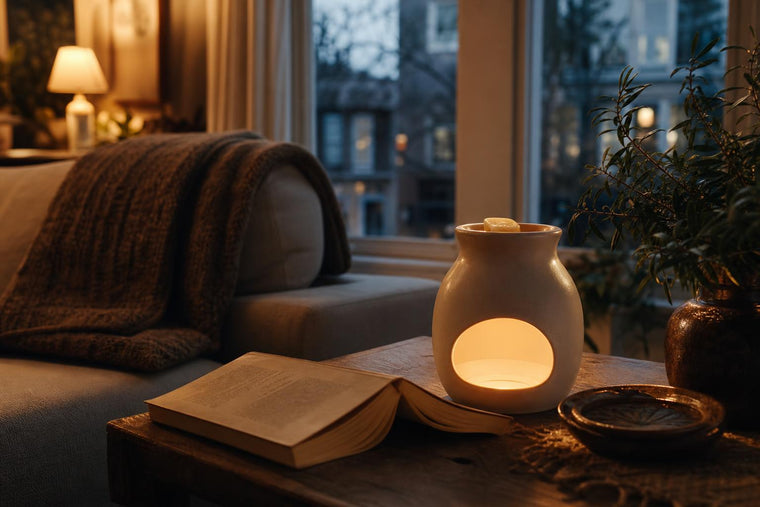
A ceramic dish, a tealight, a few pieces of scented wax the size of a fingernail. That is the whole apparatus of a simmering granule burner, and also the whole quiet argument for the format. No flame touches the fragrance itself, no smoke, no charring; only wax warming until it gives up what it holds.
What a simmering granule actually is
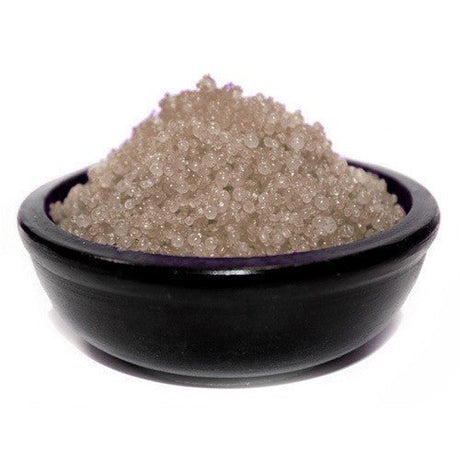
A simmering granule is a small piece of scented wax, typically paraffin or a soy and paraffin blend, made to be melted rather than burned. It sits in the shallow dish of a ceramic oil burner, and a tealight below warms the dish until the wax softens and releases its fragrance. There is no wick in the granule itself. The tealight is the heat source; the wax is only the carrier, holding the fragrance oil in suspension and letting it evaporate slowly as the dish warms. Most granules are sold by weight in small jars or bags, coloured to signal the scent inside, and a teaspoon or so is enough for one dish.
Because the fragrance oil never touches an open flame, the granules produce no smoke and very little soot. This is the practical line between a burner and a stick of incense or a cone. Incense sends a plume of scented smoke into the room and asks you to be present for it. A granule burner just quietly seasons the air, at a lower temperature and without combustion.
Where the habit of warming scent began
Warming a fragrance rather than burning it is an old idea, older than the format sold today. In eighteenth- and nineteenth-century European homes, small ceramic brûle-parfum burners were used to warm resins and perfumed pastes; the French bougie parfumée tradition, of candles cast with scent, comes from the same instinct. In a related but separate strand, American kitchens have long kept a stovetop simmer pot on a low heat: citrus peel, cloves, a stick of cinnamon, sometimes a bay leaf, simmering as much to scent the house as to freshen the winter air. It is a twentieth-century domestic habit more than an ancient one, and it sits closer to American kitchens than to British ones.
The wax granule as sold today is a more recent invention, popularised in part by brands such as Yankee Candle, among others, from the later twentieth century onward, offered as a cleaner alternative to potpourri and a lower-commitment cousin to the jar candle. The format has since been made by many houses, including Kringle Candle, Village Candle and a long list of independent chandlers who cast their own. What began as one corner of the home-fragrance shelf has become, quietly, a small category of its own.
How the burner works, and why the scent fades
The mechanics are simple, and worth knowing, because they explain most of the small decisions involved in using one. Heat from the tealight raises the dish close to the wax's melting point, typically somewhere in the range of fifty to sixty-five degrees Celsius for a paraffin blend, though the exact figure shifts with the wax's own composition and the burner's design. At that temperature the wax softens into a shallow pool without boiling or scorching. The fragrance oil bound inside the wax has a lower boiling point than the wax itself, so it lifts off into the air well before the wax would ever burn. This is why the dish never blackens the way a wick does.
The throw, the strength of scent in the room, is strongest in the first half hour or so, once the dish has come fully up to heat, and tapers over the following two to three hours as the fragrance oil is used up. What is left behind afterwards is a hardened disc of near-scentless wax; the oil has gone, the wax has not. A dish can usually be relit two or three times before that disc gives almost nothing, at which point it is worth easing it out and starting fresh, rather than adding new granules on top of spent ones. None of this is exact: a draughty room carries scent differently from a still one, and a heavier hand with the granules changes the timing more than the burner itself does.
Choosing a fragrance for the room
The room often matters as much as the mood. Warm, grounding notes such as sandalwood, vanilla and patchouli suit a living room where people gather for longer stretches; a dish of sandalwood granules reads differently across an evening than it does in the first ten minutes. Bedrooms tend to want something quieter still: lavender, rose or magnolia, warmed low rather than pushed hard. Hallways and kitchens can carry brighter, sharper notes, citrus or citronella, since the scent has more air to move through and less time to sit. Resin-based blends such as myrrh suit an evening spent reading or sitting with tea, where the scent is meant to be noticed occasionally rather than constantly.
Using and caring for the burner
A teaspoon of granules in the dish, a tealight lit beneath it, and a few minutes' patience is the whole routine. Once the fragrance has faded, blow out the tealight and let the dish cool fully before handling it; a dish that has just been warmed holds its heat for longer than it looks like it should. The spent wax can be topped up with a few fresh granules for a second or third session, or scraped out entirely once the scent has thinned to nothing. Treat the burner exactly as you would treat a lit candle: set it on a stable, heat-proof surface, away from curtains or paper, out of reach of children and pets, and never left burning unattended.
None of this asks for much attention, which is rather the point of the format. A granule burner does not compete with a room for notice the way incense does. It sits in a corner, does its slow work, and is finished by the time the tealight burns out, ready for a different scent whenever the next evening calls for one.