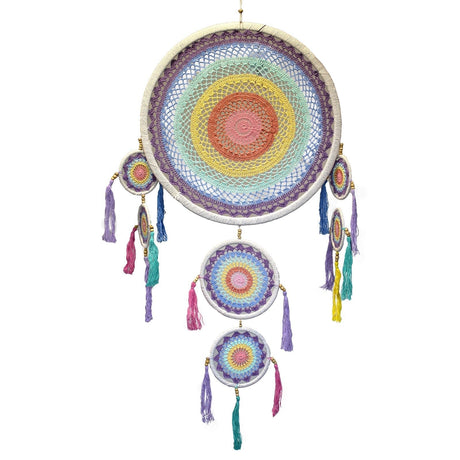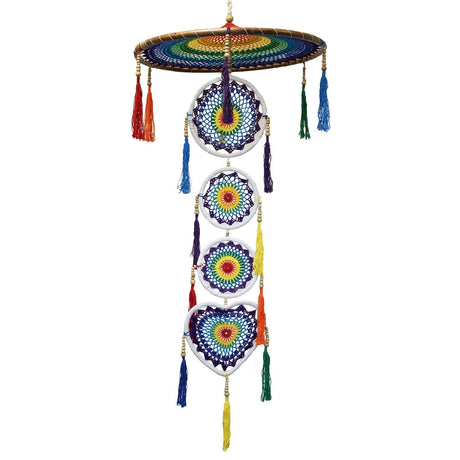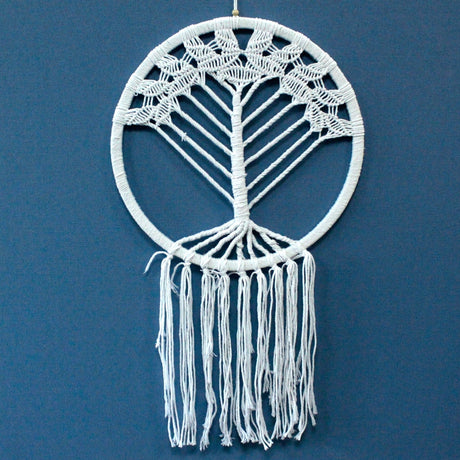
There is a quiet moment, last thing at night, when a room finally settles. The light goes warm and low, the day loosens its grip, and a dream catcher turns gently in the air above the bed. It catches the last of the evening light and, come morning, the first. For something so simple — a hoop, a woven web, a few feathers — it carries a long and careful story.
This piece walks through where dream catchers come from, what their parts have meant, and how people choose to live with one today. We offer it as a way in, not a set of rules.
The origins and historical roots
The history of the dream catcher is deeply rooted in Native American culture, primarily among the Ojibwe (also called the Chippewa). Over time, the form has been taken up by other peoples and cultures, each bringing its own reading and style.
Native American origins: the Ojibwe legend
The Ojibwe word often linked to the dream catcher, asabikeshiinh, points to the spider — the web-maker. It carries the legend of the Spider Woman, Asibikaashi, who in the old stories watched over the people, and especially over infants.
As the Ojibwe nation grew and spread, the story tells that Asibikaashi could no longer reach every cradle. So the mothers, sisters and grandmothers began weaving protective webs of their own. They bent hoops from willow and wove a pattern in the likeness of a spider's web. The tradition holds that good dreams find their way through the small hole at the centre and slip down to the sleeper, while troubled dreams are caught in the web and undone by the first light of morning.
Spread and evolution
The dream catcher travelled. Other Native American peoples took it up, each adding their own touch, and the designs and stories grew richer for it. During the Pan-Indian movement of the 1960s and 1970s, the Ojibwe dream catcher gained wider acceptance among tribes including the Cherokee, Lakota and Navajo. That movement carried it further still, and brought a broader recognition of its cultural meaning.

Design and symbolism
Authentic dream catchers are more than decoration. In the traditions that shaped them, each part of the design — from the hoop to the beads — carries meaning tied to nature and to the cycle of life.
Traditional elements
- Hoop: the foundation of a dream catcher, read as the circle of life — the steady turning of the sun and moon, the way one season leads to the next. Traditionally bent from a pliable branch such as willow, it holds everything together.
- Web: woven within the hoop, the web speaks of unity and connection. In the tradition it is said to hold troubled dreams until they fade with the morning light. The pattern echoes a spider's web — a quiet nod to creative power and care.
- Feathers: the feathers hanging below are both decorative and symbolic. In many cultures they stand for breath and air, and are seen as a gentle path for good dreams to reach the sleeper.
- Beads: beads are often threaded through the work, each one a small marker — a life stage, a thought, a touch of colour. They give every dream catcher its own character.
The number of points on the woven web
In popular dream-catcher craft, the number of points where the web meets the hoop is sometimes read for meaning. These are modern, folk associations rather than a fixed traditional code — they vary from maker to maker, and the older ethnographic record does not set them in stone. Read lightly, they go something like this:
- Five points — often read as a star in the sky.
- Six points — sometimes linked to the eagle, a sacred bird.
- Seven points — associated by some with the seven prophecies.
- Eight points — read as the spider's eight legs, recalling the Spider Woman of the legend.
- Thirteen points — connected to the thirteen phases of the moon.
Colour significance
Colour, too, has gathered associations over the years. None of this is a rule — choose the shades that genuinely draw you in.
- Black: often linked to protection and a sense of grounding.
- White: associated with clarity, purity and calm.
- Red: read as strength and vitality — the warmth of life.
- Blue: connected to calm and tranquillity, a quiet, settling shade.
- Green: growth and a sense of connection to nature.
- Yellow: the sun and new beginnings — light, hope, a fresh morning.
Together, the colours and the weave give each dream catcher its own quiet meaning — which is part of why so many people find it a personal object rather than a generic one. You might see it miniaturised into accessories like earrings, scaled up as a focal point hung on a wall, or kept small and close.

Making and caring for a dream catcher
Making a dream catcher is a slow, pleasant process — part craft, part attention. Here is a simple outline, with materials kept kind to living things.
Crafting your dream catcher
- Choosing the hoop: start with a hoop. Wood or metal hoops are easy to find; a willow branch, bent and tied, keeps things closer to the old way. Size is down to you.
- Selecting the string: the string wraps the hoop and forms the web. Embroidery floss, cotton thread, jute or hemp twine, or a vegan-suede cord all work well. Pick colours you like.
- Choosing the feathers: there is no need for real bird feathers. Faux feathers and plant-fibre tassels give the same gentle movement without any animal materials — the kinder, cruelty-free choice.
- Choosing the beads: beads add a little character. Choose ones with large holes for easy threading, and match them to your colour scheme.
- Wrapping the hoop: wrap the hoop with cotton or vegan-suede cord for a finished look.
- Weaving the web: begin at the top, looping the string around the hoop and knotting as you go to build the web. Leave a small hole at the centre.
- Adding feathers and beads: tie your faux feathers and fibre tassels at the bottom. Beads can be threaded onto the strings or worked in along the way.
A note on materials. SHAMTAM follows the Ahimsa principle — care and respect for all living things — so our own dream catchers are made without animal feathers or leather. If you are crafting one yourself, faux feathers, cotton, jute, hemp and vegan-suede cord let you honour the tradition without animal-derived materials.
Looking after your dream catcher
- Regular cleaning: use a soft brush or feather duster to lift dust gently. Handle the threads with care so nothing snags.
- Avoid moisture: natural fibres do not love damp. Keep your dream catcher away from humid spots, and let it air dry if it ever gets wet.
- Careful storage: when it is not on display, store it in a cool, dry place, wrapped in a soft cloth or tissue paper.
- Repairs: keep a little spare string, beads and faux feathers for the odd repair. A needle and thread will reattach any loose parts.
Made and kept with a little care, a dream catcher can be a cherished part of a room for years. It is worth knowing the tradition behind it as you go — the object means more when its story is understood.