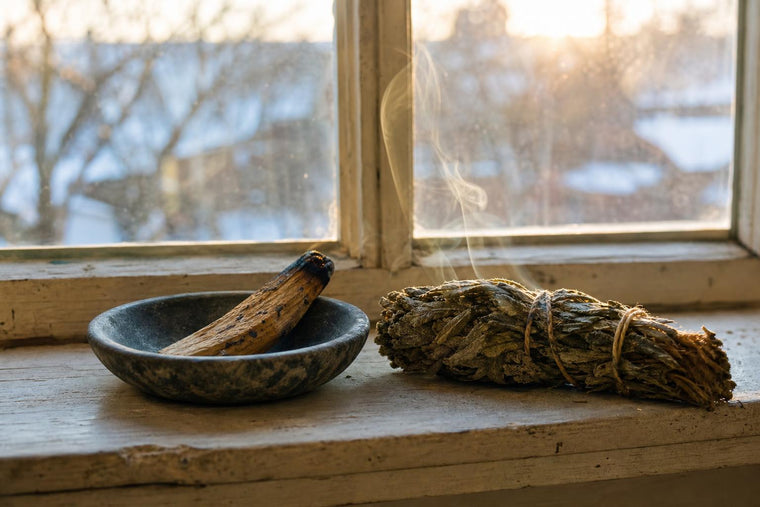
Some objects earn their keep through use, others through the good intentions that rarely survive a first cleaning. The incense holder is often the second kind, and which one it becomes has less to do with taste than with a detail nobody thinks to ask about at the till: can you actually reach every part of it with a cloth.
Where the resin actually sits
Inside a backflow incense burner, smoke is meant to fall rather than rise, curling down through a narrow carved channel before spilling over the base like a slow, cool waterfall. That channel is angled and enclosed on three sides. After a few weeks of regular burning, a fine brown resin lines it: sticky, faintly sweet, and nearly impossible to reach with a cloth or a finger. You notice it when you refill the sticks, a thin dark line at the base of the groove, then a second one layered underneath the first. The same is true of a carved lotus holder, its ring of stem-holes hiding dried oil no scrub brush was built to follow.
It is tempting to blame the material for objects like this ending up unwashed in a drawer, but the material is rarely the reason. The real variable is geometry: whether a cloth can reach every part of the object in one motion, or whether it has to chase resin around bends and vents that were carved in for beauty rather than access. A single flat tray asks for a wipe. An enclosed chamber asks for patience, sometimes a cotton bud, sometimes a screwdriver. Habit rarely survives that difference for long.
Ash tended, not scrubbed away
Set that failure point against a tradition where ash is never an afterthought. In kōdō, the Japanese art of incense, tending the ash is part of the practice itself, not a chore that follows it. Alongside kadō, the arranging of flowers, and chadō, the tea ceremony, kōdō is counted among the classical Japanese arts of refinement, and its pace reflects that company. Fragrant wood is not lit directly with a flame; it is warmed on a thin sheet of mica set above a buried, glowing ember, kept alight in much the same way the charcoal tablets many households now use for resin incense keep a coal burning underneath. Before that ember is buried, the ash bed beneath it is smoothed and shaped with a dedicated tool, ridges pressed into it with something close to the attention a person might give a small garden. The point is not speed. A slower process asks the person to attend to the whole thing, ash included, rather than treat it as residue to be dealt with later.
Shape decides, material follows
Held next to that ash bed, a backflow burner or a carved lotus holder shows a very different relationship to what it leaves behind. Vents cut for the smoke's benefit, deep floral carving, a ring of small holes drilled through brass: each is a place where oil collects and a hand cannot easily follow. A flat dish, by comparison, offers nothing to hide behind, so the wipe becomes the whole task rather than the first step in a longer one. None of this is a fault in the design. It only means the object was built for a visual effect, and cleaning was never part of the brief.
Material still matters, just less than shape. Soapstone, sometimes called steatite, is naturally heat-resistant and non-porous, which is why it wipes clean rather than absorbing the oils incense leaves behind; a seven chakra soapstone holder, wide enough to hold several sticks at once, still only takes one pass of a damp cloth, because none of its surface hides from view. Unsealed wood behaves differently: it is porous, and with repeated use it darkens and holds onto scent and oil the way stone and glazed ceramic simply don't. That is not a flaw in wood, only a fact worth knowing before you buy, since a wooden holder will always ask for a little more attention than a stone or glazed one.
A test that takes ten seconds
There is a simple way to tell, before buying, whether a holder will actually get cleaned. Run a finger or a cloth over every surface it has, without reaching for a cotton bud or a screwdriver. If that takes less than ten seconds, the object has a fair chance of staying in use. A flat, open soapstone disc holder tends to pass this test without trying; a tall carved tower rarely does. It is not a judgement on which is more beautiful. It is only a prediction about which one will still be clean in six months.
The ash you tend by hand
The small task in front of you is what this comes down to: whether it gets done, or gets postponed until postponing becomes permanent. My own incense practice is a daily one, and the part I return to almost without noticing is the moment after the stick has burned down: tipping the tray, running a thumb along the groove, resetting it for tomorrow. It takes less time than reading this sentence. That is exactly why it survives. The stick still catches from an open flame, not warmed under mica the way kōdō's wood is, but the impulse behind both is the same: attend to the whole process, not just the fragrance it leaves in the room.
Choosing a holder with that in mind is not a smaller ambition than choosing a beautiful one. A shape that gets wiped clean each week is a shape that keeps getting used, and a holder that is used is worth more than one that is only admired from a shelf. The tending, brief as it is, is where the attention actually lives.