A display organised around a daily practice behaves differently from one organised around a mood board. The difference is worth understanding before you move a single stone.
The Question Behind the Question
Most people who ask where to place crystals at home are really asking something else: what do I want these objects to do? The answer shapes everything, which stones, which surfaces, which rooms, and how often you return to them with attention rather than a duster.
There is a useful distinction between a decorative arrangement and a working display. A decorative arrangement is organised around aesthetics: colour, height, the way afternoon light catches a cluster on a windowsill. It is a perfectly legitimate thing. A working display is organised around a daily practice, japa, puja, intention-setting, a few minutes of stillness before the day begins. The stones in it are chosen for what they are said to carry, placed where you will actually encounter them, and tended with the same regularity as the practice itself. My own altar in Bengaluru holds both kinds of objects, and the distinction between them is not precious or mystical; it is simply practical. The working display asks something of you every morning. The decorative shelf does not.
Neither is superior. But knowing which you are building changes every decision that follows.
What the Stone Itself Decides
Before direction or intention, there is material reality. Certain stones cannot safely live in certain rooms, and this is not a matter of energy but of chemistry.
Selenite is gypsum (CaSO₄·2H₂O), and it is hygroscopic: it absorbs moisture from the air. In a bathroom or a kitchen with persistent steam, the surface will degrade over time, clouding and eventually pitting. A selenite bowl belongs in a dry room, away from condensation. Halite, the raw salt crystal sold in many crystal shops, is water-soluble and will simply dissolve or pit in humid conditions. Neither stone is fragile in the sense of being delicate to handle; they are fragile in the sense of being chemically specific about their environment.
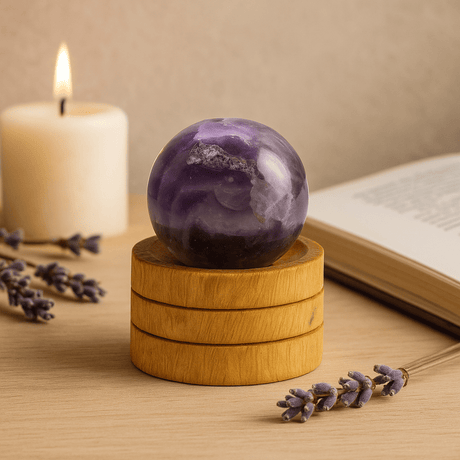
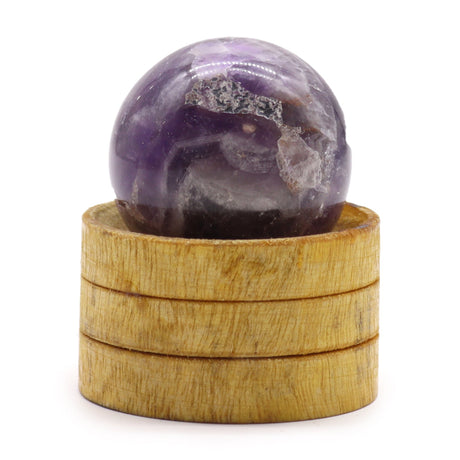
Amethyst and rose quartz are both forms of quartz coloured by trace impurities. Prolonged direct sunlight causes documented colour fading in both, a process called photobleaching. A south-facing windowsill in summer will gradually bleach a deep amethyst sphere to a pale lavender. This is not catastrophic, but it is irreversible, and worth knowing before you choose the spot.
Raw clusters have greater surface area than tumbled stones and catch light more dramatically, but they also accumulate dust in their crevices more readily and require more frequent cleaning. Rose quartz tumbled stones are easier to maintain and can be rinsed periodically. Porous or water-sensitive stones, selenite, halite, malachite, pyrite, should be cleaned only with a dry or barely damp cloth. Malachite in particular should never be cleaned with vinegar or citrus-based solutions, and should not be placed where it may be abraded, as the powder is mildly toxic.
The honest complexity here is this: a working display takes real attention. Stones accumulate dust, some degrade in the wrong conditions, and the arrangement that felt right in January may need revisiting by spring. This is not a flaw in the practice; it is the practice. Tending the display is part of what makes it work.
Direction and Light: What Vastu Shastra Offers
The question of where in a room to place a spiritual object has a long answer in Indian domestic tradition. Vastu Shastra is a classical system of spatial arrangement documented in Sanskrit texts including the Manasara and the Mayamata, and it remains in active use in Indian households and commercial architecture today. It is not mystical assertion; it is a pre-modern spatial philosophy that correlates compass orientation with solar path and seasonal light, and it gives the placement question a grounded, non-invented answer.
The north-east direction in Vastu is called Ishanya. It is associated with spiritual practice, water elements, and is traditionally considered the most auspicious zone for a puja or meditation space. The east-facing wall or surface receives the first morning light in the northern hemisphere, which is the practical basis for the Vastu preference for east-facing altars and shrines. Light arrives there when practice typically begins.
In a flat with no free north-east corner, which describes most urban homes, the principle still holds directionally: orient the practice surface toward the east if possible, and keep the zone uncluttered. Vastu's logic is about relationship between the person, the light, and the space, not about a single correct configuration that works only in a traditional house. Practices vary between communities and households; the directional principle is a guide, not a rule with no exceptions.
For the well-read practitioner: the Ishanya association with water elements is why a small vessel of water is a traditional offering on a puja altar placed in this corner. The stone and the water share the same directional logic.
Building the Working Display
A working display is built around a daily practice rather than around a palette. This means a few specific decisions.
Choose a surface you will actually return to. A high shelf you cannot reach without a step is a decorative shelf. The working display lives at a height where you can sit or stand comfortably, where your mala is within reach, where a small diya or candle can be lit without ceremony. In Hindu domestic tradition, this surface is often called a puja ghar or mandir; in contemporary mindfulness literature it is sometimes called a working altar. The terminology differs; the function is the same.
Choose stones for the practice rather than the palette. If you keep a japa practice, one or two stones placed near the mala, chosen for the quality they are traditionally said to carry, the intention you are working with, will serve the display better than seven stones chosen to match the wall colour. A crystal tree placed in the north-east corner of a practice space carries the traditional association of amethyst with clarity and stillness; whether or not that resonates with you, the object gives the eye somewhere to rest during meditation.
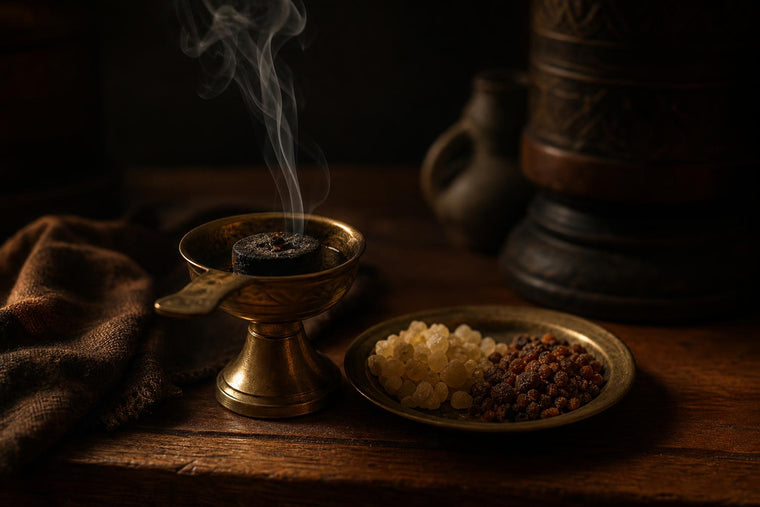
Incense and candle placement in the same zone is traditional in Indian home altars: the smoke of agarbatti or dhoop is an offering in puja, and it also functions as a sensory cue marking the beginning of ritual time. The person lights the incense; the incense does not light itself. The arrangement holds the cue; the person sets the intention.
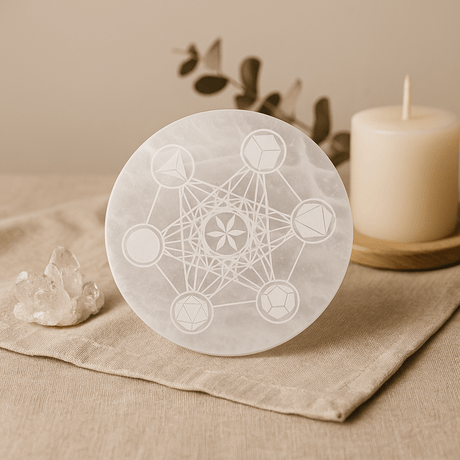
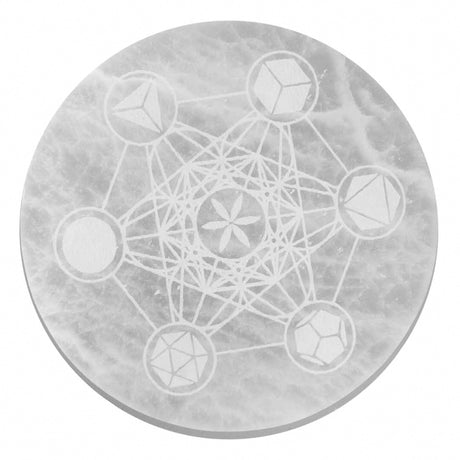
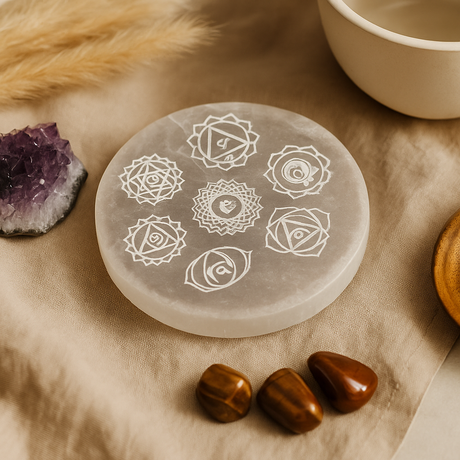
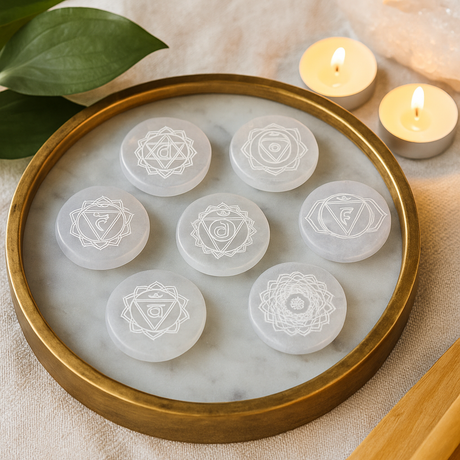
A selenite charging plate placed beneath or beside other stones in a dry room is a practical surface for a working display: flat, stable, and traditionally associated with clarity. Keep it away from the bathroom.
What Regular Attention Actually Looks Like
A display organised around practice is not set once and forgotten. This is the part that most placement guides omit, and it is worth saying plainly.
Dust accumulates on crystal surfaces, particularly on raw clusters. Some stones degrade in the wrong conditions. An arrangement that served a particular intention for several months may, honestly, have run its course, the stone that felt necessary in a difficult period may not belong on the altar once that period has passed. Removing a stone is not failure; it is the same discernment that placed it there.
Cleaning is simple for most tumbled stones: a rinse, a dry cloth, a moment of attention. For the water-sensitive stones, a dry cloth only. For malachite, handle with care. The maintenance is not onerous, but it is real, and it is part of what distinguishes a working display from a shelf that accumulates objects over time without intention.
The deeper point is this: the display is a record of your practice at a given moment. It should change as you change. The stones do not ask for permanence. They ask, in the way that any practice asks, only for attention.
The Practice of Letting Go
There is a particular kind of attention that a working display asks of you, not the attention of acquisition, of finding the right stone and placing it just so, but the quieter attention of release. Knowing when something has done its work. Knowing when the arrangement that steadied you through a difficult season no longer belongs to the person you are now. This is not a spiritual abstraction; it is simply honest housekeeping, applied to objects that carry meaning.
The display on your surface is, in the end, a portrait of your practice at a given moment. It will look different in a year, and it should. The stones that remain will have earned their place not through sentiment but through continued relevance, through the fact that you still reach for them, still notice them, still find that they accompany something real in your daily life. The ones you pass on, or return to a drawer, or give to someone who needs them more acutely than you do: they have not failed. They have finished.
What Vastu offers, what the tradition of intentional placement offers, is not a formula for the perfect shelf. It is a framework for paying attention, to direction, to light, to what you are actually trying to cultivate, and to whether the objects around you are still in service of that. The arrangement is never finished. That is precisely what makes it a practice rather than a decoration.