At the Banke Bihari temple in Vrindavan, the curtain before the deity opens for only brief glimpses during Janmashtami night — a practice described by devotees and documented in accounts of the festival. The temple air carries camphor, sandalwood and the particular sweetness of mogra. The lamp already burning is a panchapradeep — five wicks, one flame in every direction. This is a guide to what that sequence means, and how to bring its logic home.
The midnight window
Janmashtami is not simply a night festival. It is a festival governed by a specific astronomical moment: the nishita kaal, the middle watch of the night — roughly what we would call midnight — which the tradition identifies as Krishna's birth hour. Temples calculate this window each year and publish their own times; the exact span shifts with the lunar calendar. Every lamp and every fragrance in the evening is arranged around this single point.
The theological weight of that hour is not incidental. According to the Bhagavata Purana, Krishna was born in a prison cell in Mathura, in complete darkness, and the moment of his birth broke that darkness with sudden divine light. The midnight lamp is not decoration. It is a re-enactment of that rupture: darkness, then flame.
This changes how you approach the evening. The hours before midnight are preparation: the altar is dressed, the diya is lit to establish the sacred space, incense is offered to carry the prayer upward. The midnight moment is the culmination, not the beginning. If you light everything at once and wait, you have missed the sequence.
The lamp hierarchy

Three forms of flame appear in a well-ordered Janmashtami puja, and they are not interchangeable.
The ghee diya is the foundation. Ghee — clarified butter — is the traditional fuel for lamps offered to Krishna, and the diya lit at the start of the evening opens the ritual space. It burns steadily through the night, a continuous offering rather than a punctuation mark.
The panchapradeep, sometimes called the panchamukhi diya, is the aarti lamp. It carries five wicks, traditionally associated with the five elements, and its purpose is precise: to offer light in all directions simultaneously, so that the flame reaches the deity completely, not from one angle. This is the lamp moved in clockwise circles before the deity image during aarti. It is not a larger diya; it is a different instrument, with a different role in the sequence.
Camphor closes the aarti. It burns with minimal residue, and this is the reason it marks the birth moment rather than any other flame. The tradition reads that quality as an image of the self consumed entirely in devotion: nothing left over, nothing held back. It is a specific gesture, not a fragrant addition.
Incense for Krishna specifically
The generic advice — "light sandalwood for Krishna" — is true as far as it goes, but it flattens a more considered tradition. Three fragrances carry particular weight in Krishna worship, and each one does something distinct.
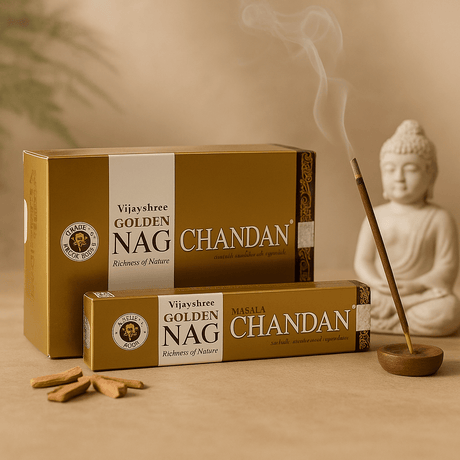
Sandalwood (chandana) is associated with cooling. In Ayurvedic understanding, sandalwood has a cooling quality, and this maps onto an epithet the tradition attributes to Krishna — the one who soothes the heat of the world, a quality described in devotional literature rather than a single canonical name. Offering sandalwood incense for Janmashtami is not simply a matter of pleasant fragrance; it is a correspondence between the quality of the material and an attribute of the deity.
Mogra, Jasminum sambac, carries sweetness, and in North Indian devotional tradition it is among the fragrances most closely associated with Krishna. Garlands of mogra are standard temple offerings. Jasmine incense for the midnight offering follows this same logic: the fragrance is an offering of sweetness to a deity whose nature the tradition describes as all-attractive.
Tulsi, holy basil, is in a category of its own. A tulsi leaf is considered essential in Krishna and Vishnu worship — among the most significant offerings one can make — and the plant itself is treated as sacred. If a tulsi plant is present at your altar, its proximity during puja is itself an offering. The fragrance is secondary to the sanctity.
In major temples, these fragrances tend to layer through the night rather than appearing all at once. The sequence follows the ritual sequence: sandalwood in the earlier hours, mogra as midnight approaches, camphor at the moment of birth. The logic is cumulative, not simultaneous. It is worth noting that regional traditions and different schools of Krishna worship vary considerably — what holds in one temple in Vrindavan may differ from practice in another setting or a South Indian household. The Pushti Marg tradition, for instance, places particular emphasis on the quality of attention brought to each offering, over and above the specific materials used.
Building the home sequence
A home altar cannot replicate a temple's resources, and it does not need to. What it can hold is the underlying logic: a sequence that moves from preparation to culmination, with each element placed where it belongs.
Begin in the early evening by lighting the ghee diya. Place it so the flame faces east or north; in many Hindu household traditions, these are the directions associated with auspiciousness, though practices vary between communities and regions. The lamp establishes the space; everything else follows from it.
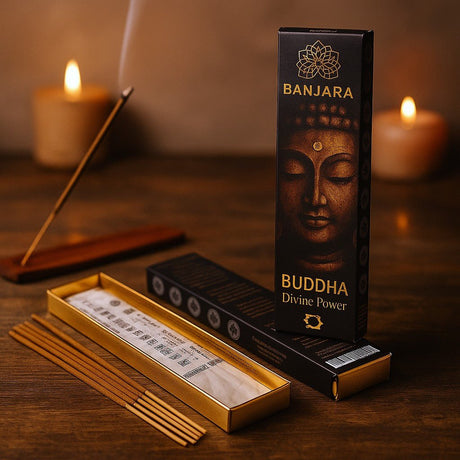
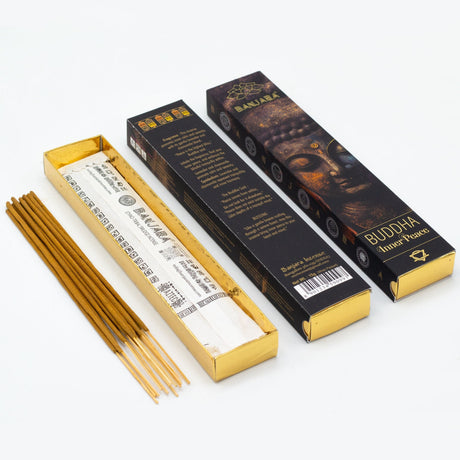
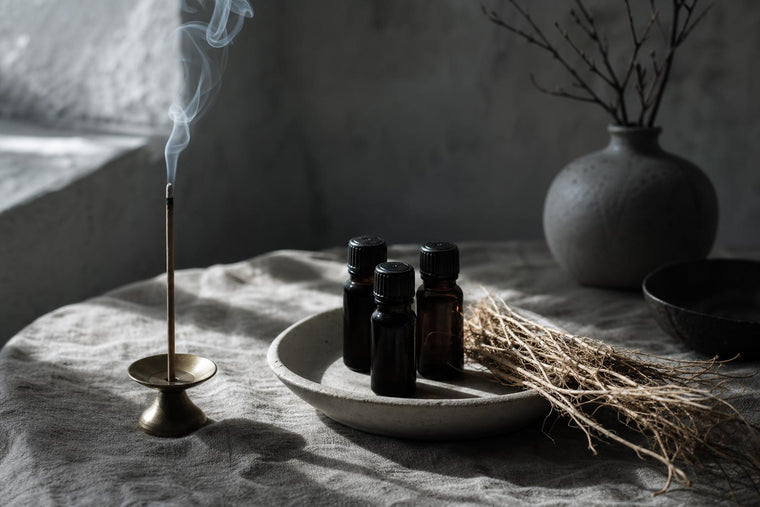
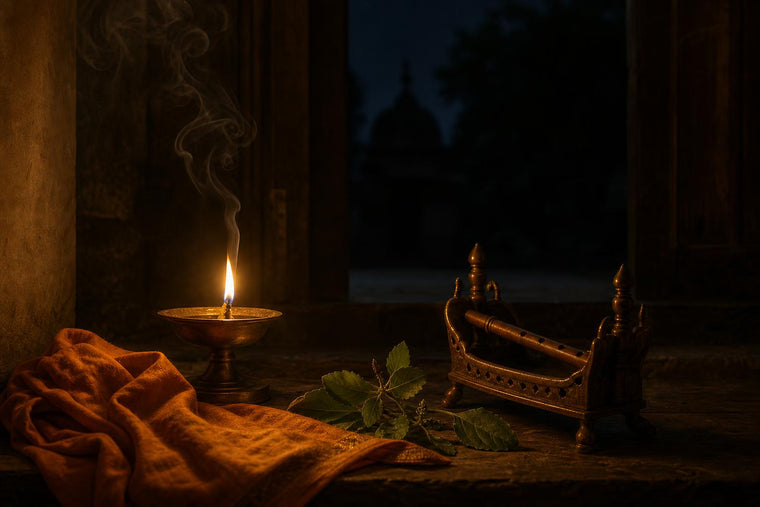
Offer incense after the lamp is burning, not before. The lamp opens the ritual space; the incense carries the prayer into it. A brass incense burner for the altar holds the stick or dhoop steadily and keeps the ash contained — a practical consideration that also keeps the altar clean and composed through a long night.
If you have a five-wicked aarti lamp, reserve it for the aarti at the midnight hour. If not, a single ghee diya moved in clockwise circles before the deity image carries the same intention. The form matters less than the attention brought to it.
At the midnight moment, light the camphor. Hold it before the deity, move it in the aarti gesture, and let it burn out completely. Do not blow it out. The completeness of the burn is the point.
Tulsi, if present, can be placed at the base of the deity image throughout the night. A single leaf offered at the moment of aarti is, in the tradition's understanding, worth more than elaborate offerings made without it.
The camphor moment
There is something clarifying about a flame that leaves almost nothing behind. Most of what we light — candles, diyas, incense — leaves wax, ash, residue. Camphor burns with minimal residue, close to nothing.
I keep returning to this as the reason the tradition chose camphor for the birth moment specifically. The other lamps burn through the night, steady and continuous. The camphor flame is brief, complete, and total. It marks the instant rather than the duration.
Whatever you bring to your altar on Janmashtami night, however simple the setup and however modest the lamp, the midnight moment is the one that asks for full attention. Not a glance at the murti while the phone is nearby. The tradition built an entire sequence of fragrance and flame to bring a person to that single point of presence. The camphor is the last step in that sequence, and the most honest one: it burns, it is finished, and the night has changed.