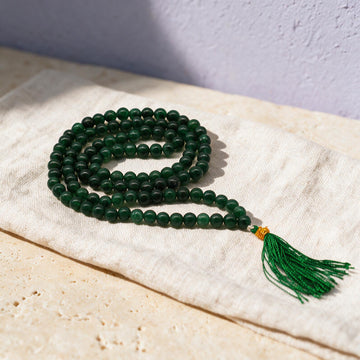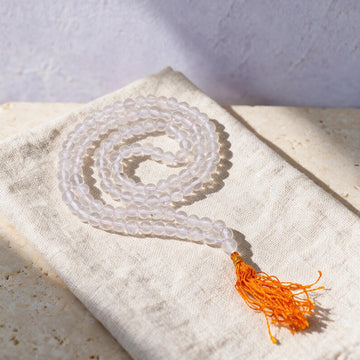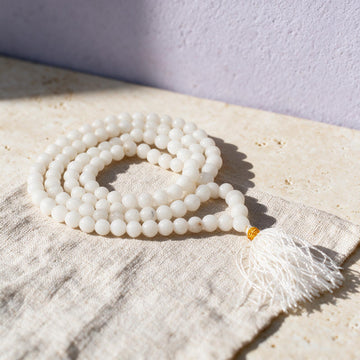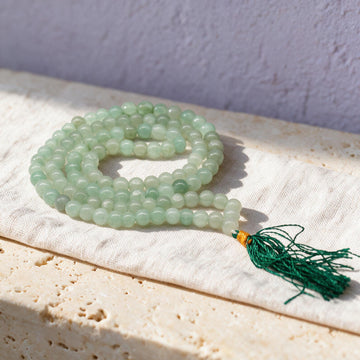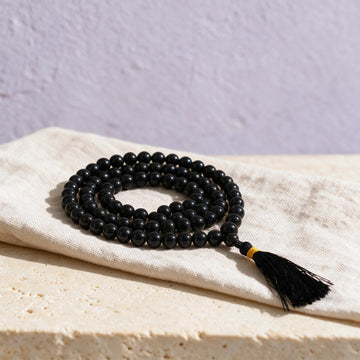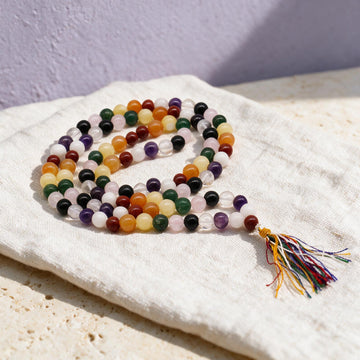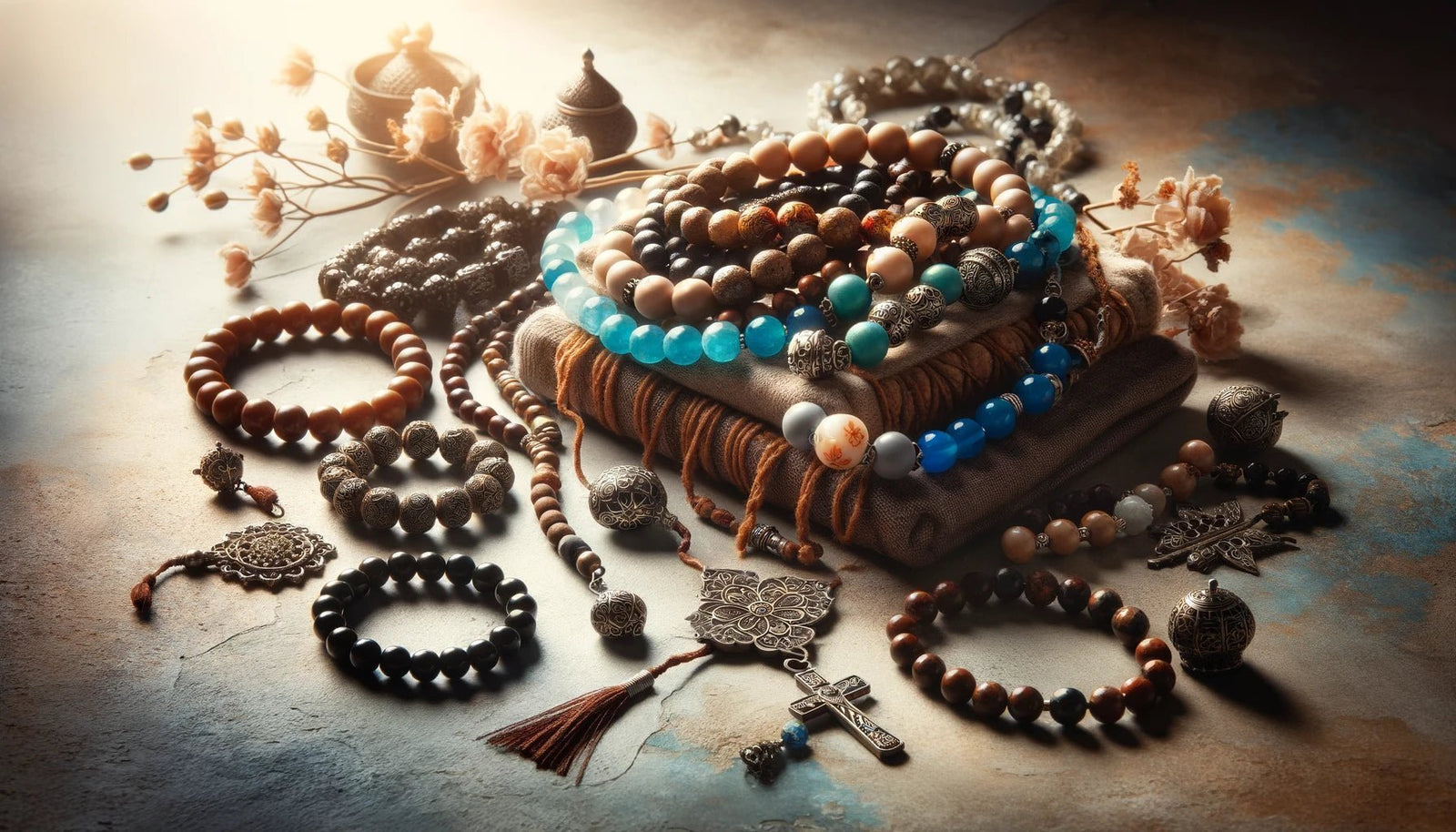
Prayer beads are a string of beads used to count prayers, mantras or the names of God, one bead for each repetition. Almost every major faith has its own: the Hindu and Buddhist mala of 108 beads, the Catholic rosary of five decades, the Muslim tasbih of 99 or 33, the Orthodox prayer rope, the Bahá'í strand of 95. The fingers keep the count so the mind can stay with the words.
In brief
- Seven traditions in one table: the name, the number of beads and what is said on them.
- Why 108, what the materials mean, and how to hold a mala.
- How to choose your first mala, by material and by how you will use it. Ours are on the mala beads shelf.
 Mala Beads & Japa Mala32 pieces
Open →
In this guide 6
Prayer beads by tradition
| Tradition | Name | Beads | Used for |
|---|---|---|---|
| Hinduism | japa mala | 108 + one guru bead | mantras and the names of a deity (japa) |
| Buddhism | mala | 108, or 27 told four times | mantras, meditation, counting prostrations |
| Sikhism | mala, simran | often 108 | repeating Waheguru, the name of God |
| Islam | tasbih, misbaha | 99, or 33 told three times | dhikr: Subhanallah, Alhamdulillah, Allahu Akbar; the 99 names of God |
| Catholic Christianity | rosary | five decades of ten, with a cross and five extra beads | the Hail Mary and the mysteries of the faith |
| Orthodox Christianity | prayer rope, chotki or komboskini | 33, 50, 100 knots of wool | the Jesus Prayer |
| Bahá'í Faith | prayer beads | 95, or 19 with counters | Alláh-u-Abhá, 95 times a day |
Judaism has no canonical prayer bead; many Jews touch the knotted fringes, tzitzit, of the prayer shawl at set points in prayer. In Greece and Cyprus the komboloi, "worry beads", grew from the prayer rope into a secular object, flicked through the fingers for calm.
Where prayer beads come from
The English word itself remembers the use: "bead" comes from the Old English gebed, a prayer, and passed from the prayer to the small object that counted it. The earliest clear record of counting prayers on beads is Indian. Japa, repetition of a sacred name, is old enough for Krishna to say in the Bhagavad Gita, "of sacrifices I am japa" (10.25), and by the early centuries of the Common Era the mala appears in Hindu and Buddhist sculpture. Buddhism carried it across Asia to Tibet, China and Japan. The tasbih spread through the Islamic world from around the eighth and ninth centuries, and the rosary took its familiar form in medieval Europe.
 Next: How to Choose a Mala, and How to Use ItRitual Tools · 6 min read
Why a mala has 108 beads
- The sky. The Sun is roughly 108 of its own diameters from the Earth, and the Moon roughly 108 of its diameters, a ratio early astronomers could estimate with the naked eye.
- The texts. The traditional canon of principal Upanishads in the Muktika list numbers 108.
- The body. Ayurveda counts 108 marma points, the vital junctions of the body.
- The mind. Many Buddhist schools count 108 afflictions or attachments, which is why Japanese temples ring their great bells 108 times at New Year.
Whatever the reason given, 108 makes a round of practice long enough to settle into, about ten to fifteen minutes for a short mantra.

What the beads are made of
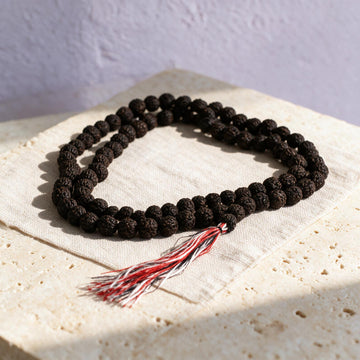
- Rudraksha. The dried seed of the Elaeocarpus tree, said to be the tears of Shiva, and the bead of Shaiva practice. Our guide to rudraksha beads explains the faces, or mukhis.
- Tulsi. Wood of holy basil, sacred to Vishnu and Krishna, the bead of Vaishnava practice.
- Sandalwood. Light and fragrant; the scent rises from the beads as they warm in the hand.
- Lotus and Bodhi seeds. Favourites of Buddhist malas: the lotus for purity, the Bodhi seed for the tree of the Buddha's awakening.
- Gemstones. Amethyst, rose quartz, tiger eye, lapis: each chosen for the quality its stone is traditionally linked with, and heavier and cooler in the hand.
- Lava stone. Porous, so a drop of essential oil sits in it and scents the mala through the day.
Bone, horn and pearl appear in some older strands; we keep to seed, wood and stone, and is your mala cruelty-free? explains why.

How to choose your first mala
Choose by how you will use it. For seated japa at home, a full 108-bead mala of a light material is easiest to hold for long rounds; to wear through the day, a necklace or a wrist mala. Then choose the material you like the feel of.
-
1
Rudraksha
For daily japa
The classic, especially for mantras to Shiva. The rough, ridged beads are easy to count by touch alone, which matters with your eyes closed.
 Rudraksha Japa Mala, 108 Wood Beads for Meditation, BrownSee it →
-
2
Amethyst
For evening practice
Smooth, cool and heavier than seed, the stone traditionally linked with calm. A good mala for the last round before sleep.
 Amethyst Japa Mala, 108 BeadsSee it →
-
3
Rose quartz
For loving-kindness
The stone of the heart, a natural fit for metta, the Buddhist practice of loving-kindness, or for any prayer for someone else.
 Rose Quartz 108 Bead Mala NecklaceSee it →
-
4
Tiger eye
For focus and nerve
Warm brown with a moving gold sheen, chosen for steadiness and courage; a mala for the morning and for work days.
 Tiger Eye Japa Mala, 108 BeadsSee it →
-
5
Lava stone necklace
To wear all day
A mala-style necklace you can wear; add one drop of oil to the lava beads and the scent stays with you.
 Handmade Lava Stone Mala Necklace with Buddha TasselSee it →
-
6
Wrist mala
A short round on the go
A bracelet of fewer beads, told around several times: for a few repetitions on the train, at a desk, before a meeting.
 Sandalwood Bead Bracelet Set with Buddha Bangle, 2 PiecesSee it →
Our step-by-step piece on choosing and using a mala goes further.
How to use a mala
- Sit comfortably, upright. Hold the mala in your right hand, draped over the middle finger, with the guru bead (the larger one at the tassel) beside it.
- Move one bead towards you with the thumb for each repetition. In Hindu practice the index finger, linked with the ego, does not touch the beads.
- Say the mantra or prayer once per bead, aloud, in a whisper or silently. Ten chants with their meanings are in our mantra guide.
- At the guru bead, stop. Do not cross it: turn the mala round and go back the other way for the next round.
- Keep the mala in a pouch or a clean place of its own, off the floor.




 India