There is a particular smell that tells you the technique has failed: not the round, resinous scent a piece of frankincense gives off when it is warmed slowly, but a thin, acrid note that arrives in under a second and does not go away. Every guide to burning resin on charcoal describes the same five steps, and every one of them skips the part that actually matters: what happens to the coal after it is lit, and how it is tended for as long as it burns.
The dimple in the coal
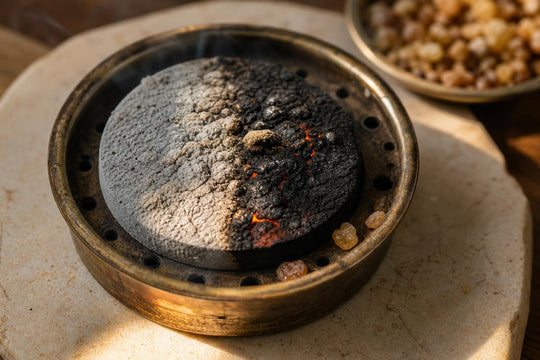
Turn a charcoal disc over before you light it and you will find a small hollow pressed into its centre, shallow, no deeper than a thumbprint. It is easy to miss, and even easier to ignore once the disc is glowing and a piece of resin is already between your fingers. But that hollow is not decoration. It is the seat built to hold a thin layer of ash, and that layer of ash is the whole difference between resin that scents a room and resin that scorches on contact.
Why an unwatched coal scorches
That difference matters more than it looks, because of what is actually burning beneath the ash. A self-igniting charcoal disc is not quite the same fuel as a barbecue briquette, even though the two can look alike in a shop. It is usually pressed with a mineral oxidiser worked through the charcoal, which is what allows a single match to set the whole thing alight and keep it burning on its own, without the steady fanning that plain wood charcoal needs. That same oxidiser is what makes the ember run hotter, and more steadily hot, than an open barbecue coal. A pinch of resin dropped straight onto that surface does not release its oils gently. It combusts, almost at once, and what should have been fragrance turns to char before you have finished reaching for the next piece.
This is worth knowing before you buy a self-igniting charcoal disc, because it changes what you are actually managing when you light one. You are not warming resin on a coal. You are keeping resin just far enough from an ember that would happily burn it.
An old answer, held in more than one tradition
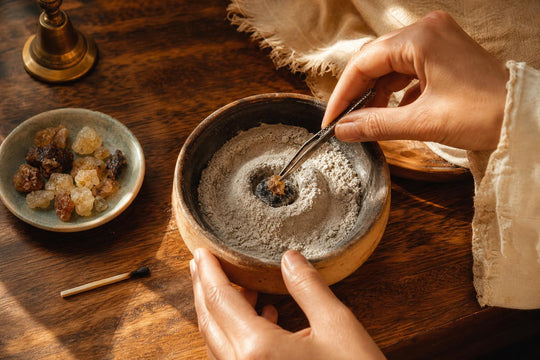
Once you know why the coal needs shielding, it is easier to recognise the same fix wherever people have burned resin on live coal for long enough to have thought carefully about it. In the thurible used in Catholic and Orthodox liturgy, the charcoal sits beneath a perforated metal disc, or beneath a settled layer of ash, so that the frankincense placed on top is warmed rather than scorched. Across the Gulf, where wood chips and resin are burned as bakhoor, the same principle appears again in domestic form: a spoonful of ash built up over the coal before the fragrant material ever touches it. Neither tradition calls this insulation, but that is what it is. Ash slows and evens the heat reaching whatever sits above it, letting the aromatic oils lift off gently instead of blackening on contact.
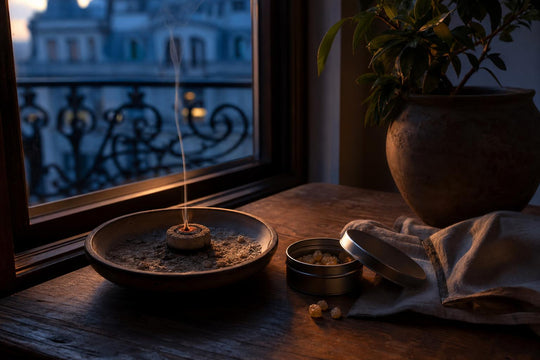
A holder matters here too, mostly because it lets you build and keep that ash bed without it scattering. A deep, heatproof charcoal incense burner filled with sand or ash gives the ember somewhere stable to sit while you work, and gives you room to move resin toward or away from the hottest point as the burn goes on.
Choosing a resin for the ember
With the ash bed in place, the resin itself decides how close it wants to sit to the heat. Frankincense, the resin of Boswellia trees, is forgiving: it releases its scent readily at a moderate distance from the ember, which is part of why Frankincense Resin Incense Cups are often where people start. Myrrh, drawn from Commiphora trees and just as often reached for as an oil, behaves differently: denser and slower to open, it rewards being left a little further from direct heat and given more time, so myrrh in resin form asks for patience rather than a bigger pinch. Copal sits somewhere between the two, brighter and quicker than myrrh, and worth trying once the ash-bed method feels familiar, since copal scorches fast if placed too eagerly. Benzoin, from Styrax trees, behaves differently again, softening and spreading its scent gradually rather than in a single burst, while dragon's blood, a name shared by unrelated red resins from several different plants across different parts of the world, burns with a heavier, warmer note that most people find wants a slightly cooler seat on the ash than frankincense does. None of this is fixed. It is closer to learning how a particular loose-leaf tea wants its water a little cooler than the last one: a habit built by paying attention, not a rule to memorise.
Keeping the ember through its life
The ash bed and the resin's own character are only half the technique; the other half is timing, because the coal itself keeps changing under everything sitting on it. A lit charcoal disc does not stay one temperature for the whole of its burn. It runs hottest in its first stretch, once the sparks have crossed its full surface, and cools gradually as it works through its life, which for most discs runs to something like half an hour to three-quarters of an hour before it needs replacing. The technique, properly understood, is to track that curve rather than to set the resin down once and leave it. Early on, keep pieces well back on the ash, or add only a small pinch at a time rather than a larger piece that will scorch before it can release its oils. As the coal greys and cools through the middle of its burn, you can move resin a little closer, or add slightly more. Toward the end, when the ember has thinned and dimmed, a fresh disc, lit and rested until the sparks have crossed it, takes over rather than trying to coax more heat from one that is nearly spent. This is the same discipline incense asks for in any form, resin or stick: attention held across the whole span of the burn, not just at the lighting.
What the ash actually teaches
Take the disc out once the burn has finished and cooled, and the ash bed usually keeps its own shape rather than settling flat. Look for a slightly raised ring nearest the rim, where resin sat furthest from the centre and the ash stayed pale and full, against a thinner hollow at the middle, burned down to a fine grey dust no more than a few millimetres deep where the coal ran hottest and least watched. Tip that out before you look and the record is gone. Read it first, and it will tell you, more honestly than any checklist, exactly where your attention held for those thirty minutes and where it did not.