You come through the door at the end of a long day, and the day does not quite come through with you, it stays caught in the chest, in the shoulders held a little too close to the ears. The keys find their dish. The bag finds its hook. And then, before anything else, your feet meet the floor. Notice, for a half-second, whether the shoulders drop with them, or stay hitched where the day left them. That small check, feet on floor, shoulders falling or held, is the whole of this piece. Not a system to learn, but one honest moment of arriving, repeated until the body begins to believe the ground is still there.
The ground that keeps moving
It does not take a catastrophe for the ground to feel thin. A new city where the streets still read like a stranger's handwriting. A job that quietly ended, and with it the shape of the week. A relationship that folded without a single loud moment. Or only the low hum of news you cannot control, the kind that sits in the jaw before you notice it has moved in.
What happens in the body is older than any framework that names it. The breath goes shallow and quick, high in the chest. The shoulders climb. The jaw sets. There is a vague sense of bracing, not for anything in particular, just bracing, the way a person stands on a train that has not yet moved but might. Sleep comes late and leaves early. The home, the place meant to be the refuge, starts to feel like somewhere you are only passing through.
Most root-chakra writing begins wrong. It opens with the Sanskrit name and the element and the colour and the mantra, as though the reader's first need is a spec sheet, what the root chakra is, not what it feels like when the ground keeps shifting. The fresher work is to meet you in the bracing first, name it plainly, and only then offer the root as a map: a vocabulary for noticing where safety lives in the body, and a small set of evening practices that rebuild it, one night at a time.
What 'root' has always pointed at
The root chakra carries a Sanskrit name, Muladhara. The two halves of the word are plain: mula means root, and adhara means base or support. So the name itself is 'root support', the foundation on which the rest of the system is said to rest. In the traditional subtle-body maps of the Hindu and yogic traditions, it is the first of the seven primary chakras, located at the base of the spine, the ground from which the other six rise. Nothing above stays upright for long if the roots are shallow.
The traditional imagery is earthy and unhurried. Its element is Prithvi, earth. Its colour is red. Its symbol is the four-petalled lotus, the chaturdala, and within it is often drawn a square, the earth itself, stable, four-cornered, and an inverted triangle. The seed sound, the bija mantra, is Lam, pronounced 'lahm', recited as a grounding practice in several yogic and Tantric lineages. And the animal the old iconography gives it is the elephant, Airavata in some depictions, the mount of Indra, chosen for the qualities you would guess: stability, weight, the strength of something that knows where it stands.
Read lightly, this is a remarkably precise map for a very human question: where do I feel safe, and what happens in my body when I do not? The root chakra is the corner of that map pointing at the most foundational needs, safety, stability, the felt sense of having ground beneath you. When teachers speak of being 'grounded', this is the centre they mean.
The felt signs the ground is thin
So what does an unsettled root feel like, in an ordinary week, before anyone has diagnosed anything? The body often knows the ground has moved before the mind has caught up.
- Shallow, high breath. The inhale sits in the upper chest, quick and small, as if the lungs are unwilling to fill all the way down.
- Shoulders held high. Climbed toward the ears and kept there, sometimes for hours, without noticing.
- A clenched jaw. The teeth meeting, the hinges tight, especially in the small hours.
- The urge to grip or to flee. Holding on too hard to what is familiar, or a constant low pull toward leaving.
- Sleep that will not settle. Late to arrive, early to leave, thin in between.
- A home that no longer feels like refuge. The same rooms, suddenly reading as somewhere you are only passing through.
None of this is a diagnosis. It is the body's honest reading of a life in motion, and the root chakra offers a vocabulary for noticing it, a way to name where the sense of safety feels thin, so that it can be tended rather than endured.
How to ground yourself when the ground keeps moving

Here is the centrepiece practice, and it is deliberately small. It does not ask you to clear an evening or build an altar. It asks for the few minutes between coming through the door and picking up the phone again. The root responds to repetition more than intensity; a small thing done nightly settles deeper than a grand thing done once.
Come home, or, if home is not where you are tonight, come to the present moment wherever you are. Then:
- Shoes off, feet flat. Let the soles find the floor, wood, tile, stone, whatever it is, and let the weight of you drop into that contact. This is the body-scan in its smallest form: not a tour of the whole body, just the feet, just the floor, just the fact of standing on something.
- One slow exhale, longer than the inhale. Breathe in gently, then let the out-breath be a little longer, a little softer. A long exhale is the breath's own way of telling the nervous system that nothing is chasing it. Do this three or four times. No counting to hit, no strain.
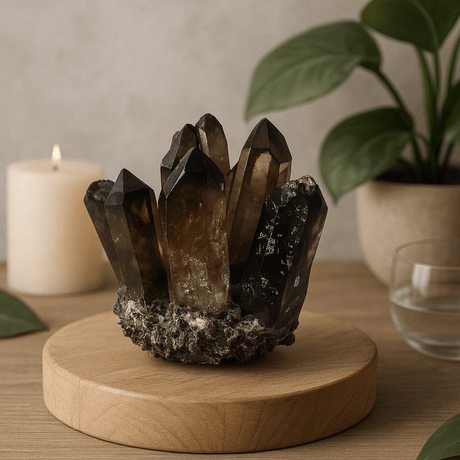
- Place a grounding stone where the hand will find it. On the dish by the door, on the corner of the desk, beside the cup you reach for last thing. Not as a charm that does the work for you, as a note, a small weight that says: return here. When the hand finds it through the evening, let it be a cue to drop the shoulders and feel the feet again.
- A cup of something warm. Tea, water, whatever you actually drink. The warmth is the point, a felt thing, held in both hands, that asks the grip to soften.
- The lamp turned low. Mark the turn from the day into the evening with the light itself. The body reads the dimming as permission to set things down.
That is the whole arrival ritual. Shoes, breath, stone, cup, lamp. Safety is not declared in any of it; it is rehearsed, one evening at a time, until the body begins to believe the ground is still there. The stone accompanies the practice, it does not perform it. You are the one who chooses to pause, to feel the floor, to let the exhale run long.
The stones people reach for at the base

The stones traditionally paired with the root are dark or earth-toned, and there is a quiet sense to the pairings, these are the colours of the ground itself, of soil and iron and cooled volcanic glass. Grounding stones have been carried for this purpose for a long time, and the ones most often named for the base of the body are a small, honest set.
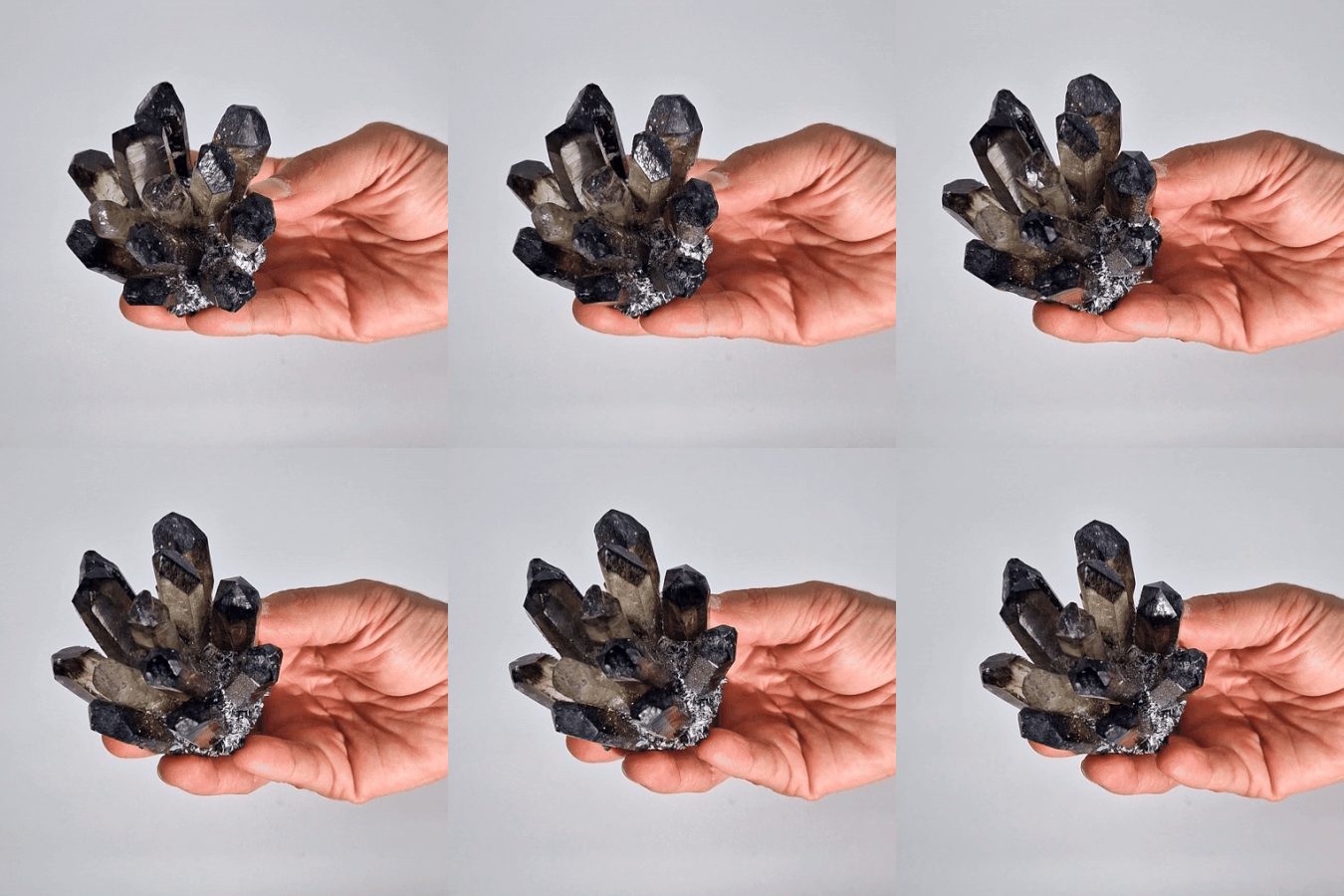
Smoky quartz is a brown-to-black variety of quartz, its smoke-grey depth reading like the feeling of exhaling after a long hold. Hematite is an iron oxide mineral, metallic grey-black, heavy in the hand and cool to the touch, long associated with the simple sensation of being pulled back into the body. Red jasper is an opaque red chalcedony, earthy and matte, the colour of the root itself. Black tourmaline, the schorl variety, is the stone most often reached for when the day feels unsteady. And obsidian, a volcanic glass born of fire and cooled to stillness, is carried as an intention of staying present when the surface shifts.
Choose the one you are drawn to, not the 'correct' one. The relationship matters more than the catalogue entry. Carry it in a pocket, hold it during a few slow breaths, or set it where you will find it when you most need to come back down. A stone is a companion to the practice, not the practice itself.
The walk without a destination
There is a second small practice, even simpler than the first: walk, but do not walk to arrive. Most of the movement in a modern day is task-shaped, to the station, to the desk, to the next thing on the list. The body learns to read walking as transit, something to get through on the way to somewhere else. The root, which answers to rhythm and repetition, tends to go quiet in transit.
So take a walk with no destination. Ten minutes is enough. Let the attention settle on the contact of each footfall, the heel, the roll, the toe, the ground receiving and giving back. This is the slow-living frame at its plainest: movement as a way back into the body, not a task to finish. You are only letting the body remember that it stands on something, step after step, reliably, without being asked.
The scent that brings you down
The root is associated, in some modern correspondences, with the sense of smell, which is why certain earthy aromas have long been paired with root practice. The scents most often named are low, slow, and loamy: patchouli, cedarwood, vetiver, sandalwood. These are not perfumes that lift; they are scents that descend, and the descent is the whole point.
Lighting a stick of incense or warming a little oil becomes part of the evening wind-down, an invitation to come down out of the day, carried on the breath before the mind has decided to. The scent is a cue, the same way the grounding stone is a cue: a thing the body learns to associate with the turn toward rest. Keep it consistent. The same aroma, lit each evening, teaches the practice where it lives.
When the ground has moved for a long time
There is a kind of instability that is not a single bad week but a long season, the aftermath of displacement, of loss, of years in which the ground kept moving and never quite settled. It is worth being honest about what a sustained root practice can and cannot do.
What it can do is give the body small, repeated experiences of ground, feet on floor, a long exhale, a stone in the palm, a walk for no reason. Over time, those small returns can loosen the bracing a little. What it cannot do is undo what life has unsettled. A stone does not grieve for you. A ritual does not replace the home that is gone. The agency stays with the person, you are the one who chooses to return, and the returning is the work.
And it is worth saying, gently, that a deep, persistent sense of unsafety, the kind that does not ease when the feet find the floor, may be something to bring to a trusted person or a practitioner. The practices here are companions to a life, not a substitute for the care a life sometimes needs.
A practice you can return to

So we end where we began. You come through the door at the end of a long day. The keys find their dish. The bag finds its hook. Your feet meet the floor. And this time, not every time, but this time, the shoulders have somewhere to go. They drop, a little, with the weight of you settling into the ground.
The ground has not stopped moving. The city is still new, or the week still has no shape, or the news still hums low in the jaw. Nothing has been fixed. But something has been learned: how to find the ground anyway, one evening at a time, in the small honest sequence of shoes and breath and stone and cup and lamp. A practice is not something you finish. It is something you return to, and the returning is the whole of it.
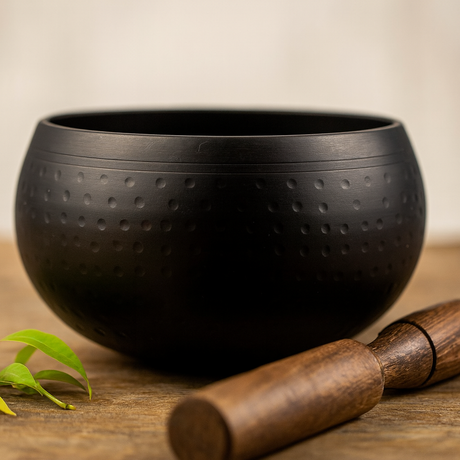
If you would like a sound to mark the turn, a singing bowl struck once at the start of the evening gives the body a clear note to settle to. And if you are curious how the root fits among the rest, the seven chakras each answer to a different human need, the root simply the first and most foundational among them.