There is a particular kind of quiet that arrives when a thread of smoke begins to rise. The room settles. Time slows. In China, that small ritual has been part of daily life for the better part of two thousand years — a way to mark a threshold, ready the mind, and fill a space with something gentle and alive. This is a slow look at the art of Chinese incense: where it comes from, the forms it takes, how it is made, and the scents at its heart.
Known as xiang (香) — fragrance, or aroma — incense runs through Chinese history, spirituality, and ordinary days alike. Here we trace its origins, explore its many forms, and follow the patient craft behind it, then sit a while with the cultural meaning and the aromas that have been valued for generations.
Historical background
The story of incense in China reaches back to the Han dynasty (206 BC–220 AD), where it began as a way to scent rooms and garments, to take its place in Buddhist worship, and as a pastime for the educated elite and nobility. Its significance is deeply rooted in Buddhist tradition, where incense is highly valued during ceremonies — a connection that carried incense practices from China onward to Japan.
Over the centuries, the art of incense ceremonies grew more refined, with tools made especially for the purpose. During the Song dynasty (960–1279 AD), porcelain became a favoured material for incense accessories, while the Ming dynasty (1368–1644 AD) is associated with the introduction of Xuande copper stoves. The Qing dynasty (1644–1912 AD) continued to refine the craft, with a range of incense devices reflecting the changing aesthetics and uses of the day.
The Tang dynasty (618–907 AD) marked a flourishing of incense culture in China, carried by lively trade, the spread of Buddhist practice, and exchange with distant lands. This era coincided with the rise of the Silk Road, which introduced materials such as agarwood, camphor, and clove to Chinese incense making — with agarwood becoming a mark of luxury among royalty.
Incense culture reached its height during the Song dynasty, when it became a sophisticated cultural pursuit among the nobility, some of whom built rooms set aside for incense ceremonies. The Imperial Court reportedly established an ‘Incense and Medicine Repository’ to manage the import of prized aromatics and ingredients. Incense found its way into scholarship, the arts, and social life, and this thread carried on into the Ming and Qing dynasties, woven deep into everyday culture.
Remarkably, during the Song dynasty the value of agarwood was said to rival that of gold. Agarwood forms in the heartwood of Aquilaria trees through a process set in motion by natural injury and a particular fungal infection, and the fragrant resin can take a very long time — in the finest cases, centuries — to develop. Today, first-grade agarwood remains one of the world’s rarest natural materials, a testament to the long legacy of incense in Chinese culture.

Types of incense
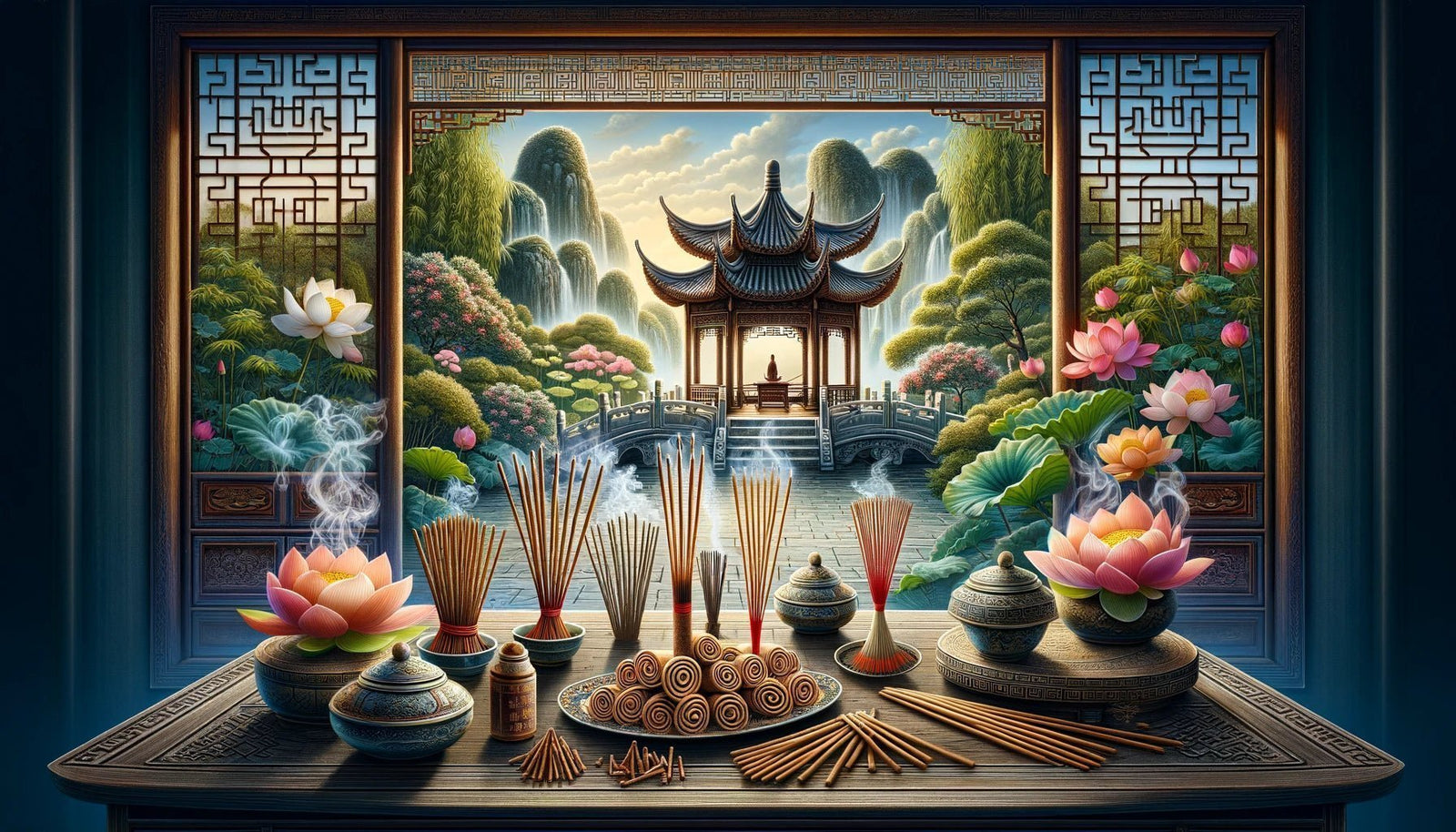
Chinese incense comes in many forms, each suited to a different occasion, mood, and space. Among them, sticks, coils, and cones stand out for their distinct character. They differ not only in shape but in how they release their scent, so each offers a slightly different experience.
-
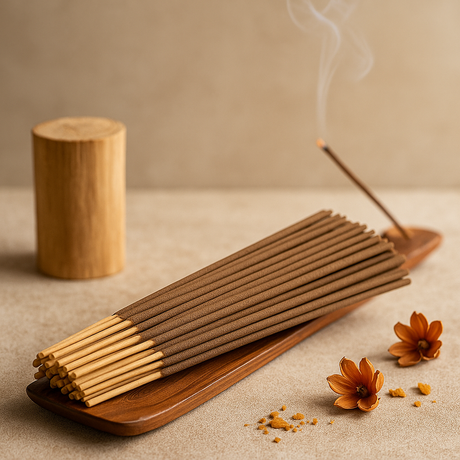
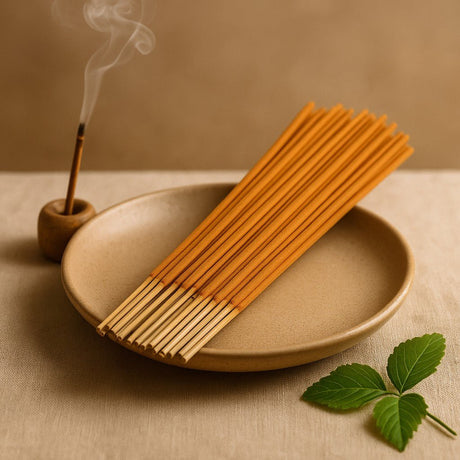
Incense sticks. The most familiar form — slender, elegant, and easy to light, well suited to daily ritual. They burn evenly, releasing a steady stream of smoke and fragrance. A natural choice for meditation, for prayer, or simply for setting a calm, tranquil mood, their simplicity makes them a favourite in homes and temples alike.

-
Incense coils. Known for their longer burn, coils are a practical choice for an extended ceremony, or whenever you want a continuous scent without frequent relighting. Shaped into spirals that can last for hours, they suit larger spaces and outdoor settings. Their slow burn lets the fragrance unfold gradually, settling over a space for a long, gentle while.

-
Incense cones. Compact and shaped like small pyramids, cones offer a fuller, more concentrated scent. Once lit, they smoulder and give off a rich, generous plume that fills a room quickly. They suit shorter, focused sessions — a sit, a quiet evening — and many people first fall for them simply for the beautiful sight of the smoke swirling up.

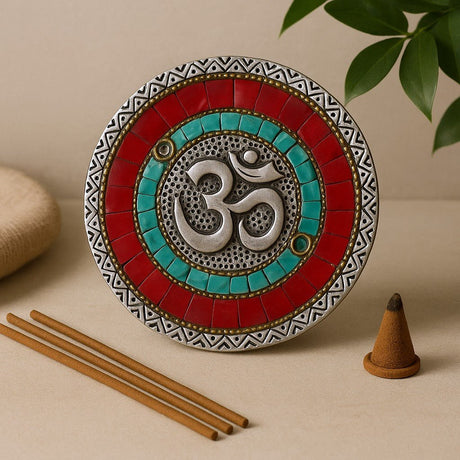
Each form has its own quality — the gentle, sustained release of a stick, the immersive plume of a cone, the long, enduring presence of a coil. Whether you are after a moment of focus, a calmer space, or simply the pleasure of an aromatic wood or resin, there is a form of Chinese incense to suit. The right burner makes the ritual easier still: browse our incense burners and holders to find one that catches the ash and holds a stick or cone steady.
The incense-making process
Making Chinese incense is a careful, traditional craft — rooted in old practice, yet open to modern tools. At the heart of stick incense lies the choice of bamboo, mostly from the Phyllostachys heterocycla cv. pubescens variety, prized for its dense wood and clean burn. This bamboo, along with kinds such as Phyllostachys edulis, is harvested and dried with care, chosen for the way it burns cleanly and fully down to ash.
The work begins with dried bamboo poles, roughly 10 cm across, which are trimmed, soaked, peeled, and split into thin sticks with a square cross-section of less than 3 mm. Traditionally this was done by hand; in much of today’s production the labour has shifted to machines, which streamline the work while keeping the quality.
Once the bamboo sticks are ready, the next steps follow:
- Blending natural ingredients. Aromatic herbs, resins, and woods are finely ground and mixed with makko powder — a natural binder made from the bark of the Tabu-no-ki tree — so the mixture holds together and burns evenly.
- Kneading the incense dough. The blend is combined with water into a dough-like consistency, then kneaded carefully for an even scent and texture.
- Forming the incense sticks. The dough is either hand-rolled around the bamboo or extruded through machines that shape it precisely.
- Straightening and drying. The freshly shaped sticks are straightened to keep them from bending, then laid out to dry — a crucial step that sets their form and stabilises the fragrance.
From the choice of bamboo to the final drying, the process balances traditional craftsmanship with modern efficiency, so that each stick carries the natural aromas of its ingredients along with generations of heritage and artistry.

Cultural and spiritual significance
In Chinese culture, incense is more than fragrance. It has long been woven into spiritual and daily life as a kind of bridge between the everyday and the sacred. In the tradition, the act of burning incense purifies and readies a space, and the rising smoke is said to carry prayers and thoughts upward, joining the ordinary to the spiritual. Lit at the start of meditation, it serves as a quiet preparation — a way of marking the moment that practice begins.
Incense and meditation
The bond between incense and meditation is an old one. Lighting incense can be a cue — a signal to the mind and body that practice is beginning. The fragrance won’t do the work for you, but as a marker it helps set a calm, attentive atmosphere, drawing the senses toward the present. The ritual is the tool; you bring the practice. Many people light incense to mark the start of meditation, alongside the bowl or breath that opens the sitting.
Incense in ceremonial use
Incense also has its place in religious ceremonies and festivals, where the tradition holds it as a symbol of purification and a connection to the divine. In temples and homes, burning incense signifies respect and veneration, its smoke understood to carry prayers upward. The practice reflects a long-held belief in incense’s power to cleanse, protect, and uplift, making it part of celebrations and solemn observances alike.
Aromatics in tradition
Many of the materials used in incense also appear in Traditional Chinese Medicine, and the same woods, resins, and herbs were valued in incense for the atmosphere and focus they bring to a practice. Camphor, for example, was traditionally believed to help dispel negative energies — a belief held within the tradition, rather than a property of the smoke itself. These overlaps point to incense’s place at the meeting of the everyday, the spiritual, and the cultural.
Incense as a timekeeper
With the arrival of Buddhism in China, incense took on a new role as a timekeeper. Calibrated incense sticks and incense clocks allowed time to be measured in a way that was both practical and spiritually fitting. It is another example of how many uses incense found, settling ever deeper into Chinese cultural and daily life.
A symbol of religious devotion
Beyond Buddhism, incense is used across various religious traditions, including ceremonies by the Sunni Muslim Hui Gedimu and the Yihewani — a reminder of how widely it is valued. Such practices show incense as a tool for worship and devotion that crosses many boundaries.
Incense as an art form
In time, incense burning in China grew into an art form known as xiangdao, set alongside the tea ceremony and calligraphy. This refined practice draws on an array of tools and techniques, meant to elevate a personal space and accompany other arts. It marks the high point of incense’s cultural journey — from a simple aromatic to a symbol of aesthetic and spiritual care.
Through all of these uses — meditation, ceremony, timekeeping, and art — incense remains a cornerstone of Chinese heritage, holding much of the texture of its cultural and spiritual life.

An aromatic guide
Beyond its cultural and spiritual roles, Chinese incense is loved simply for its scents. Many of these aromatics also feature in Traditional Chinese Medicine, and the same materials were valued in incense for the atmosphere and focus they bring to a practice — the warm woody and resinous notes of sandalwood, the deep complexity of agarwood, the bright sweetness of frankincense. The guide below sets out the character of each, and the traditions long associated with it.
| Scent | Description | Character & traditional associations |
|---|---|---|
| Sandalwood (檀香) | Warm, rich, and woody | Grounding and quietly comforting; long favoured to settle a room before meditation |
| Agarwood (沈香) | Deep, complex, and resinous | The prized luxury wood; traditionally linked with focus and contemplation |
| Frankincense (乳香) | Sweet, woody, and citrussy | A Silk Road traveller; long associated with ceremony and a sense of occasion |
| Cloves (丁香) | Spicy and warming | Warm and aromatic; a familiar note in festive and spiced blends |
| Star anise (八角) | Liquorice-like and sweet | Sweet and distinctive; a warming presence in traditional spice mixes |
| Cinnamon (桂皮) | Warm, spicy, and sweet | Cosy and inviting; the spiced warmth of cinnamon suits the colder months |
| Cedar (翠柏) | Fresh, woody, and balsamic | Crisp and forest-like; traditionally linked with freshening a space |
| Camphor (樟腦) | Cool, penetrating, and fresh | Cool and bracing; in the tradition, associated with clearing a space |
| Amber (琥珀) | Warm, rich, and earthy | A grounding base note; amber’s warm, earthy note rounds out many blends |
| Spikenard (甘松) | Musky and earthy | Deep and grounding; long valued in ritual and devotional blends |
| Ligusticum (川芎) | Spicy and herbal | Green and aromatic; a traditional note in herbal incense mixes |
| Eleutherococcus (五加) | Woody and slightly sweet | Soft and woody; a gentle, herbaceous presence in blends |
You don’t need to chase the rarest material to begin. A single, well-loved scent — sandalwood, perhaps, or a touch of frankincense — is enough to mark a quiet evening or open a sitting. Explore the wider family of warm woody and resinous aromas and find the one that feels like yours.

A closing thought
The art of Chinese incense is a long, quiet testament to the way a fragrance can connect us, steady the mind, and spark a little inspiration. Its many forms and deep cultural roots, woven through millennia, keep it part of everyday life still. To light incense with attention is to honour a tradition that asks very little and gives a moment back in return — a small pause, a thread of smoke, a steadier breath.
At SHAMTAM, we’d love you to explore this tradition for yourself. Whether you want to deepen a meditation practice, add a quiet ritual to the day, or simply enjoy a beautiful scent, there is a form and a fragrance to suit. Take your time, choose from our carefully kept selection, and let the timeless art of Chinese incense bring a little stillness to your space.