There is usually one pose you skip, one sound you don't quite make, one chakra your attention slides past without deciding to. This is a guide to reading that instead of fixing it: what the avoidance itself is telling you, and one practice to meet it, gently, every day.
The sound you keep not making
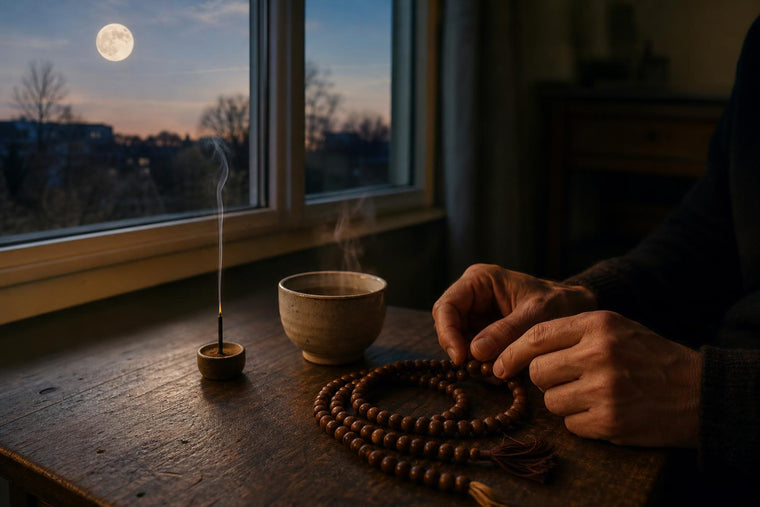
I know the shape of this from my own japa practice, where some mornings a particular sound simply doesn't want to come. Not every seed-sound lands the same way every day, and over years of sitting with a mala I've noticed that the ones I quietly shorten or mumble through are rarely random. They cluster. If you have ever worked through a chakra sequence, sound by sound, you will know the feeling of arriving at one centre and finding your attention already halfway to the next one, the sound clipped, the breath hurried past it.
Chakra teaching gives each of these centres a Sanskrit name, and the names are not decoration. They are old, specific claims about what that centre is doing. The one most people rush past sits at the chest: Anahata, the heart chakra. The word means "unstruck", and in the Vedic and later yogic traditions it points to a particular kind of sound, the kind made without two things touching or striking together. Most sound in the world is struck: a bell, a drum, a voice against air. Anahata names the sound that isn't.

Contemporary chakra teaching tends to describe a "blocked" centre as constricted rather than malfunctioning: tightened by stress, by a feeling pushed down long enough that it stopped announcing itself, by a habit of attention that simply never goes there. That is a different claim from "broken", and it changes what you do next. A broken thing needs replacing or repairing by someone else's hands. A constricted thing needs space, and usually time, and the kind of patient return that nobody can do for you in one sitting. This also reframes what avoidance means. The chakra you keep not quite doing is more interesting than the one with the longest list of symptoms, because it is telling you something about your own attention right now, rather than describing a state you read about somewhere.
Anahata: a sound made without two things touching
Anahata sits at the centre of the chest, its element given as air, its seed sound as YAM. In Hindu goddess-centred traditions and in broader yogic tradition alike, "Anahata Nad", the unstruck sound, refers to a sound said to exist prior to or beneath the ordinary friction of the world: two objects colliding, a voice pushing out from strain, an argument that has to be won. It is sometimes described as a sound heard in deep stillness rather than produced by effort.
If you avoid heart-chakra work specifically, that word is worth sitting with before reaching for a technique. Unstruck. Not produced by impact. The avoidance of a centre whose very name refuses friction might be telling you that friction is exactly what you're used to running on: a day built from small collisions, a habit of proving a point, a closeness that has started to feel like it needs defending rather than simply being there. None of that is a diagnosis. It's a question the word itself is asking.
Reading the chakra you keep skipping
Different centres skipped say different things, and it's worth being specific rather than reaching for one universal story. Muladhara, the root chakra, sits symbolically at the base of the spine and carries associations of safety, stability and the material, bodily world: money, shelter, the ground under the feet. Someone who avoids root-chakra work is often, in my experience, avoiding the plainest and least glamorous questions: am I steady, is this arrangement actually safe, have I built on solid ground or just told myself I have.

Vishuddha, the throat chakra, carries associations of expression, communication and honesty, speaking the thing that is true rather than the thing that keeps the peace. Avoidance here often has a different flavour: not "is this safe" but "will I be believed, will it cost me something to say this plainly". Throat and heart avoidance often travel together, since an unexpressed feeling and an unspoken sentence are frequently the same stuck thing wearing two names.
There is an old and sensible reason chakra work is traditionally approached from the bottom up: the base is worked first, because a shaky foundation makes everything built above it harder to hold. If you notice strong resistance to heart or throat work specifically, it is worth checking honestly whether root-level questions, safety, stability, the basic material facts of your life, have actually been attended to, or whether you've skipped ahead because the higher centres sound more interesting to write about than rent and sleep and whether you feel safe in your own days. None of these are fixed meanings handed down with certainty: traditions and teachers vary in how they describe each centre, and the value here isn't in matching your life to a chart. It's in noticing which direction your own resistance points, and taking that seriously as a clue rather than a flaw.
Bhramari: the humming-bee breath
There is one practice worth naming plainly rather than gesturing at vaguely: bhramari pranayama, the humming-bee breath, so called for the low hum made on the exhale, closer to a bee's drone than a sung note. It is practised in connection with Anahata and its unstruck sound precisely because the hum isn't produced by striking anything. Breath simply moves and the sound arrives with it, closer to a vibration you allow than a note you perform.

In practice it is unremarkable to describe: sit, close the ears gently with the fingers if that helps you turn inward, and hum on the exhale, letting the sound sit low and steady rather than reaching for volume or feeling. The point isn't to manufacture calm or produce the "unstruck sound" as an experience on command. It's closer to leaving a door unfastened and returning to it daily, without insisting that it open today. Some mornings the hum will feel like nothing in particular. That's not failure. It's one more ordinary day of doing a quiet thing without demanding a result from it, which is most of what any sustained practice actually consists of. This isn't a rule enforced by anyone; it's closer to advice from people who tried the shortcut first and noticed it didn't hold.
Objects that keep the order visible
A specific Chakra Stones Set of 7 Small Rounded can be a quiet way to keep that bottom-up order in view, laid out in sequence rather than treated as seven unrelated options to pick from on a given day. And for the daily repetition that bhramari and seed-sound work both rely on, a mala for daily seed-sound practice gives the hands something to count so the mind doesn't have to keep score.
The chakra you keep forgetting is not a defect in your practice to be corrected by better discipline. It is closer to a note left by your own attention, pointing at exactly the place that needs it, which is precisely why it's uncomfortable to look at directly. Treat it the way you'd treat a constriction rather than a fault: something that loosens with return, not with force. You don't have to resolve it this week, or ever finally, in some tidy once-and-done way. You only have to notice, tomorrow morning, which sound you're tempted to skip, and hum it anyway, low and unforced, and see what, if anything, it has to say.


 India
India




 Uruguay
 South Africa