Among the most frequent questions we receive, singing bowls prompt some of the most honest ones. Three of them are answered here.
I keep seeing these called Tibetan singing bowls. Are they actually Tibetan?
The short answer: almost certainly not made there, though the name has stuck for reasons that are historically understandable.
The bowls are Newar in origin. The Newar people are the indigenous inhabitants of the Kathmandu Valley in Nepal, and it is their metalworking tradition, centred principally in Patan (also known as Lalitpur), that produced these objects for centuries before they acquired a Western market name. Within Patan, the Oku Bahal neighbourhood has long been the heart of this craft, worked by artisans from the Shakya and Shrestha castes whose families have been shaping metal for Newar Buddhist monasteries across many generations.
So how did "Tibetan" happen? From the late 1960s onward, Western travellers arriving in Kathmandu encountered the bowls in two places: the tourist markets of the valley, and the communities of Tibetan exiles who had settled there after 1959. Tibetan monasteries had imported and used Newar-made bowls liturgically for a long time, so the association was not invented from nothing. But the place of manufacture was the Kathmandu Valley, not the Tibetan plateau. The export label followed the encounter, not the origin.
It is worth naming this plainly not to correct anyone's enjoyment of the object, but because the actual story — a specific caste of craftspeople in a specific neighbourhood of a specific city — is considerably more interesting than a vague Himalayan mystique.
What is actually in the metal, and does it matter for the sound?

The traditional alloy is called panchadhatu, a Sanskrit term meaning five metals. The canonical composition is gold, silver, copper, iron and tin. In practice, workshop alloys vary by maker and era; lead has sometimes substituted for one of the rarer metals, and the exact proportions are not standardised across the tradition. What matters more than the precise recipe is the method of working the metal.
Hand-hammering does something to an alloy that machine-spinning cannot replicate. The repeated blows work-harden the metal and create slight irregularities across the surface: variations in thickness, small undulations in the rim, that give the bowl its characteristic acoustic behaviour. When you run a mallet around the rim of a hand-hammered bowl, the tone does not simply ring and stop. It blooms; overtones build on each other, the sound sustains and shifts slightly as it decays. A machine-spun bowl, made from a single sheet of metal turned on a lathe, produces a surface that is too uniform for this. The ring is cleaner, shorter, flatter.
This is not a mystical claim. It is a documented property of work-hardened metal and surface geometry. The tradition layers meaning onto each of the five metals, associating them with planets, qualities, intentions, and those associations are part of what the object carries culturally. But the acoustic difference between a hand-hammered and a machine-spun bowl is audible to anyone who listens carefully, and it has a straightforward physical explanation.
One honest complexity: the panchadhatu canon is itself contested. Some scholars of Newar metallurgy note that the five-metal formula appears more consistently in ritual texts than in spectrographic analysis of historical bowls, where the actual composition varies considerably. The tradition is real; the recipe is more fluid than the name implies.
What were they actually used for before the wellness industry found them?

In Newar Buddhist practice, the bowl functions as a ritual vessel: holding water, grain or other offerings during puja sequences, and marking transitions in ceremony alongside mantra recitation. It is one element within a larger liturgical structure, not a stand-alone instrument. The idea of the bowl as the centrepiece of a "sound bath" — a session organised around its resonance alone — is largely a post-1960s Western development, shaped by the same encounter that produced the Tibetan misnomer. In Ubud and other centres where contemplative tourism has taken root, workshops built around the bowl's resonance have become a genre of their own, distinct from but not unrelated to the original liturgical use.
Both uses are real. The object's history does not invalidate what someone does with it in a quiet room in another country and another century. What the history does offer is a sense of proportion: the bowl was made to accompany attention, not to replace it. In its original context it was one voice in a longer conversation between the practitioner, the offering and the ritual moment. That framing seems worth carrying forward, whatever form the practice takes.
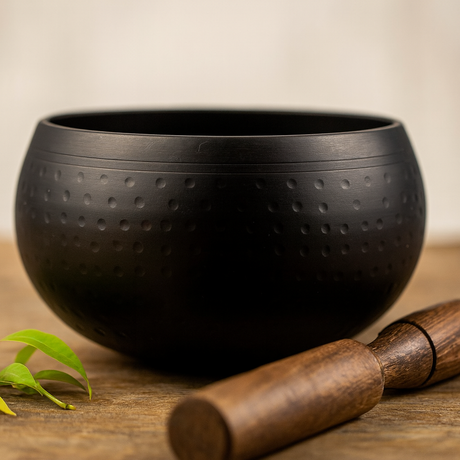
If you want one that is genuinely hand-made in the valley, the practical indicators are these: visible hammer marks on the outer surface, slight irregularity in the rim when you look closely, and a sound that sustains and opens rather than ringing briefly and closing. Provenance from a named Patan workshop, rather than a generic "Nepal/Tibet" label, is a reasonable further signal. Genuine craft pieces cost significantly more than machine-spun imports, and the difference is in the making.
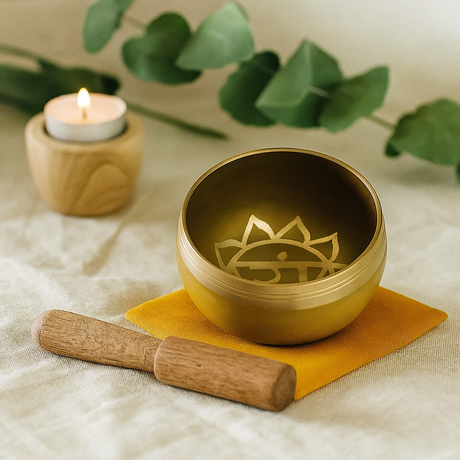
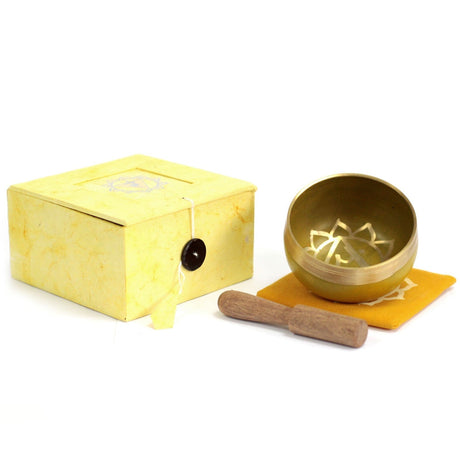
A hand-hammered Singing Bowl Black Beaten or a complete Singing Bowl Set with a Singing Bowl Mallet are worth considering if provenance matters to you. For those drawn to the solar plexus associations of the panchadhatu tradition, the Solar Plexus Chakra Singing Bowl carries that intention.
The Kathmandu Valley was inscribed as a UNESCO World Heritage Site in 1979, and Patan Durbar Square is among its seven monument zones — context that gives some sense of the depth of craft culture the bowl emerges from. But the more useful frame, for anyone sitting down with one of these objects, is simpler: somewhere in Oku Bahal, a craftsperson spent time with a hammer and a piece of alloy, and the result of that attention is still audible in the sound the bowl makes. That is what you are holding.