Flower of life
The flower of life is a pattern of overlapping circles, set so that six petals open around every centre. The pattern is ancient: it appears on an Assyrian threshold of the 7th or 6th century BCE, on Roman floors and in medieval art. The name Flower of Life is modern, from New Age writing of the late twentieth century.
- Oldest known
- an Assyrian threshold, 7th to 6th century BCE
- Name
- modern, from New Age writing
- Studied by
- Leonardo da Vinci

As a gift

Shop Flower of life
- Essential Oil Diffuser Necklace Flower Of Life 30mm Stainless steel
 China 5.0 (1)£16.95Members: +£0.95 back
- Essential Oil Diffuser Necklace Flower of Life 25mm Stainless steelChina 4.5 (2)£15.95Members: +£0.90 back
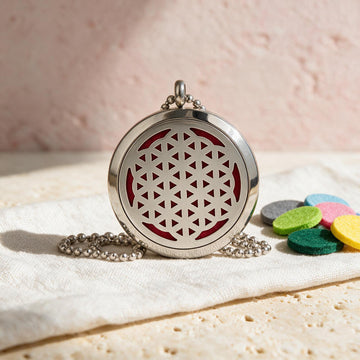
 China
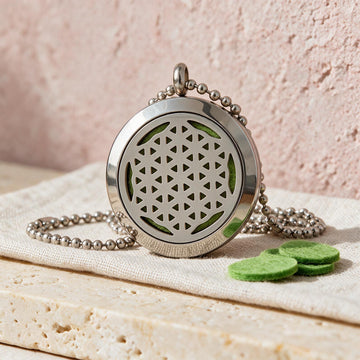
A small practice
- Take a pencil, a compass and a sheet of paper.
- Draw one circle, then six more, each centred on the edge of the first.
- Watch the petals appear on their own. Keep the drawing where you work.
In the library


Frequently asked questions
What does the flower of life symbolise?
Today it is read as the unity of life: many circles from one rule, each joined to the next. Historically it was mostly ornament, and in some old buildings it may have been a protective mark.
Is the flower of life a religious symbol?
It belongs to no single religion. It appears in Assyrian, Roman, Islamic and Gothic art and in folk carving, and modern spiritual movements gave it its name.
How old is the flower of life?
The overlapping-circle pattern goes back at least to the 7th century BCE. The name Flower of Life is much newer, from the late twentieth century.
What is the seed of life?
The smaller figure at the heart of the pattern: seven circles, one in the centre and six around it. It is the first step when you draw the full flower.
Sources: Wikipedia, Overlapping circles grid; Historic England, What are witches' marks?