A circle with a centre. That is all it is — and yet the mandala has occupied the hands of monks, the walls of temples, and the notebooks of psychologists for longer than most living traditions can trace. What makes a simple geometric form so persistently useful?
A Form That Keeps Returning
The word comes from Sanskrit: maṇḍala, meaning circle, or more precisely, that which contains essence. In Tibetan Buddhist practice, monks spend days constructing intricate sand mandalas grain by grain, only to sweep them away at the completion of the ritual. The destruction is not waste; it is built into the form from the beginning. Impermanence is the instruction, and the point was never the object itself — it was the quality of attention brought to making it.
The mandala is not the exclusive property of any single tradition. Circular diagrams mapping the structure of the cosmos appear in Hindu yantra practice, in the rose windows of Gothic cathedrals, in Navajo sand paintings, in the geometric tilework of Islamic architecture. The convergence is striking enough that Carl Jung, encountering mandalas in the dreams of his patients in the early twentieth century, proposed that the form arises from something structural in human perception: a tendency to organise experience around a centre. Whether or not one follows Jung's framework, the cross-cultural recurrence is a fact worth sitting with.
What the Structure Actually Does
A mandala works through symmetry and orientation. The eye enters at the edge, follows the pattern inward, and arrives at a centre. That movement — from the outer edge to the core — mirrors a quality of attention that contemplative traditions across cultures have long cultivated deliberately.
In Hindu tantric practice, specific mandalas (often called yantras when rendered in geometric rather than pictorial form) are associated with particular deities or qualities of awareness. The Sri Yantra, for instance, is traditionally said to represent the dynamic interplay of consciousness and matter, its nine triangles fitted together in a pattern that generates a visual field practitioners use as a focus for meditation. The associations are traditional and layered; the meanings vary between lineages and teachers, and it would flatten something genuinely complex to reduce any of them to a single interpretation. It is also worth saying plainly that mandala imagery has travelled well beyond any lineage — onto stationery, phone cases, yoga-studio walls — and that popular life runs alongside the traditional one without replacing it.
What most traditions agree on is simpler: the mandala gives the wandering mind somewhere to land. Colouring one, drawing one, or simply resting the gaze on one can function as a gentle anchor — not because the geometry holds power independent of the person, but because the person, in attending to it, has chosen to slow down. The structure is the frame; the person does the work.
Colour, Symbol, and the Language of Intention
Traditional mandalas are rarely arbitrary in their colour choices. In Tibetan iconography — the Five Buddha Family system central to Vajrayana tantra, and best known outside specialist circles through the Bardo Thodol, the Tibetan Book of the Dead — each of the five directions carries an associated colour, a Buddha family, and a quality of mind: white for the centre and mirror-like awareness, yellow for the south and equanimity, red for the west and clear seeing, green for the north and all-accomplishing action, blue for the east and the vastness of space. These are not decorative decisions. They are a symbolic vocabulary, and reading a mandala with that vocabulary changes what you see in it.
Contemporary mandala practice, particularly in art therapy and secular mindfulness contexts, tends to work more freely with colour as a vehicle for intention rather than fixed symbolism. Both approaches are legitimate; they simply operate in different registers. If you are drawn to a particular colour when you sit down to draw, that preference is worth noticing — not as a diagnosis, but as a small piece of self-knowledge.
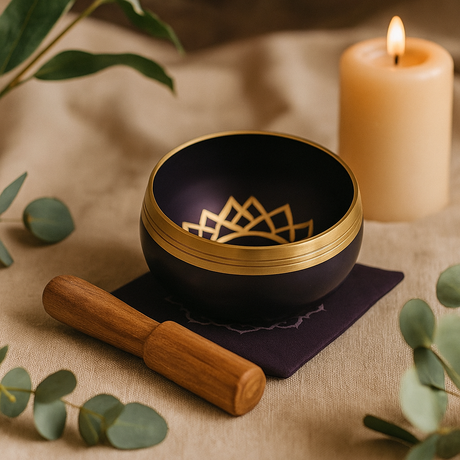
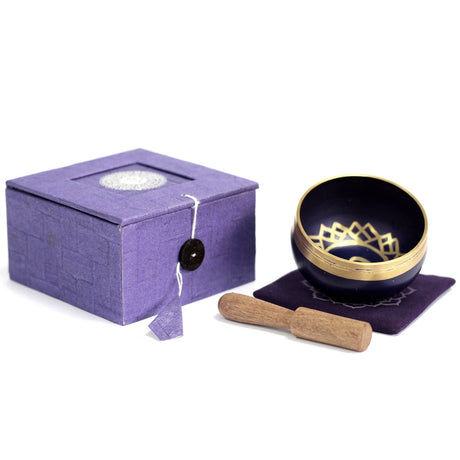
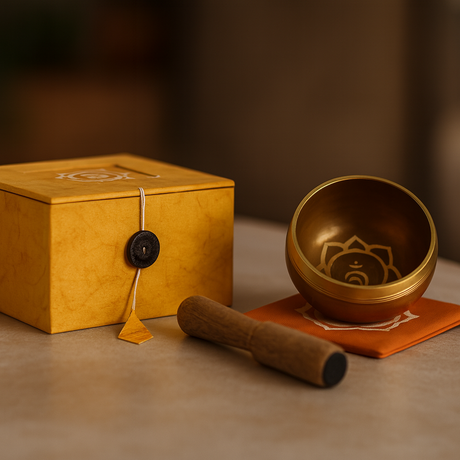
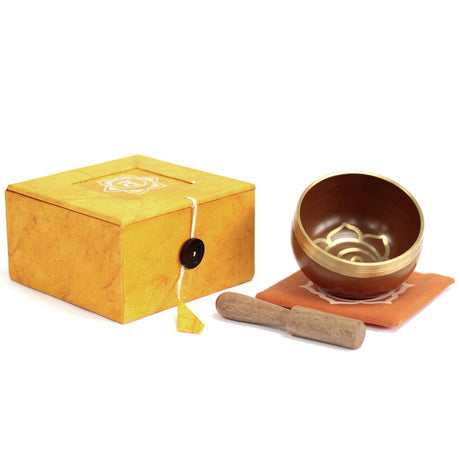
For those who work with chakra singing bowl practice alongside visual meditation, the mandala and the bowl can complement each other naturally: the sound provides a temporal anchor while the image provides a spatial one, and together they make the quality of attention easier to sustain.
Making One Yourself
The most direct way to understand a mandala is to make one. You do not need artistic training. You need a compass, or a round object to trace, a centre point, and enough patience to work outward from it in layers.
Begin with the centre. Mark it clearly. Then decide what the first ring will hold: a simple petal shape, a geometric division, a repeated mark. Work outward, keeping the symmetry as consistent as you can manage. The effort of maintaining symmetry is itself the practice. It requires a quality of attention that is neither rigid nor slack, and when the mind drifts, the line shows it immediately.
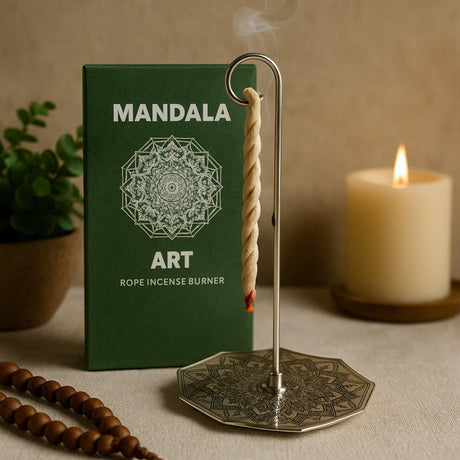
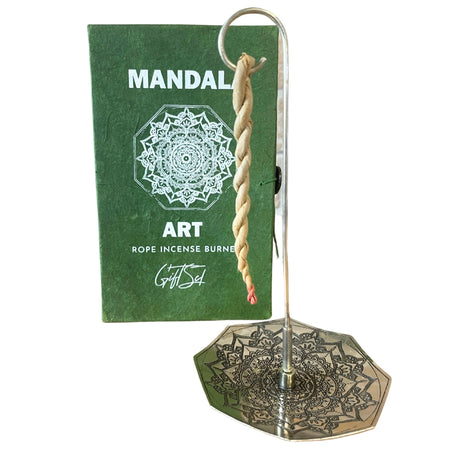
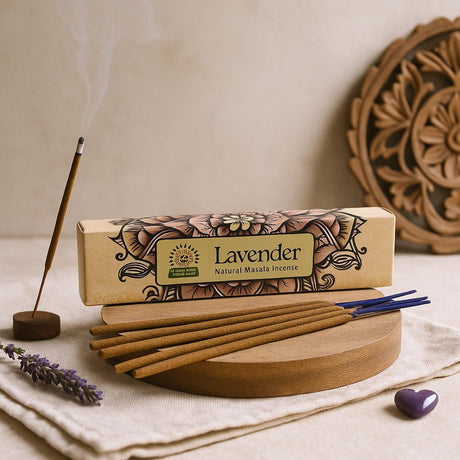
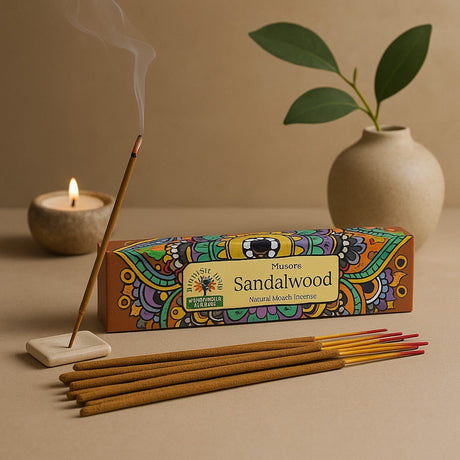
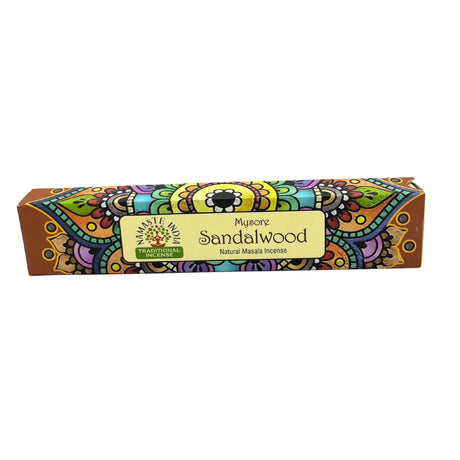
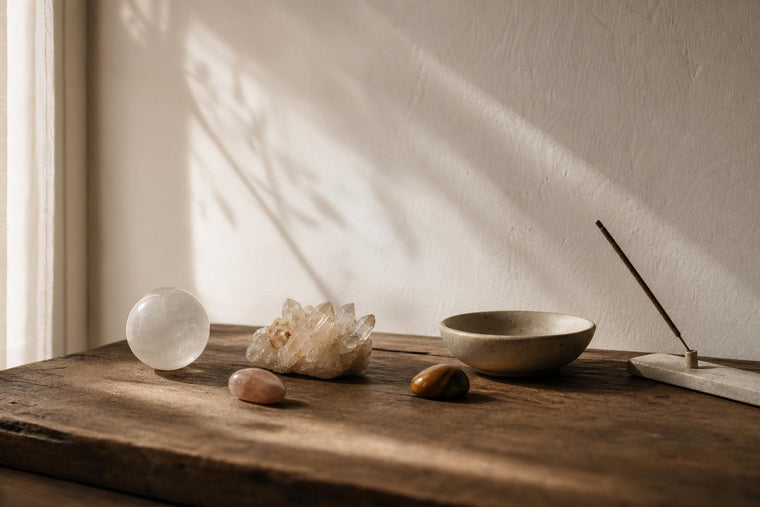
Many practitioners light incense before sitting down to draw, not as a ritual requirement, but as a way of marking the transition from ordinary activity to something more deliberate. Sandalwood incense has a long association with clarity and focus in South Asian contemplative contexts, and the scent can serve as a simple sensory cue that this time is set apart. Alternatively, mandala rope incense suits longer sessions.
When the mandala is finished, spend a few minutes with it before putting it away. Look at the centre. Notice whether the quality of attention you brought to the making is still available to you now that the task is complete.
The Altar and the Everyday
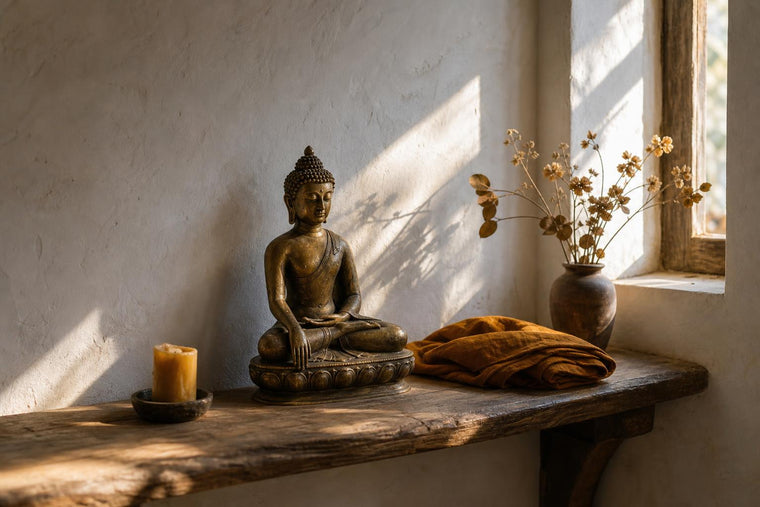
In many Hindu and Buddhist households, mandalas appear not as artworks to be contemplated but as functional elements of a puja space: a visual field that orients the practitioner toward the quality of awareness they are cultivating. Placed on a home altar, a mandala set becomes part of that daily return rather than a piece of decoration.
The distinction matters. An object placed with intention and returned to regularly accumulates a different quality of presence in a space than one placed for aesthetic reasons alone. This is not a mystical claim; it is simply an observation about how attention works — we notice what we have chosen to notice, and a chakra mandala plate on a small altar rests on the same principle.
An Ordinary Tuesday, Not a Retreat
None of this requires a shrine room or a spare hour. A mandala works on a shelf beside the kettle, on a windowsill that gets the morning light for four minutes before the day starts properly. The form does not ask for devotion; it asks for a glance that is slightly more awake than the one before it. That is a low bar, and it is also the whole point — the centre is only useful if you actually look at it, on the days when looking is inconvenient as well as the days when it isn't.
What changes is not the room but the habit of noticing where your attention has drifted. A mandala placed where you will see it daily becomes less a picture and more a question, asked quietly, repeated without insistence: is this where you meant to be standing. Most days the honest answer is no, and that is fine — the return is the practice, not the arrival.
That is the whole use of the thing, in the end. Not a symbol to be decoded once and filed away, but a shape ordinary enough to survive on a shelf, patient enough to be looked at badly most days and properly only sometimes. A mandala does not keep score. It simply stays where you put it, waiting for the next glance that is a little more awake than the last.