A letter on choosing the right Buddha for your calm corner, and the one question that matters more than placement rules.
You have already decided something. Not which statue to buy, not which direction it should face. Something quieter than that. You have decided that you want a corner of your home to hold a different quality of attention. The statue is not the decision; it is the record of one you have already made.
I keep a small image of the Buddha near where I sit for japa each morning. It is not there to bless the room or to perform any work on my behalf. It is there because, when I look up, it reminds me of something I already know but regularly forget: that stillness is available, and that I am the one who has to choose it. That is the only job a statue can honestly do, and it is not a small one.
Most of what you will read about choosing a Buddha statue concerns placement: which room, which direction, which height from the floor. Some of it draws on Feng Shui, some on Vaastu Shastra, some on a loose conflation of both. These are real traditions, and they carry genuine thought about how space shapes attention. But they are also a separate layer from Buddhist teaching itself, and conflating them can leave you more anxious about the rules than present in the room. So let us set the checklist aside and start somewhere more useful.
What the gesture is actually saying

The word mudra is Sanskrit for "seal" or "gesture." In Buddhist iconography, each mudra encodes a specific inner state or a precise narrative moment: not a general blessing, not a decorative choice. When you understand what a gesture means, the statue stops being an aesthetic object and becomes something closer to a sentence.
The mudra you will encounter most often is the Bhumisparsha: the right hand resting on the right knee, fingers pointing downward to touch the earth. This is the gesture of Shakyamuni Buddha at the moment of his enlightenment at Bodh Gaya, in present-day Bihar, in India. By traditional Theravāda reckoning, that moment is placed around 528 BCE, beneath a Ficus religiosa (the Bodhi tree) whose descendant still grows at the Mahabodhi Temple complex, a UNESCO World Heritage Site.
What was he doing with that hand? He was calling the earth goddess Vasudharā to witness. Māra, the force of delusion and craving, had challenged his right to enlightenment. Shakyamuni's response was not a raised fist or a declaration. He simply reached down and touched the ground, asking the earth itself to testify to his practice, his resolve, his readiness. It is the most widely reproduced gesture in Buddhist iconography precisely because it is not a blessing directed outward. It is a moment of inner resolve made visible.
Other mudras carry different meanings. The Dhyana mudra (both hands resting in the lap, palms upward) is associated with meditation and inner stillness. The Abhaya mudra, right hand raised with palm outward, is traditionally read as reassurance. The Varada mudra, open hand extended downward, is associated with generosity. None of these is more correct than another; they are different sentences, and the one you choose should be the one you want to read each morning.
The faces and proportions of statues vary for reasons that are equally specific. The earliest surviving Buddha images come from Gandhāra (present-day Pakistan and Afghanistan) and date from roughly the first to the fifth century CE. They carry a strongly Hellenistic character: a straight nose, wavy hair, toga-like robes. This is the direct legacy of Alexander's cultural presence in the region, and it produced the idealised, serene facial type that many people think of as simply "classical." Tang-dynasty Chinese images, from the seventh to tenth centuries CE, are rounder in the face and fuller in the body, reflecting centuries of aesthetic assimilation as Buddhism travelled the Silk Road. Zen and Chan traditions tend toward simplicity and restraint, smaller and less ornamented, consistent with those traditions' emphasis on direct experience. None of these is more authentic than the others. They are the same teaching, held in different hands over time.
One question worth asking before you choose

Not: which direction should it face? Not: what material is most auspicious?
Ask instead: what do I want to remember when I look up?
If the answer is resolve, the Bhumisparsha mudra is the image of that. If the answer is stillness, the Dhyana mudra holds it. If the answer is simply the quality of being present, any image that genuinely stops you when you glance at it will do the work.
In Theravāda practice, a Buddha image in the home is understood as a focal point for three trainings: ethical conduct, concentration, and wisdom. It is not an object of petitionary prayer. It does not intercede. It reminds. The distinction matters, because it puts the agency exactly where it belongs, with you.
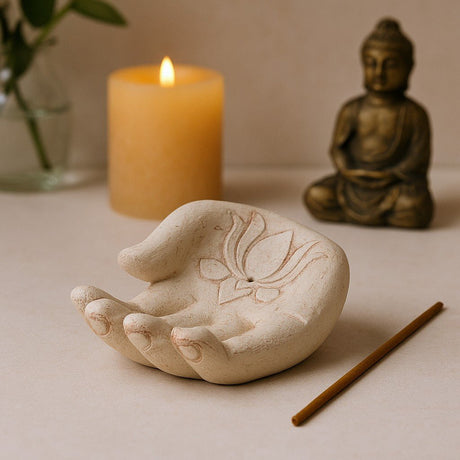
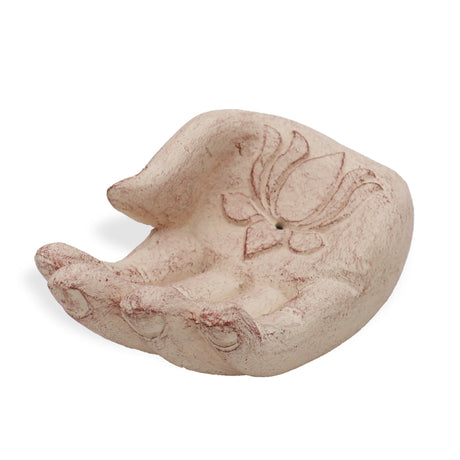
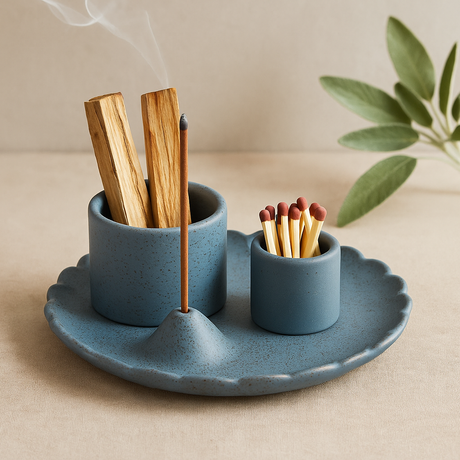
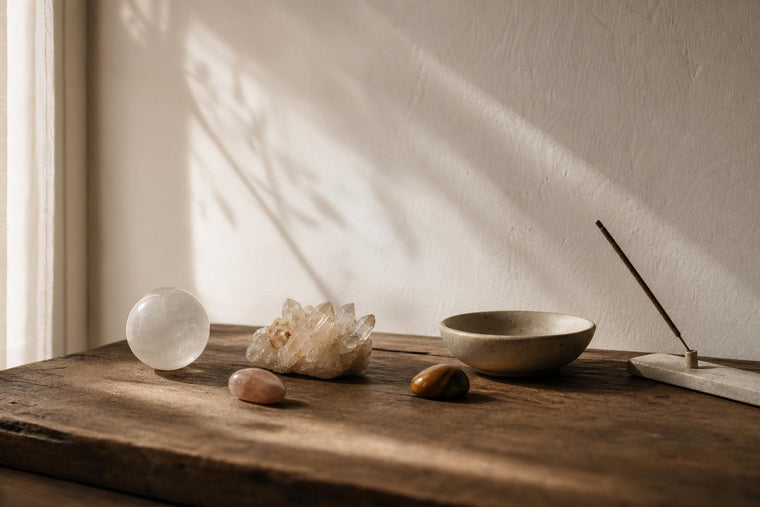
The corner itself can be simple. A surface at a respectful height, a sense of intention in how it is arranged. Some people add a candle (a Buddha candle holder can anchor the space without crowding it) or a thread of incense for a calm corner, lit not as an offering in any ritual sense but as a small act of marking: this moment is different from the one before it. The objects are not the practice. They are the frame that makes the practice easier to enter.
If you already keep a japa practice, you know this instinctively. The mala does not do the repetition for you. It counts. You do the rest.
What happens over time
There is something that occurs with a chosen object when it becomes genuinely familiar. It stops being decorative. You stop seeing it the way you see a picture on a wall. It becomes, instead, a kind of punctuation: a pause built into the room.
I have noticed this with my own altar over the years in Bengaluru. The objects on it have not changed much, but my relationship to them has. They no longer require my attention; they simply receive it, when I have some to give. That is a different thing from a beautiful room. It is closer to a habit of mind that has been given a home.
Choose the statue that makes you stop. The one whose gesture says something you want to keep hearing. Place it where you will actually see it, not where the rules say it belongs. And then, over time, let it become ordinary in the best sense: so familiar that looking at it is already, in itself, a small return.
With warmth,
Alex