Letters about zodiac stones arrive in batches, usually around a birthday or an anniversary, and they nearly all circle the same worry: everyone seems to be quoting a different rule. Here are four of them, answered plainly.
"My girlfriend's a Leo. Every site gives her a different stone: citrine, peridot, ruby. Which one is actually right?" — J., Manchester
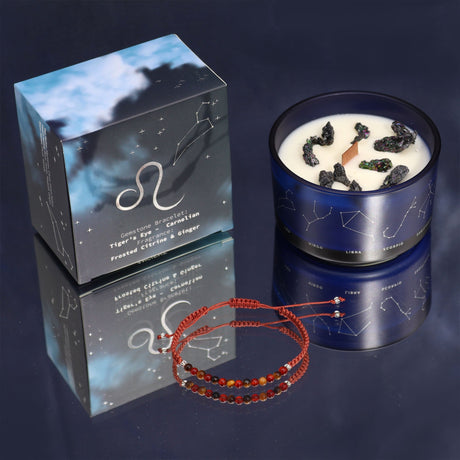
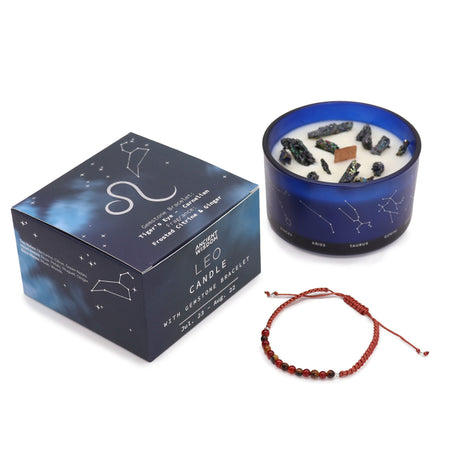
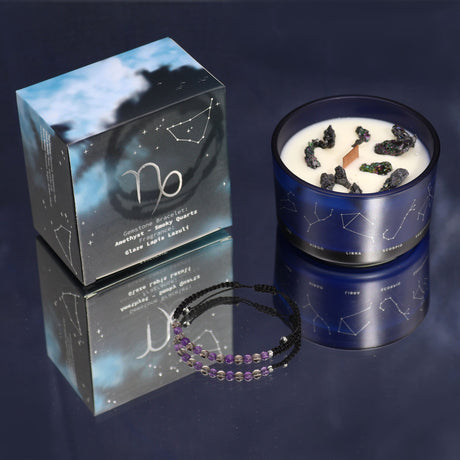
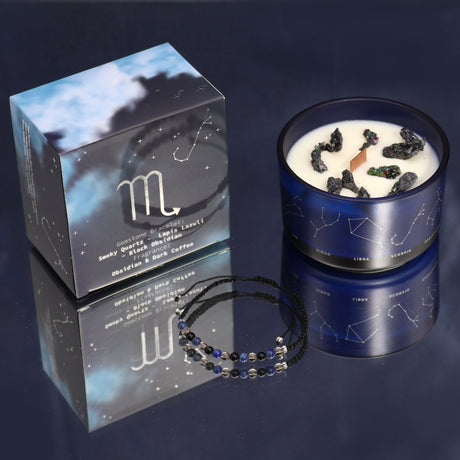
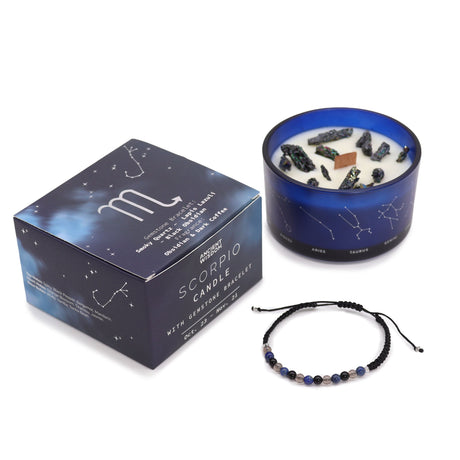
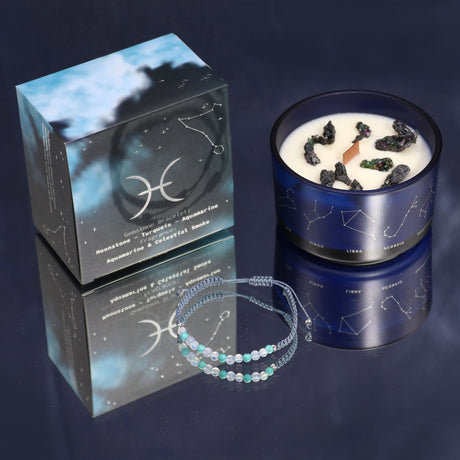
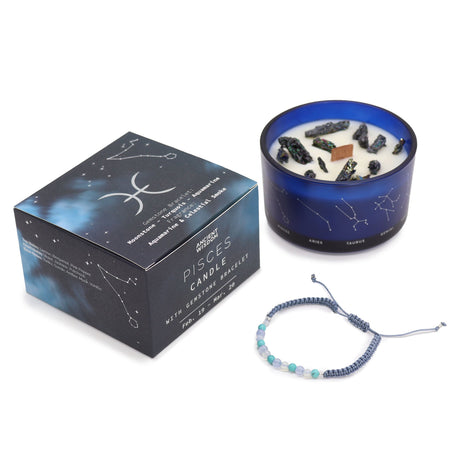
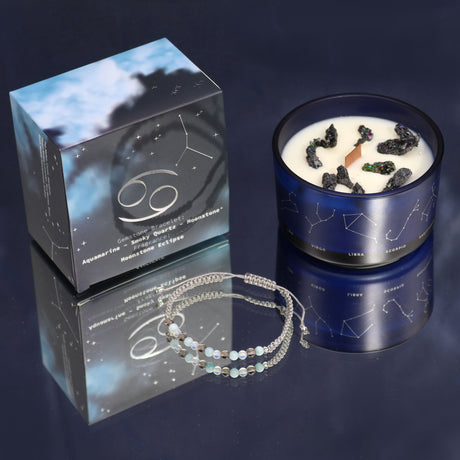
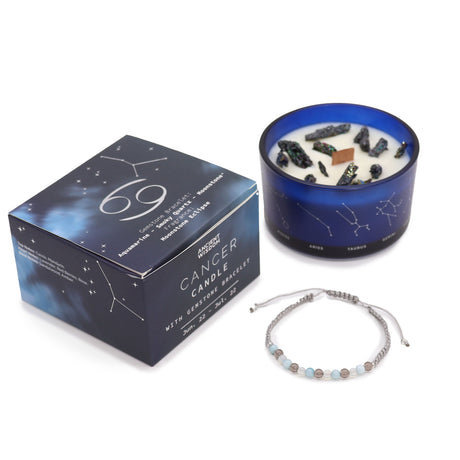
None of them, in the sense you mean it. There's no widely recognised authority that assigns one stone per zodiac sign the way there is, say, for a country's currency or a chemical symbol. Different writers, across different decades, have proposed different lists, and none of those lists outranks the others. Leo turns up with peridot in one, ruby in another, citrine in a third, and all three are simply someone's choice, based on colour, on a planet they associated with the sign, or on whatever felt fitting at the time. If you want to mark her sign at all, pick the version whose meaning you actually like: the zodiac crystal candle and bracelet set made for Leo does that honestly, without pretending it arrives stamped with an authority it doesn't have.
Two traditions wearing one label
"Is a star-sign crystal the same thing as a birthstone? I always thought they were interchangeable." — R., Bristol
They get used as if they're the same thing, but they're two separate systems sharing a shelf. The birthstone list most people know, garnet for January and diamond for April, is tied to the calendar month you were born in, and it's a comparatively recent convention: a group of American jewellers, the National Association of Jewelers, agreed a standard list in 1912 and revised it in 1952, largely to settle stock and advertising rather than to record any older belief. It has one accepted version, and most retailers still follow it.
Star-sign stones are older in spirit but far looser in practice. No equivalent trade body ever sat down and ruled on which stone belongs to Aries or Scorpio. What exists instead is a scattering of lists compiled by different astrologers and writers over a long stretch of time, agreeing on some signs and disagreeing on others. That isn't a flaw to apologise for. It simply means a zodiac stone carries the weight of a tradition rather than the authority of a catalogue.
Where the zodiac-stone idea actually comes from

"Is any of this actually ancient, or did someone just invent it for the gift market?" — S., Leeds
It's genuinely old, though not quite in the shape it arrives in today. The book of Exodus describes the high priest's breastplate set with twelve gemstones, one for each of the twelve tribes of Israel. Centuries later, the Romano-Jewish historian Josephus, writing in the first century CE, described those same twelve stones in Antiquities of the Jews and noted that they were taken to represent the months of the year and, by extension, the twelve signs of the zodiac. It's a genuine and often-cited passage (Book III, chapter 7), though the text itself is brief on the point, and readers have long debated how firmly Josephus meant the zodiac link versus how much later writers read into his words. Ambiguous as it is, that passage is about as close as the idea gets to a documented starting point: a sacred object reinterpreted once through an astrological lens, then carried forward and reshuffled by everyone who found the idea appealing afterwards.
Which is also why no two modern lists match. Each is a later writer's own attempt at the exercise that passage set going: matching twelve stones to twelve signs by feel, by colour, by whichever symbolism suited them. There was never a second reading strong enough to settle the argument for good.
When the tradition is Vedic, not Western
"My mother follows Indian astrology and wants a stone recommended for her chart. Is that the same idea as a star-sign crystal?" — P., Leicester
Not quite, and it's worth knowing the difference before buying anything on her behalf. In Vedic astrology, or Jyotish, gemstones are matched not to the twelve zodiac signs but to nine planetary bodies, or grahas: ruby for the Sun, pearl for the Moon, red coral for Mars, emerald for Mercury, yellow sapphire for Jupiter, diamond for Venus, blue sapphire for Saturn, and two further stones for the lunar nodes, Rahu and Ketu. This nine-stone set is called the navaratna, and it remains a living, still-practised tradition rather than a historical footnote. The part that matters most is how it's meant to work: a stone is properly recommended by an astrologer who has read someone's full birth chart, not handed out because they happen to be born under a particular sun sign. Buying blue sapphire for a Capricorn friend because a website says so skips the actual practice entirely. If your mother wants a stone chosen this way, the more honest gift is pointing her towards someone who reads charts, not towards a shop.
What a shop can offer, honestly, is a stone chosen for a different and equally real reason: what it's traditionally said to support, rather than which planet is said to govern it. A chakra gemstone bracelet, put together by what each stone is reached for in the body's energy centres, sits closer to that logic than any sun-sign list ever will, because it makes no claim to an inherited authority it can't back up.
Which brings the whole question back to something plainer than astrology. A crystal chosen for someone doesn't need a single, unimpeachable tradition behind it to mean something. It needs the giver to know what they're actually saying with it, whether that's her sign, her month, her planet, or simply a colour she'd like on her wrist. The stone can carry meaning that both of you agree on, whether that meaning was settled by a nineteenth-century jeweller or read out of a two-thousand-year-old text. What it can't do is decide, on its own, which meaning is correct. That part stays yours.