Hold a faceted amethyst up to a window and watch what happens. The purple is not even. It pools and deepens exactly where the stone is thickest, thins to almost clear glass at the edges, as if colour has weight and gathers where it can. Every February, birthstone charts get handed round like a shopping list: one stone, one virtue, one line of care advice, repeated twelve times. None of it tells you what you are actually holding. Amethyst has a longer, stranger, better-documented story than that, and it is worth following from the ground up.
Quartz, Coloured by Time
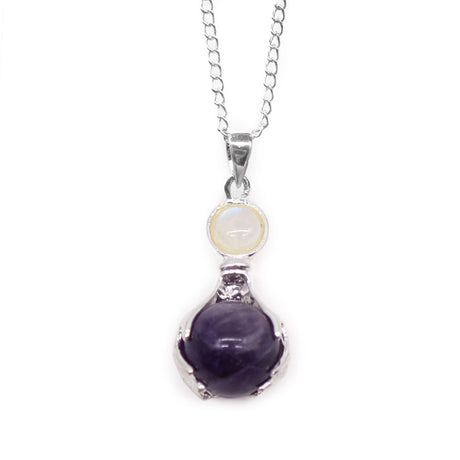
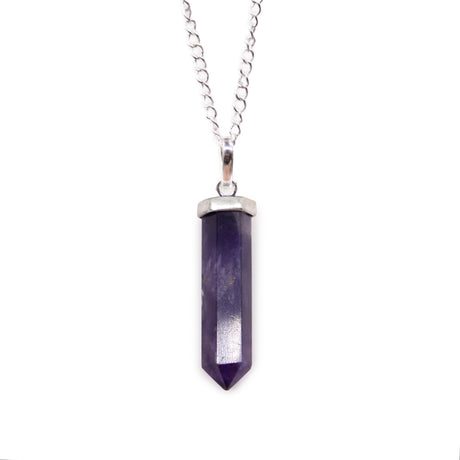
Amethyst is not a rare mineral dressed up. It is ordinary quartz, silicon dioxide, the same chemistry as the clear crystals sold as points on every market stall. What makes it purple is a trace of iron trapped inside the crystal as it grew, altered over a very long stretch of geological time by natural irradiation deep in the rock. The colour is not painted or added afterwards; it is grown into the lattice itself, which is why the deepest tone sits at the thickest part of a cut stone and fades where the material thins out, exactly as it does in a simple amethyst pendant held to the light. It also explains why the stone wears well: at 7 on the Mohs scale, and with no internal cleavage plane to split cleanly along, amethyst resists the everyday chipping that troubles softer or more brittle gems.
From the Ural Mountains to Rio Grande do Sul
For most of its documented history, fine amethyst meant Russian amethyst. Before large deposits turned up in South America in the nineteenth century, the Ural Mountains were the main source of good material, and "Siberian amethyst" became the phrase the trade used for the finest, most saturated colour, a standard against which everything else was measured. That changed once enormous geode beds were opened in Brazil, particularly in the state of Rio Grande do Sul, where amethyst still forms in cavities large enough to walk into. Uruguay, sharing the same geological formations, produces a darker, more saturated stone often found alongside Brazil's lighter material. Zambia entered the trade in the middle of the twentieth century and has since become known for richly coloured amethyst of its own. The stone, in other words, does not come from one place; it comes from a shifting map that has moved continents at least twice.
How a Common Stone Became a Cardinal Gem
The name itself carries the oldest part of the story. Amethyst comes from the Greek amethystos, "not intoxicated," reflecting a belief that the stone protected the wearer against drunkenness. The earliest literary trace of that idea is not a vague folk memory; it appears in a poem by Asclepiades of Samos, a poet born around 320 BCE, and Pliny the Elder later records, separately, that drinking goblets were carved from amethyst for exactly this purpose. In the Christian tradition the stone became associated with bishops and clergy rings, and is still sometimes called the bishop's stone. For centuries it stood as one of the cardinal gems, ranked with diamond, ruby, sapphire and emerald, until the Brazilian and Uruguayan discoveries made it far more widely available and quietly demoted it from rarity to abundance. Its fixed place on the modern calendar is more recent still: the official birthstone list that gives amethyst to February was standardised in the United States only in 1912, by the National Association of Jewelers, a piece of twentieth-century commerce sitting on top of a genuinely ancient stone.
From Mine to Shelf
What happens between a Brazilian geode and a small shop shelf is a longer chain than most gift guides admit, and it is fair to say plainly what is known and leave the rest alone. Rough amethyst is broken from geode cavities, sorted by colour and clarity, and passed to cutters who orient each piece to bring out the deepest tone rather than the largest carat weight, since a badly cut stone can look pale where a well-cut one glows. Some material stays whole, kept as points or clusters; some is faceted for jewellery; some is drilled and strung, bead by bead, into the kind of counting cord used in japa practice, where the fingers move one bead at a time through repeated prayer. My own japa practice runs on rudraksha, but I understand the appeal of turning to something like a japa mala of amethyst beads instead: the stone is common enough to be affordable, hard enough to survive years of daily handling, and it carries this whole history in every bead without asking the wearer to know a word of it.
Living With It

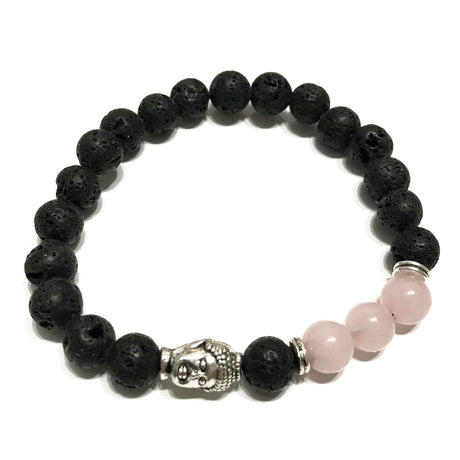
The one real caution with amethyst has nothing to do with soft cloths and everything to do with its chemistry. The same combination of iron and irradiation that gives the stone its colour can be partly undone by heat and by strong light held for long periods, which is why a piece left for months on a sunlit windowsill can fade noticeably while one worn daily, tucked under a sleeve or kept in a drawer between wears, tends to hold its depth for years. That is really all the care it asks: keep it out of prolonged direct sun, and otherwise treat it as the tough, forgiving stone it is. Worn as an amethyst bracelet worn against the wrist each day, it is quietly present through ordinary hours rather than saved for occasions, which suits a stone whose real history was never about occasions at all. It was quarried, carved, worn, argued over by poets and naturalists, ranked among the great gems and then made common, long before anyone thought to fix it to a month on a calendar. Wear it, or give it, knowing the calendar is the newest part of the story, not the oldest.