Five real questions land in this column more often than most. Here they are, answered as plainly as I can manage, without the countdown clock.
Is five minutes actually enough, or is that just something people say to sell a planner?
Honestly, no. Five minutes will not undo a day that ran hot, and it will not repay sleep you owe yourself from three nights ago. If that is the claim, it is the wrong claim.
What five minutes can do is smaller and more useful: it can mark the day's actual end. Most evenings do not end. They just thin out, one browser tab and one half-finished thought at a time, until you are lying down without ever having decided the day was over. Five minutes, held with attention, draws that line yourself instead of letting the evening draw it for you. It does not need to be five, either. Two minutes does the same work, provided it is genuine: a junction is still a junction if you cross it quickly, as long as you notice that you have crossed it. What matters is not the length of the pause but the fact of it, the decision, made again, that the working part of the day has ended.
What do I actually do in five minutes, and do I need candles, a bath or an app for it?
You need none of those, though any of them can serve if you already reach for them. What you need is a moment that is genuinely yours, repeated enough times that your body starts to recognise it.
There is an old word for this hinge in the day. In Sanskrit, sandhya means twilight, and it comes from sandhi, a junction or a joining. It names the meeting of day and night, not a time on a clock. In Vedic and later Hindu daily practice, the day was traditionally marked at these junctions, dawn, midday and dusk together called trisandhya, with brief prayer or recitation. What is actually said or done at that point has always varied a great deal by region, household and lineage; no single version of it is the only true one. Lighting a lamp or a stick of incense at dusk is a widely observed part of this marking in many Hindu households, though it is a tradition rather than a rule that binds every practitioner.
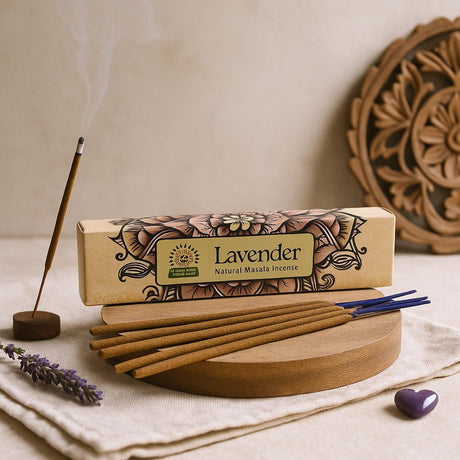
My own evening close is plain, and I offer it as one honest example, not a script to copy. I light incense and let it catch and settle. I sit for a short round of japa with a mala, moving one bead at a time until the round is done. Then I make tea and let it go from too hot to drinkable while I do nothing else at all. None of that is a technique for falling asleep faster. It is simply the shape my own junction has taken, repeated enough evenings that my mind now recognises it as the day's edge.
Yours does not need incense or a mala. It could be washing one cup by hand, standing at a window while something cools, or sitting with the lights off for the length of one song. The object matters less than the repetition. Choose one thing and let it be the same thing most nights, so your attention learns what it means without you having to explain it to yourself each time.
Sandhya itself was never fixed to a number on a clock; it names the meeting point of day and night, and that point moves with the season and the day's own shape. Some nights your junction will fall at nine. Some nights later, earlier, or halfway interrupted by whatever the day still owes you. What stays constant is not the hour but the marking itself, the fact that you drew a line somewhere and noticed yourself crossing it. Keep incense and a mala if that is what you keep. Keep a cooling cup by a window and nothing else if that is closer to true. Either is enough, provided it is genuinely repeated and genuinely yours.