A geode the size of a watermelon, split open on a workbench in Ametista do Sul, looks like a mistake of nature correcting itself. The outside is grey basalt, as unremarkable as a river stone. The inside is a cathedral of violet points that took roughly 130 million years to grow. This is a guide to where they come from, how they are found, and what it means to hold one.
What the Lava Left Behind
The amethyst deposits of Rio Grande do Sul, Brazil's southernmost state, are not a geological accident so much as a very slow collaboration between fire and water. During the Early Cretaceous period, approximately 130-135 million years ago, among the largest known volcanic events in Earth's history flooded the region now known as the Paraná Igneous Province with successive waves of basaltic lava. As each flow cooled, gases trapped inside formed bubbles, vesicles, sealed within the hardening rock.
Over millions of years, silica-rich hydrothermal fluids percolated through fractures in the basalt and into those sealed cavities. Quartz crystals grew slowly inward from the walls, layer by layer. The violet colour that distinguishes amethyst from ordinary quartz comes from iron impurities within the crystal lattice, activated by natural irradiation over geological time. The precise shade, from pale lilac to deep Siberian purple, depends on iron concentration and the temperature history of that particular pocket of rock. No two geodes are identical, because no two vesicles shared exactly the same conditions.
The Paraná Basalt plateau extends across parts of Brazil, Argentina, Paraguay and Uruguay, but the gem-quality amethyst deposits are concentrated in the Brazilian portion, particularly in Rio Grande do Sul. The geology was right here in a way it simply was not elsewhere along the same formation. It is worth noting that the precise boundaries of gem-quality concentration are still a matter of ongoing geological survey, the region's full extent is better understood than its exact limits.
Ametista do Sul and Planalto: The Heart of the Trade
The municipality of Ametista do Sul sits in the Alto Uruguai region of Rio Grande do Sul, and its name, literally "Southern Amethyst", was formally adopted in 1992, though mining activity in the region dates to the early twentieth century. The neighbouring municipality of Planalto is also a significant producing centre. Together, these two communities are among the leading sources of commercially available gem-quality amethyst, alongside deposits in Uruguay, Zambia and parts of southern Africa.
The mines themselves are not the open-pit operations one might imagine. Many are low horizontal tunnels cut into hillsides, following the basalt seams where geodes are most likely to occur. Miners work by headlamp in narrow passages, reading the red clay walls for the subtle signs, a change in rock density, a particular formation, that suggest a geode pocket nearby. When a cavity is found, it is opened carefully. The outer shell gives nothing away. Only the split reveals what is inside.
Cathedral geodes, the largest formations, can be big enough for a person to stand inside. The term is used commercially and descriptively rather than as a formal mineralogical classification, but it captures something real: the interior of a large amethyst geode does bear a structural resemblance to a vaulted Gothic nave, with crystal points rising from every surface toward a hollow centre.
The Gaúcho Mining Tradition
Alongside larger cooperative and industrial operations, artisanal miners known as garimpeiros have worked these deposits for generations. The craft knowledge involved in assessing and splitting a geode is not written down in any manual. It passes through families and communities: how to read the weight of an unbroken geode, where to strike it, how to judge the quality of the crystal interior by the depth and evenness of its colour, the clarity of its points, the absence of internal fractures.
A fine cathedral geode is distinguished from a commercial one by criteria that experienced hands recognise immediately and that are genuinely difficult to articulate. The colour should be consistent rather than zoned unevenly. The points should be well-formed, not stubby or clouded. The matrix, the basalt base from which the crystals grow, should be stable. Much of this assessment happens in a matter of seconds, the result of years of handling.
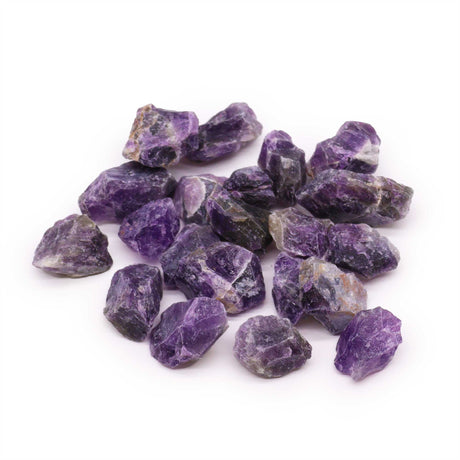
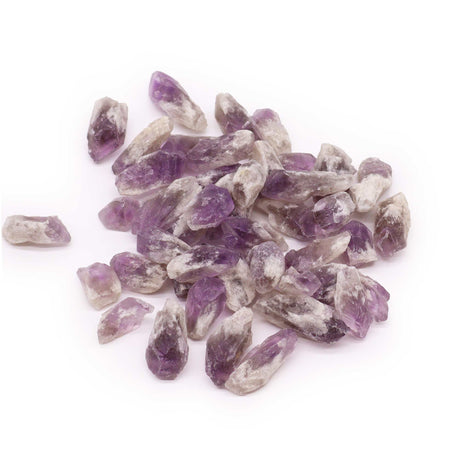
The trade that flows outward from Ametista do Sul and Planalto reaches collectors, retailers and practitioners across the world. A raw amethyst raw crystal points sold in London or Bengaluru almost certainly began its journey in one of these red-clay tunnels, assessed by someone who knew exactly what they were looking at.
Holding as Practice: The Attention Anchor
In Ayurvedic and broader South Asian traditions, amethyst is associated with the Ajna and Sahasrara chakras, the third eye and the crown, and is traditionally reached for in connection with clarity and inward attention. Western crystal traditions carry similar associations. These are the meanings a long lineage of practitioners has brought to the stone; they are worth knowing, not because they settle any question, but because they shape the quality of attention one brings to the object.
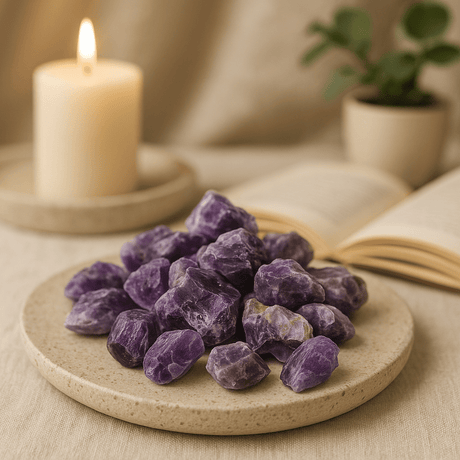
There is a simpler, more concrete practice available to anyone, regardless of their relationship to those traditions. Take a raw amethyst point in your hand. Notice its weight, which is more than you expect. Notice the temperature, which is cooler than your palm and stays that way for longer than seems reasonable. Run a thumb across the faces of the crystal: the flat termination, the slight ridges along the prism edges, the rougher matrix at the base where it was separated from the geode wall.
This is not a healing protocol. It is an attention practice in the most literal sense: the object's specific physical qualities, weight, temperature, texture, are sufficiently distinct from the surfaces of ordinary life that they interrupt the autopilot. The mind, briefly, has nowhere else to go. An amethyst japa mala works on a related principle, the repetition of touch across 108 beads providing a structure for sustained, unhurried attention.
What changes when you know where the stone came from is the quality of that pause. A specific cave in the Alto Uruguai region. A specific lava flow, 130 million years old. A specific garimpeiro who read the clay wall correctly. The object in your hand is the end of a very long chain of particular events; holding it with that knowledge is a different act from holding it without.
What It Means to Own a Piece of Serra Geral Basalt
A geode on a shelf in a flat in London or Bengaluru does not ask to be understood. It does not require that you know the Paraná Igneous Province or the name of the municipality where it was found. It simply sits there, violet and patient, doing what it has done for 130 million years: existing with a completeness that has nothing to do with being observed.
But the knowledge is available, and it changes something. The grey outer shell that most people find unremarkable is the same basalt that covered much of a continent during the Cretaceous. The colour inside is iron, irradiated over geological time. The hollow that made the crystal possible was a gas bubble in cooling lava, sealed before the first human being existed.
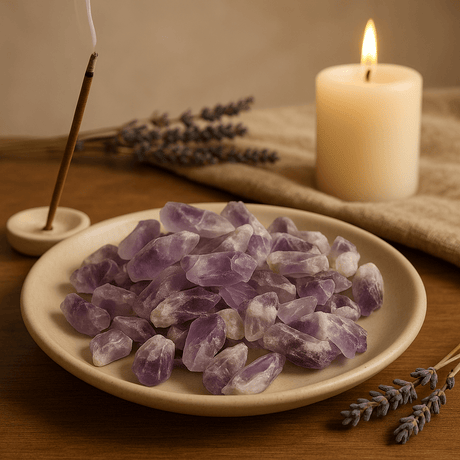
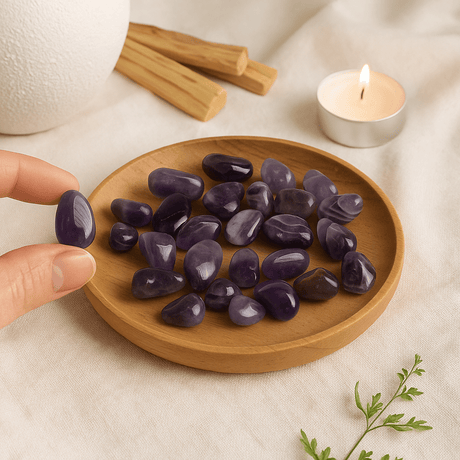
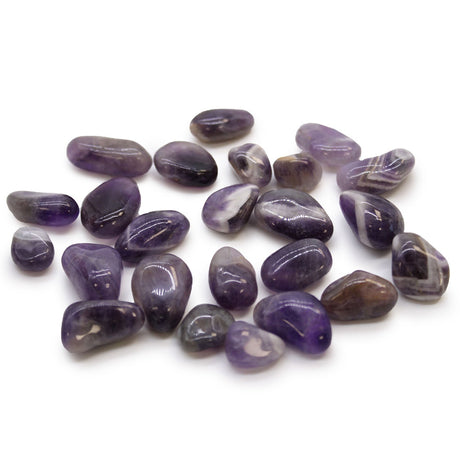
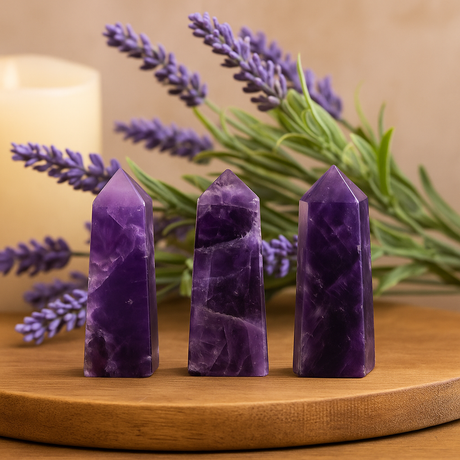
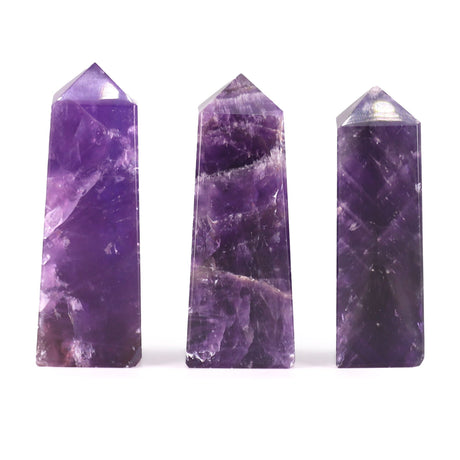
Slow living, at its most honest, is not about acquiring beautiful objects. It is about the quality of attention brought to whatever is already present. A piece of tumbled amethyst stones on a windowsill, or an amethyst crystal tower on a desk, is an invitation to that quality of attention, not a guarantee of it. The geode does not do the work. It simply makes the work easier to begin.
That is, in the end, what any good object does: it waits, with more patience than you have, until you have some attention to spare.