Somewhere behind the ordinary word "curfew" is a bell, and behind the bell is an instruction nobody enforces any more: cover the fire before you sleep. The instruction is gone. The small evening decision it used to make on everyone's behalf, whether a room stays lit or is allowed to go dim, has quietly become a private one, made at a wall switch, without ceremony, most nights without a thought at all. This piece is about giving that decision back a little of its old shape.
The bell that told a town to cover its fire
A curfew was once a literal instruction, not a punishment. The word comes from the Old French couvre-feu: cover the fire. In towns built largely of timber, a bell rang at a fixed hour each evening, and at that signal households covered or put out the fire burning in the hearth, a fire-safety measure that stopped one carelessly banked flame from taking a whole street with it while everyone slept. The bell did not care whether anyone found the dark cosy. It cared that the town woke up in the morning.
No bell rings for that any more. What is left is a switch on the wall, and the decision it makes almost too easy: flick it up, and a room fills evenly with light from above, at whatever hour suits you, for as long as you like. The choice of when a room settles into evening, and how, has moved from the town to the person standing by the door. It is worth noticing that it moved there at all, rather than treating it as no choice.
Tanizaki and the material of shadow
The Japanese novelist Jun'ichirō Tanizaki wrote about a version of this same shift in 1933, in an essay usually known in English as In Praise of Shadows. He was not being sentimental about candles. He wrote about lacquerware, and how its gold decoration was designed to be seen catching stray, low light in a dim room rather than lit flat under a bulb; about traditional rooms built to hold shadow in their corners the way another room holds furniture. When bright electric lighting arrived from the West, he argued, it did not simply illuminate those rooms and objects. It changed what they were for. Shadow, in his account, was a material a room was built with, not an absence waiting to be corrected. The complete English translation, by Thomas Harper and Edward Seidensticker, appeared decades later, in 1977, but the argument had already outlived the room it was written about.
The lamp at sandhya
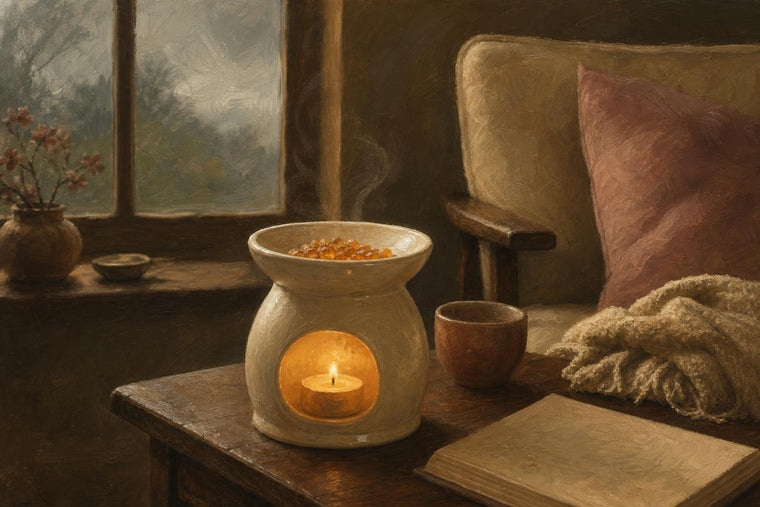
In the house where I keep my own practice, dusk has a name before it has a mood. Many Hindu households mark it as sandhya, one of the day's traditional junctions, and lighting a lamp or a stick of incense at the altar around this hour is an ordinary habit rather than a special occasion; practices vary between households, but the small gesture is a common one. I rarely reach for the overhead light at that hour, because there is already a flame doing the work of telling the day it has turned. It is practical as much as anything: enough light to move around the room safely, and no more, so the room settles rather than snapping straight into evening the way a ceiling bulb does.
What to light instead, room by room
None of this argues for sitting in the dark. It argues for choosing where light comes from, and how warm it is once it arrives. A single flat source overhead, especially a cool white bulb, sits nearer the blue end of the scale; bulbs sold as "warm white" commonly sit around 2700K, a lower, more amber number that reads as evening rather than midday. The difference is easy to feel for yourself, room by room.
- Living room: a lamp or two at seated height, rather than one source from the ceiling, so light falls where people are sitting rather than where the wiring happens to be.
- Bedroom: something low and warm near the bed rather than a fixture switched on from the doorway; a warm light for a bedroom set at bedside height can do this without waking the whole room up.
- Kitchen: keep the overhead light while there is real cooking to see by, and let it go once the washing-up is done and the room has nothing left to ask of your eyes.
- Hallway: a lamp at one end rather than a bright strip overhead. A hallway rarely needs daylight; it needs enough to walk by.
The salt itself
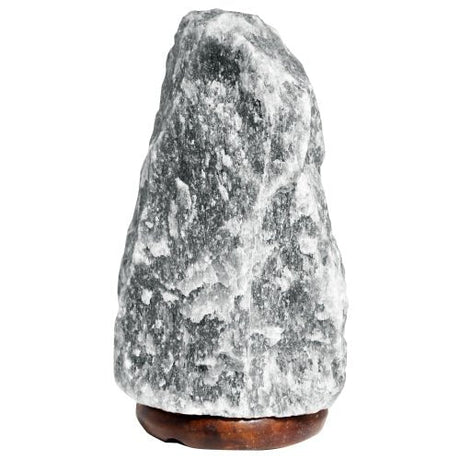
One object that turns up often in a room lit this way is cut from rock salt rather than glass or ceramic. Himalayan pink salt lamps come from deposits at Khewra, in the Jhelum district of Punjab, Pakistan, part of the wider Salt Range. The rose-to-terracotta colour running through the stone comes from trace iron-oxide minerals, mainly haematite and goethite, held within the halite crystal itself. Light it from inside with a small bulb and the glow reads warm and uneven, closer to firelight seen through a window than to a bulb looked at directly, because the light is passing through stone and picking up colour on the way. A Himalayan salt lamp works this way regardless of size; a salt lamp with a wooden base simply sits lower, nearer a shelf or a side table, which suits a room where the glow wants to sit at eye level rather than up near the ceiling.
There is no bylaw left telling anyone which light to leave on after dark, and the switch by the door makes the choice feel automatic: up for light, down for none. But a switch only has two positions, and a room has more moods than that. The habit worth keeping from the old bell is not the darkness itself, but the single small decision it forced on a whole street at once: pick, on purpose, which flame in the house still wants covering for the night, and which one has earned the right to keep burning.