

A dream catcher is a hoop with a woven web, first made by the Ojibwe people of North America to hang over a sleeping child. In the tradition, bad dreams are caught in the web and fade with the first morning light, while good dreams slip through the hole at the centre and down to the sleeper. Hang it above the bed or in a window where the dawn can reach it.
In brief
- The meaning: a protective web, from the Ojibwe legend of the Spider Woman, Asibikaashi.
- Where to hang it: above the bed or by a window that gets morning light; small ones in a child's room or on a car mirror.
- Every dream catcher on our shelves is made without real feathers: cotton, rattan, macramé and fabric tassels.
 Dreamcatcher16 pieces
Open →
In this guide 7
Where the dream catcher comes from
The dream catcher belongs to the Ojibwe, also called the Chippewa, of the Great Lakes. Their word for it, asabikeshiinh, means "spider", and its story is the story of Asibikaashi, the Spider Woman, who watched over the people and above all over infants. As the nation spread across the land she could no longer reach every cradle, so mothers and grandmothers began weaving webs for her: willow bent into a hoop, sinew or nettle twine knotted across it in the pattern of a spider's web, a small hole left in the middle.
Traditional Ojibwe dream catchers are small, a few inches across, and were meant to wear out: the willow dries, the hoop breaks, and the child has grown. During the Pan-Indian movement of the 1960s and 1970s other nations, Lakota, Cherokee, Navajo, took the dream catcher up as a shared sign of Native identity, and from there it travelled into homes all over the world.

What each part means
| Part | Traditionally stands for |
|---|---|
| Hoop | the circle of life, the turning of the sun and moon across a day |
| Web | the spider's protection; it holds bad dreams until the light dissolves them |
| Centre hole | the way through for good dreams |
| Hanging tassels | breath and air, a soft path for good dreams down to the sleeper |
| Beads | in some tellings, the spider herself, or the good dreams the web has caught |
| 5 points | a star |
| 7 points | the Seven Fires prophecy of the Anishinaabe |
| 8 points | the spider's eight legs, and Asibikaashi |
| 13 points | the thirteen moons of the year |
The meanings of the points and colours come from modern craft, not from one fixed Ojibwe code, and makers differ. The colours follow the same loose language: black for protection, white for calm, red for vitality, blue for rest, green for growth, yellow for new beginnings. Choose the shade you will like waking up to.
 Next: The Mystical Tree of Life: Exploring Its Symbolism and SignificanceHome · 7 min read

Where to hang a dream catcher
The tradition puts it over the place you sleep, where the first light falls on it. Beyond that, these are the spots people choose most, with the size that suits each.
-
1
Above the bed
The traditional place
Hang it from the ceiling or the wall over the headboard, close enough to see when you lie down. A piece of about 50 cm fills the space above a double bed without crowding it.
 Dream Catcher Large 55cm Pastel RainbowSee it →
-
2
In a bedroom window
Where the dawn reaches it
An east-facing window catches the morning sun the legend relies on, and a natural-coloured hoop looks right against the light.
 Dream Catcher Handmade Feather-Free Vegan BalineseSee it →
-
3
In a child's room
What it was first made for
The first dream catchers hung over cradles. Hang a small one out of reach, above the cot or bed, and tell the child the spider's story at bedtime: it is a good one.
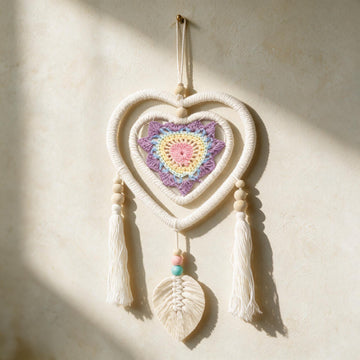
 Dream Catcher Pink Double Heart Feather FreeSee it →
-
4
On a living-room wall
A statement piece
In a shared room a very large dream catcher works as wall art; at well over a metre long it reads from across the room.
 Dreamcatcher Rainbow Wall Hanging 140cmSee it →
-
5
In a meditation or reading corner
Something to rest the eye on
Hung at eye level beside a cushion or chair, the slow turn of the web in moving air gives the eyes somewhere soft to settle.
 Dream Catcher Brown No Feathers Handmade In BaliSee it →
-
6
On the car mirror
A small one for the road
A mini dream catcher of around 10 cm hangs from the rear-view mirror without blocking the view. Keep it short so it does not swing into sight.
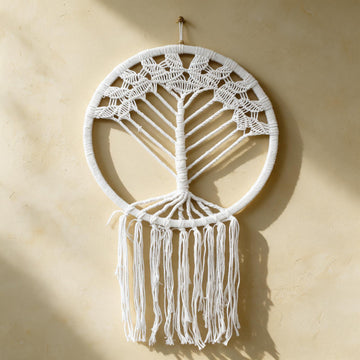
 Dreamcatcher Macrame Tree of Life 12cm, 6 PackSee it →

Living with one
A dream catcher works best as part of a bedtime ritual: dim the lights, look at it for a moment, name the kind of night you would like. The slow turning of the tassels in the night air is a small signal that the day is over. Some people add a candle or a stone to the same corner; our guide to the crystal to sleep with picks up from there, and a salt lamp gives the same corner a low, warm light.
Is it respectful to own a dream catcher?
Yes, when you know where it comes from. The dream catcher is an Ojibwe object that became a shared Native American sign, and many Native artists make and sell them today. Respect means knowing the story, not passing off a decorative piece as a sacred one, and buying from Native makers when you want the traditional object. Many of ours are handmade in Bali, inspired by the form; they are not Ojibwe objects and we do not sell them as such.
How to care for a dream catcher
- Dust it every few weeks with a soft, dry paintbrush or a hairdryer on cool, held at arm's length.
- Keep it dry. Cotton, rattan and willow do not like damp; keep it out of bathrooms and let it air-dry if it gets wet.
- Straighten the web by hand if a strand slips; a dab of clear glue holds a loose knot.
- Store it flat in tissue paper, away from sunlight, when it is not hanging.
Making your own
A dream catcher is an easy first craft. Bend a willow twig or take a metal ring of 10 to 20 cm and wrap it in cotton cord. Tie the string at the top and work around the hoop in loops, half-hitching every few centimetres, then keep going round the inside of the first loops so the web tightens towards the centre, threading a bead or two as you go. Leave a hole the size of a fingertip in the middle. Finish with tassels of cotton, wool or faux feathers: no real feathers needed.




 United Kingdom
 China
 India
 Mexico