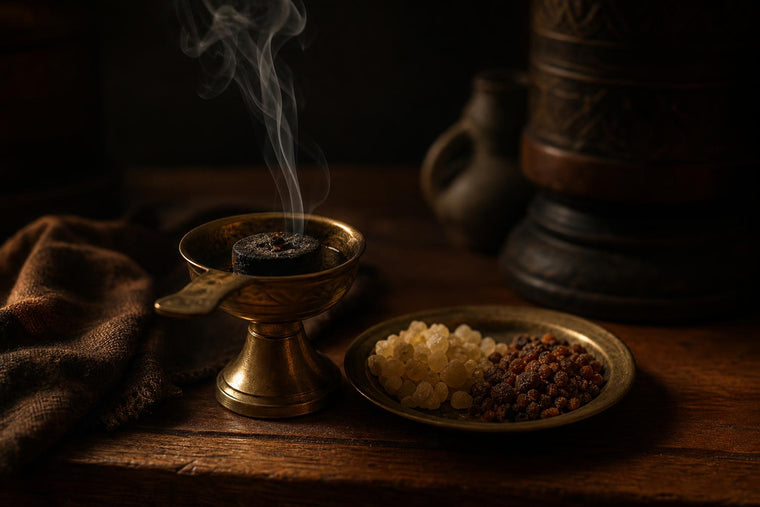
Readers write in with practical questions about scent and practice. Alex answers the ones that keep returning to his inbox, because they deserve a real answer.
The oil, the method, and what most guides skip
I keep reading lavender for calm, peppermint for focus. Is it really that simple?
Not quite, and the part that gets left out is usually the most useful. The oil matters, yes. But the method of use changes the experience of the same oil more than most guides acknowledge.
Diffusion disperses volatile molecules into a room gradually, at low concentration. You are breathing a gentle ambient presence. Direct palm inhalation (one drop on the palms, cupped over the nose and mouth) delivers a concentrated, immediate dose; the effect is faster and more pronounced. Diluted application on pulse points in a carrier oil produces something slower still: a skin-warmed release that follows you through the hour. These are not interchangeable. The same lavender oil in each mode produces a qualitatively different quality of attention.
So before asking which oil, it is worth asking: what kind of moment is this? A room you want to settle into over an evening calls for a diffuser. A sharp, present pause in the middle of the afternoon calls for the palms. A slow-release intention you carry into a meeting or a practice session calls for the wrists. The oil is the same; the experience is not.
Peppermint is a useful example here. Its primary constituent, menthol, activates cold-sensitive receptors in the nasal mucosa, which is why direct inhalation feels clarifying and immediate in a way that diffusing it across a large room does not. The physiological mechanism is real; the method determines whether you reach it.
Does the origin of the oil actually matter, or is that just marketing?
Origin affects chemical composition in documented ways, and that is worth understanding plainly. Bulgarian lavender (Lavandula angustifolia) grown at altitude in the Kazanlak region is a well-documented source for high linalool and linalyl acetate content: the two compounds most associated with lavender's characteristic softness. Linalool content in quality Bulgarian lavender oil typically ranges from approximately 25 to 38 percent per ISO 3515, depending on harvest year and altitude. A lavender oil from a lower-altitude or different-cultivar source can smell adjacent to this and behave differently under the nose.
This is not snobbery. It is the difference between an oil that does what the tradition says it does and one that merely resembles it on the label. When you are using an oil as part of a daily practice, as I do with incense and sometimes a drop of something on the wrists before japa, the quality of the material is part of the practice. A thin or adulterated oil does not carry the same weight of attention.
The honest answer is: origin is one signal among several. Look for oils that name the botanical species (Lavandula angustifolia, not just "lavender"), the country of origin, and ideally the distillation method. Steam-distilled from the flowering tops is the standard for lavender. Beyond that, your nose is a reasonable guide once you have smelled enough of them.
On vetiver: what it actually is
I want something grounding. Vetiver keeps coming up, but I have no idea what it actually is.
Vetiver (Chrysopogon zizanioides, syn. Vetiveria zizanioides, called khus or khus-khus in much of South Asia) is a perennial grass native to India. The essential oil comes not from the leaves but from the roots, which are harvested after a minimum of 18 to 24 months of growth, a slow process that partly explains the oil's density and tenacity on the skin. It is steam-distilled from those roots, and the result is a notably heavy, tenacious base note in natural perfumery.
The scent is earthy, smoky, and faintly sweet, with a quality that is difficult to describe without smelling it: something between damp soil after rain and the interior of an old wooden room. It is nothing like the clean, abstract "grounding" that most product pages promise. It is specific and particular, and some people find it immediately settling; others need time to meet it.
Its history in India is long and practical. Khas mats, woven from vetiver roots, were traditionally dampened and hung in doorways or windows as an evaporative cooling system, the scent released as air passed through them. The practice predates mechanical refrigeration and is documented in colonial-era accounts as well as earlier Indian sources, though it is worth noting that the trade in vetiver roots and oil has historically attracted adulteration, and quality varies considerably depending on origin and distillation practice. In Ayurvedic texts, vetiver appears as ushira, valued for its cooling (sheeta) and stabilising properties, used in formulations for heat-related conditions and as a component of cooling pastes. The Charaka Samhita references it in this context. The association with steadiness, in other words, is not a modern spa invention; it has a long and specific lineage.
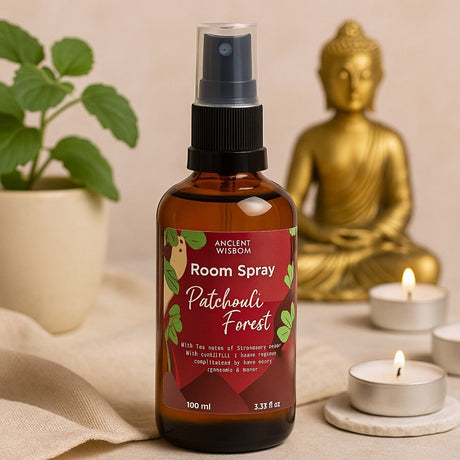
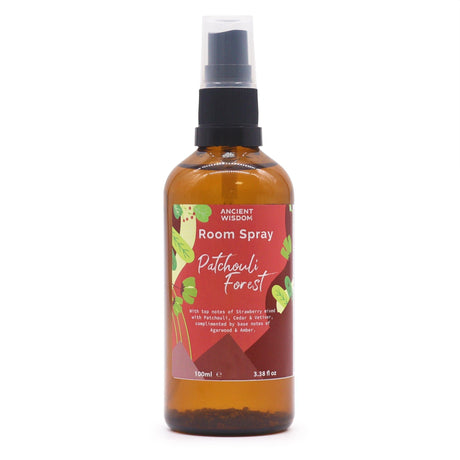
How to use it: vetiver is strong, and a little is enough. One drop on the wrists or sternum, diluted in a carrier oil, is a reasonable starting point. In a diffuser, a single drop alongside a lighter oil keeps it from becoming overwhelming. A vetiver and patchouli smudge follows the same logic: the two anchor each other, both being slow, resinous base notes with traditional use in South and Southeast Asian contexts. If you want the scent in a room without committing to a diffuser session, a room spray with vetiver lets you introduce it lightly.
Whether it steadies you is yours to discover. The oil accompanies the intention you bring to it; the work remains with the person holding it.
On blending, and knowing what you are working with
Can I mix oils for different moods, or does that muddy the effect?
You can, and there are pairings with genuine traditional precedent. But the practical advice for anyone new to working with oils is: two at most, and only once you know each one individually. The reason is simple. If you blend three oils and something shifts in your attention or your body, you have no way of knowing which one is doing what. You lose the ability to learn from the experience.
Pairings that make sense and have some grounding in tradition: vetiver and patchouli, both slow and tenacious, both with long histories of use in South and Southeast Asian ritual contexts. Lavender and frankincense is another combination worth exploring. Lavender's softness alongside frankincense's mild, resinous alertness produces something that is neither purely calming nor purely focusing, which is sometimes exactly what a practice session needs. Frankincense oil is steam-distilled from the resin of Boswellia trees; Boswellia serrata is the Indian species used in Ayurveda, while the frankincense most associated with ritual use, including in incense traditions across the Middle East and East Africa, is typically Boswellia sacra. Both are real; they are simply different trees with overlapping but distinct histories.
If you are building a small collection and want to understand what each oil does before blending, a well-chosen essential oil set gives you the range to work with.
The word "aromatherapy" was coined around 1928 by French chemist René-Maurice Gattefossé and published in his 1937 book of the same name, but the ritual and practical use of aromatic plants runs through many cultures long before that word existed. The clinical lineage and the traditional lineage are distinct; both are real. What they share is the understanding that scent is not passive: it asks something of the person who reaches for it.