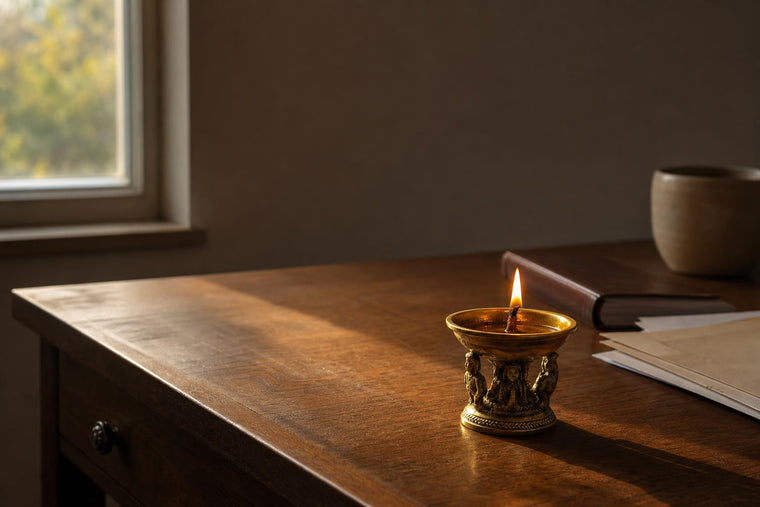
A small terracotta dish, a candle, a few drops of oil, and water. The oil burner is one of the quietest objects in a home, and one of the most misunderstood. This is its story: where it comes from, what it is made of, and how to live with it well.
The Object in Your Hand
Pick up a traditional Indian oil burner and the first thing you notice is the weight: not heavy, but present. The terracotta body has a density that plastic and resin never quite achieve, a warmth that comes from the material itself before any flame is lit. The upper dish is shallow and unglazed, its surface slightly rough to the touch, the colour of dry earth after rain.
That unglazed finish is not a shortcut in the making. It is the point. Unglazed terracotta is porous; the same quality that allows a clay water pot to keep its contents cool through gentle evaporation also slows the release of essential oil vapour from the dish above a candle. Where a glazed or metal surface would flash the volatile top notes of an oil into the air almost immediately, the porous clay holds them back, releasing the scent in a longer, quieter arc: a bright opening, a rounder middle, a dry-down that lingers. The form has persisted across centuries not because it is traditional but because it works.
Where It Comes From
The potters who make these objects are called kumbhars, from the Sanskrit kumbha, meaning pot. Across India, and particularly in Rajasthan and Uttar Pradesh, kumbhar communities have worked the wheel for generations, producing the full range of clay domestic life: water vessels, storage jars, ritual lamps, diyas. Khurja has long been a centre of ceramic production, with records dating to at least the early modern period, supplying both glazed and unglazed ware across the subcontinent. Jaipur's potters are known for their painted blue-glazed work, but the unglazed tradition runs alongside it, quieter and older.
The forming technique for an unglazed oil burner dish is essentially the same as for a water pot: hand-thrown on a kick wheel, shaped while wet, dried slowly in shade to prevent cracking, then low-fired in a kiln. The low firing temperature is what preserves the porosity. A higher-fired stoneware or porcelain would vitrify, closing the pores and losing the quality that makes the dish function as it does. The potter's choice of temperature is, in this sense, also a choice about how the object will behave in your home, months later.
Much of this work is done in small family workshops rather than large factories, and practices vary considerably between communities and regions. What holds across most of the tradition is the material logic: clay, wheel, shade, kiln, and an unglazed surface left open to the air.
The Tradition It Carries

The oil burner's direct ancestor in Indian domestic life is the diya: a small, shallow clay lamp that holds oil and a cotton wick. The diya is both a ritual object and an everyday one; in many households it is lit at dusk as a matter of course, not only on festival days. The logic of a clay vessel holding aromatic oil over a heat source is ancient and practical, and it appears in parallel forms across many cultures. Moroccan mabkhara clay incense burners use charcoal and resin; Japanese kōdō heats aloeswood over ash-buried charcoal without combustion. The impulse to warm an aromatic substance gently, to let scent move through a room slowly, is not exotic. It is one of the most widely shared domestic instincts across cultures.
The modern oil burner, with its separated heat source below and water-and-oil dish above, is a secular domestic adaptation of this older form. The sacred and the everyday have always been close in Indian material culture; the transition from ritual lamp to aromatic diffuser is less a departure than a quiet continuation. I keep a ceramic oil burner on the shelf near where I do my morning practice, and the scent that rises from it has become part of the texture of that time: not because the object performs any hidden work, but because I have made it a consistent part of attention.
How to Live With It

The practice is simple, and the order matters. Fill the dish with water first, to roughly two-thirds depth, before adding oil. Three to five drops is a reasonable starting point. Essential oils are not water-soluble; they float on the surface, which means even distribution is not necessary. What the water does is act as a thermal buffer: it absorbs heat from the tealight below and prevents the oil from reaching flash-vaporisation temperature too quickly. Add too little water and the top notes burn off almost immediately, leaving only the heavier base. Add the right amount and the scent unfolds over the full life of the candle.
Oils like lemongrass or sandalwood behave differently in the dish: lemongrass is sharp and volatile, its top notes brief and vivid; sandalwood is slower, its base notes dominant, the dry-down long and warm. Blends such as cinnamon and orange layer a resinous base under a bright citrus opening. The water buffer is what lets you experience both rather than only the first. Once you understand the scent arc, you begin to read it: the shift from top to middle notes is the burner's way of telling you the session is settling in.
Place the tealight in the chamber beneath the dish and light it after the water and oil are already in place. A standard tealight burns for roughly three to five hours. If you want to extend the session, top up with warm water, not cold. Adding cold water to a hot dish creates thermal shock, and unglazed terracotta, for all its virtues, does not forgive sudden temperature changes. Warm water, added carefully, lets the session continue without interruption.
Care and the Long Life of the Object

An unglazed terracotta dish asks for very little, but what it asks for is specific. After use, let it cool completely before touching it. Rinse with plain cool water and wipe with a soft cloth. Do not use soap or detergent: surfactants penetrate the open pores and leave a residue that alters subsequent scents and, over time, can block the porosity that makes the dish work as it should. Dry it fully before the next use; a damp dish over a flame will steam rather than diffuse.
What shortens a burner's life is almost always thermal shock or soap residue. What extends it is simply attention: water in the dish before the flame is lit, warm top-ups rather than cold ones, a gentle rinse and a full dry between sessions.
One honest complexity worth naming: terracotta quality varies. Dishes made from finer-grained local clays and fired at consistent temperatures will hold their porosity and resist cracking far longer than those made quickly for the tourist trade. The difference is not always visible at purchase, but it becomes apparent over months of use — in how evenly the scent releases, and in whether the dish survives its first accidental cold-water rinse.
Over months of regular use, an unglazed terracotta dish develops a patina: a faint darkening, a layered scent memory from oils absorbed into the clay. This is not wear. It is the material recording its use, the way a well-used clay cooking pot seasons over time, or the way a mala takes on the warmth of the hand that holds it. The things we attend to consistently do not diminish. They deepen.