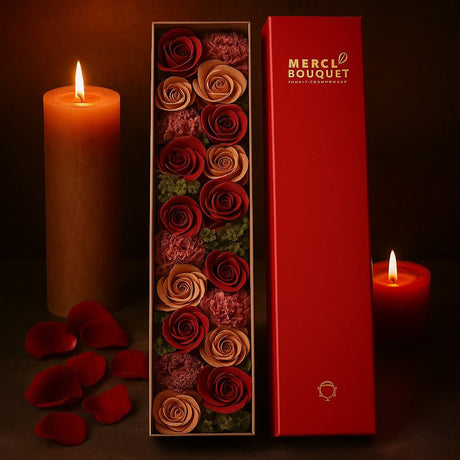
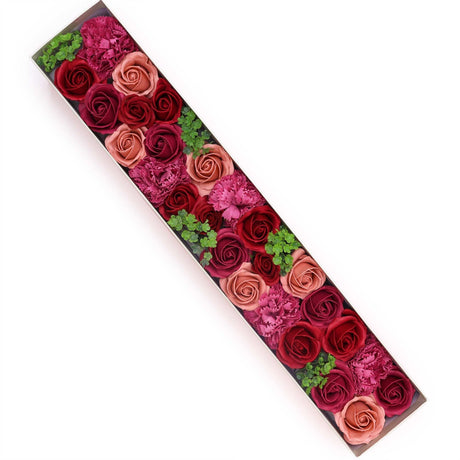
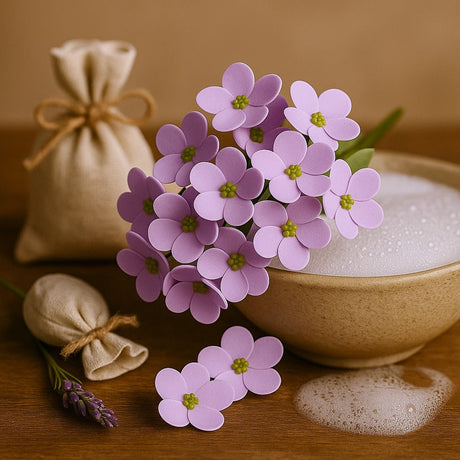
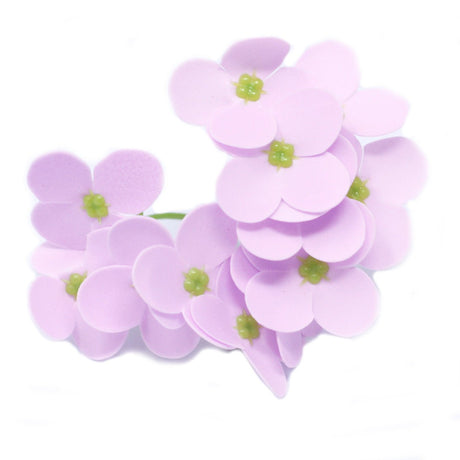
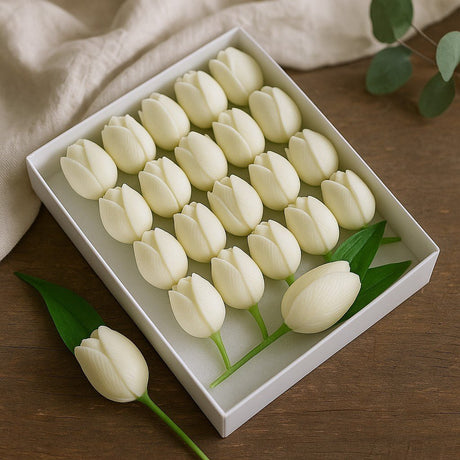
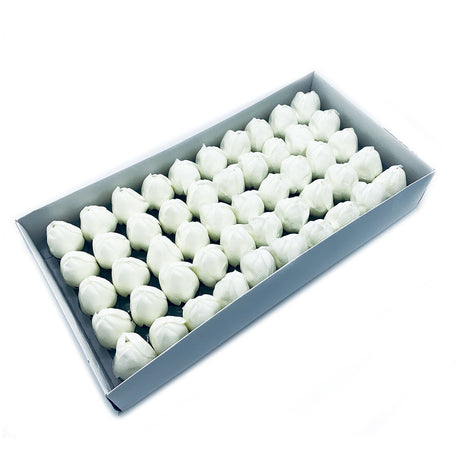
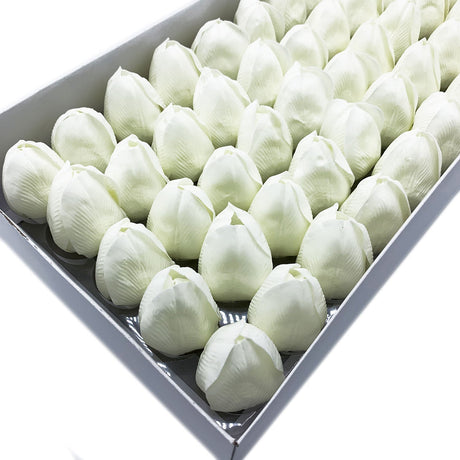
A cut flower lasts a week. A soap flower, kept on a shelf away from steam and sunlight, can hold its shape and scent for a year or more, and when the time finally comes, it lathers. That second life is not a quirk of the material. It is what the object was designed for.
A gift with a second life
Most gifts resolve themselves quickly. The wine is drunk, the chocolates finished, the candle burned to its wick. Cut flowers are the most honest version of this: they arrive in full bloom and spend the next ten days reminding you that beauty is temporary. There is nothing wrong with that. But it is a particular kind of gift, one that asks to be witnessed in its decline.
A soap flower works differently. It arrives as a display object and waits. It sits on a dressing table or an entrance shelf, holding its colour and fragrance across seasons, until the person who received it decides, consciously, on some ordinary Tuesday, to take it to the bathroom and use it. The gift does not expire; it transforms. That shift from display to use is not incidental to the object's meaning. It is the object's meaning.
In the slow-living gift economy, this dual nature places soap flowers in a category of their own: neither purely consumable nor purely decorative, but something that occupies both registers across time. Choosing one is a different act from choosing a bouquet. It asks the giver to think not just about the moment of receiving, but about the weeks and months that follow.
From royal court to gift box: the kra-bueang lineage

The carved-flower form has a traceable history that most gift guides do not mention. In Thailand, the tradition of carving fruits, vegetables and soap into intricate floral shapes is known as kae-salak, a branch of the broader decorative craft called kra-bueang. Documented from the Sukhothai period, the 13th and 14th centuries CE, it was practised at the royal court as an art of offering: carved forms presented at ceremonies, placed as table ornament, given as expressions of care and skill.
The craft was traditionally taught to ladies of the Thai royal court, and the knowledge passed through generations of practitioners. Today the Thai government recognises it as a form of intangible cultural heritage, and it is taught at craft institutions including schools in Chiang Mai. The transition from carved fruit and vegetable to carved soap was a natural one. Soap holds detail, takes colour, and carries fragrance in a way that a carved mango cannot sustain beyond a day.
The commercial soap flower that now appears in gift boxes across the world is a direct descendant of this court tradition. It became an export form from Thailand in the late 20th century and is now produced across Southeast Asia, often by artisans working within the same hand-rolling and petal-layering techniques the tradition established. When you hold a well-made soap flower bouquet, you are holding something with a longer lineage than its packaging suggests.
What makes a soap flower last
Not all soap flowers are the same material, and the difference matters both for longevity and for eventual use on skin. The distinction comes down to what the soap is made from.
Cold-process soap is produced by combining plant oils or butters with an alkali, sodium hydroxide, at low temperature. The chemical reaction, saponification, converts the oils into soap and produces glycerin as a natural by-product. In mass-produced commercial soap, that glycerin is typically extracted and sold separately. In cold-process and handmade glycerin soap, it remains in the bar. Glycerin is a humectant: it draws a small amount of moisture from the surrounding air, which is why glycerin soap flowers feel slightly soft to the touch and hold their fragrance considerably longer than harder alternatives.
The alternative is paraffin wax or synthetic resin, both of which are used to make decorative flowers sold under the same name. These contain no glycerin, produce no lather, and are not suitable for skin. They are purely ornamental, and their scent, if any, fades faster. The visual difference can be subtle; the material difference is complete. A cold-process or glycerin soap flower, kept in good conditions, retains its shape and fragrance for approximately one to three years. A paraffin imitation is a different object wearing the same name.
Rose is the dominant form in commercial soap flowers because the layered petal structure translates most naturally into the hand-rolling technique. Peony, lotus and cherry blossom are also common. The lotus carries particular resonance in South and Southeast Asian gifting contexts, associated with purity and offering in both Hindu and Buddhist traditions. Peony soap flowers carry their own weight: in many East Asian traditions, the peony is associated with prosperity and generous feeling, which makes it a natural fit for celebratory gifts.
The practice of keeping

Where you place a soap flower determines how long it lasts and how it behaves. The bathroom is the intuitive location, but it is also the worst environment for display. Steam accelerates the softening of glycerin soap, and humidity can cause the surface to weep slightly, distorting the petal edges over time. Direct sunlight fades the colour and, in oil-based soaps, can accelerate rancidity.
The better locations are a bedroom shelf, a dressing table, or an entrance console: cool, dry, away from direct light. In these conditions, the flower holds its form and releases its fragrance gently into the room. Not as a diffuser, but as a quiet presence, the way a well-chosen object tends to work. You notice it when you pass, and then you stop noticing it, and then one day you notice it again.
When a soap flower has been displayed long enough, when the occasion it marked has settled into memory, the person who received it can choose to take it to the bathroom and use it as soap. It lathers. It functions. This is not a consolation prize for an object past its prime; it is the second chapter the craft form was designed to have. Some people keep soap roses in a gift box for months before using them. Others display them until the scent has faded and then use them immediately. Both are correct. The choice belongs entirely to the person who received the gift.
Giving with intention

A soap flower given without context is a pretty object. A soap flower given with a sentence of explanation becomes something else: a considered choice, a small act of cultural transmission, a gift that the receiver can think about.
That sentence does not need to be long. A handwritten note that mentions the kra-bueang tradition, or simply notes that the flower is made from cold-process soap and will eventually lather, changes the register of the gift entirely. It moves the object from novelty to narrative. The receiver now holds something with a history and a future, not just a present.
The occasions that suit soap flowers are broader than the obvious ones. They work for birthdays and housewarmings, but also for quieter moments: a thank-you that deserves more than a card, a welcome gift for someone settling into a new home, a gesture toward someone who has been going through a long and difficult season. The longevity of the object makes it appropriate for occasions that ask for something that will stay.
Objects that outlast their occasion
There is a quality in objects that outlast their occasion, a patience that cut flowers, by their nature, cannot have. A soap flower placed on a shelf the day after a birthday, or a housewarming, or a difficult conversation, does not mark the end of something. It continues. It holds the fragrance of the moment that brought it there and releases it slowly, across weeks, into ordinary mornings. When the time comes to use it, that is not the object diminishing. It is the object completing what it was always meant to do.