Dear reader, before you choose a wind chime, look at the bottom edge of the glass. On a hand-blown Edo-style furin, that edge is left rough. Not sanded, not machine-finished, not smoothed into a neat circle the way most glassware is. The maker leaves it jagged on purpose, because a smooth rim gives one flat tone every time the clapper hits it, and a rough one breaks the strike into something softer and more layered, a small cluster of overtones instead of a single note. That single unfinished detail is most of what separates a chime that whispers from one that clangs, and almost nobody selling wind chimes tells you it is there.
What decides gentle or loud
Three plain mechanics do most of the work, before material ever comes into it. The sail, the flat piece hanging below the clapper that catches moving air, decides how much wind it takes to set the whole thing swinging: a large sail moves in a light breath, a small one waits for something stronger. Wall thickness in the bell or tube decides how bright or dull the strike lands, thin walls ring further, thick ones thud. And the weight of the clapper against the bell decides how hard each strike lands, regardless of how gently the wind pushed it there. A chime built from the softest material in the world will still clatter if its clapper is heavy and its sail oversized.
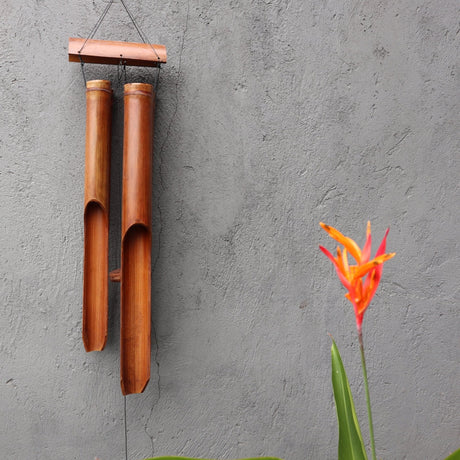
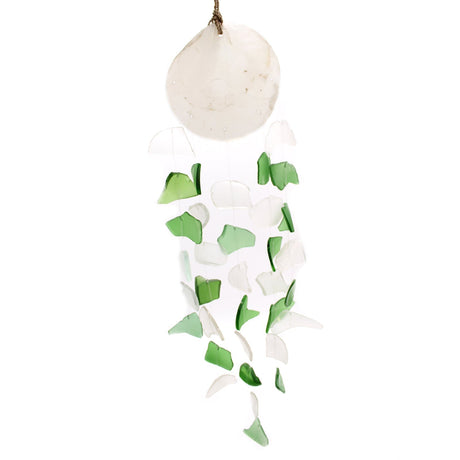
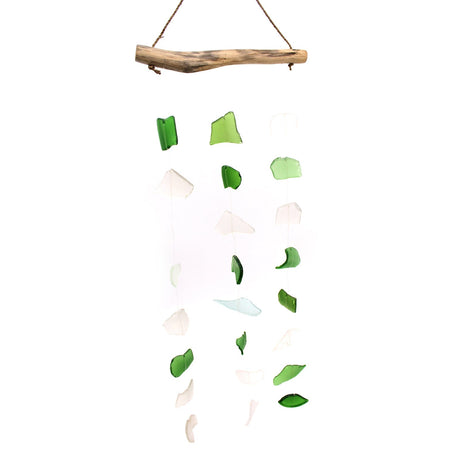
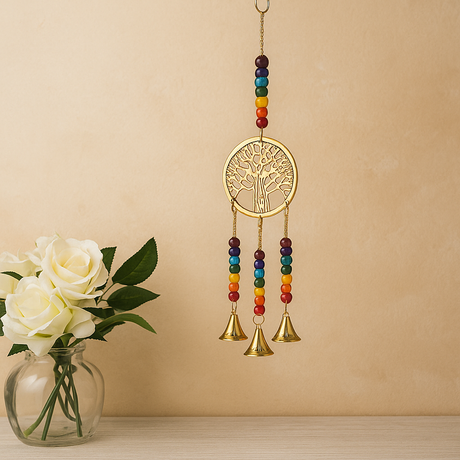
Once those proportions are fixed, material shapes the character of the sound rather than its volume. Bamboo gives a hollow, woody knock, the sound of two dry sticks rather than a bell. Solid wood mutes the tone further, felt in a room more than heard across a garden. Metal, cast or cut, carries brightest and furthest, and it is often the material people reach for when they want a chime heard across a whole garden rather than kept close. Glass gives a single, clear, comparatively short note, and its exact character depends on that unfinished rim mentioned above: a smooth-cut rim rings flatter and more repetitive strike after strike, while the deliberately irregular rim of a hand-blown Edo furin means the same bell never rings quite the same way twice.
A workshop in Edogawa Ward
That rough-rim technique is not folklore, it belongs to a living trade. Shinohara Furin Honpo, a family workshop founded in 1915 in Edogawa Ward, Tokyo, still shapes each glass bell by hand without moulds, one at a time, over an open flame. Its second-generation chairman, Yoshiharu Shinohara, is the person credited with giving these bells the name Edo Furin, around 1965, to distinguish hand-blown Tokyo work from the machine-made furin that had begun to fill shops elsewhere. He is reported to still blow glass alongside his son, Hiroshi, an ordinary working trade being carried from one generation into the next, in the way most trades are. The craft is a narrowing one: hand-blown glass furin take years to learn to make well, and only a small number of Tokyo workshops are still recognised as producing authentic Edo Furin by this method, Shinohara Furin Honpo among them, which is part of why a genuine hand-blown piece costs more than a moulded one and why fewer are made each year.
The paper strip is the real test
If you want a genuine way to judge gentleness before you buy, look at the paper strip hanging from the clapper, called a tanzaku, rather than at the bell itself. Its size and its weight, not the glass or the bamboo above it, decide how little wind it actually takes to set the chime moving at all. A large, heavier strip needs a proper gust to catch and swing; a small, light one will lift and turn in almost nothing, a breath crossing a window left ajar, and that turning is what pulls the clapper against the bell in the first place. So a chime with a small paper strip will tend to ring more often, and more softly, simply because it takes so little air to move it. This is a far more honest test than reading a material chart, because two glass furin of the same size can behave completely differently depending on what is tied beneath them.
Choosing something heavier, or somewhere quieter
Not every good chime is built to be quiet, and gentleness is a choice rather than a ranking. In Iwate Prefecture, furin are also cast in traditional Nambu ironware, solid metal rather than blown glass, giving a deeper, more resonant, distinctly metallic tone. Because the bell is cast rather than a thin blown shell, it generally needs a proper gust to sound at all, and answers with something closer to a low toll than a light chime's ring. Choosing a cast ironware chime, deeper and metallic, is not a lesser choice than choosing glass, it simply asks the object to do a different, less frequent kind of work: fewer sounds across a day, each one heavier.
Where a chime hangs matters just as much as what it is made of. Even the gentlest chime, hung where wind gathers and funnels, a narrow gap between two walls, a corner where draughts concentrate, will ring more than its maker intended. Hung somewhere air moves in from more directions and loses its force, an open porch, a wide eave, a window that only cracks a little, that same chime settles into something closer to background weather than noise. For a room where you genuinely want near-silence most of the time, worth choosing with that particular window's draught in mind, rather than by size or price alone.
A festival that still gathers around this sound
None of this is only theory kept in workshops. Each summer since 2014, Kawagoe Hikawa Shrine in Saitama Prefecture, a shrine said to date back many centuries and traditionally associated with deities linked to marriage, has held the Enmusubi Furin festival, which reportedly draws large crowds across the season. Along a corridor known as the Furin Kairo, thousands of hand-painted glass furin hang together, and visitors write personal wishes on tanzaku strips and tie them beneath the bells, so the same small paper that decides how a chime sounds also becomes, for the length of a summer, a place to leave something written and hoped for. Furin traditionally come down again once summer ends; before air conditioning, their sound, and the paper strip's movement, is said to have served as one of the season's cues for a feeling of coolness rather than an actual drop in temperature. Handmade chimes can still be found beyond Kawagoe too, in older craft districts such as Asakusa in Tokyo and the narrow lanes of Kyoto, where the trade has simply never fully left, though in every one of these places the number of people who still know how to blow a furin by hand is smaller than it was a generation ago.
Choosing your own
I keep returning to the idea that a chime's real quality is not how beautifully it is decorated but how little it asks of the wind before it decides to speak. That is a strange thing to look for in an object, since it means the best chime for a quiet life is often the plainest looking one, judged by its paper strip rather than its finish. When you are ready to choose, that is the question worth carrying into the decision, whether the wind outside your own window is the light, constant kind or the occasional gusting kind, and letting the answer, rather than a chart of materials, choose the chime. Among the wind chimes we carry, whether a hand-blown glass furin or bamboo chimes with their hollow, woody knock, the same small test still holds: watch what moves it, and let that tell you what it will sound like once it is finally hanging where you live.
You might also like
For a deeper, less frequent voice, a cast metal chime answers a proper gust rather than a passing breath. And if what you are really after is a single struck note rather than something the wind decides for you, a singing bowl sits well alongside a chime on the same quiet shelf.