Vastu Shastra is a traditional Indian system for arranging a home so that movement, light and what tradition calls energy flow freely through it. You do not need to move a wall to use it. The method that actually works in a flat you didn't build is placement, not construction: find the home's real orientation, keep its centre clear, and put what you already own where the tradition says it belongs. The rest, including most of the room-by-room checklists you'll meet online, is secondary detail that varies by source.
I keep this practical, because that is how I use it. My own altar corner in Bengaluru sits where the tradition would want it, kept open and uncluttered, and that single decision has done more for how the room feels than any remedy I've read about in a list.
What is Vastu Shastra, and does it work in a flat you didn't build?
Vastu means the site or foundation of a dwelling, and Vastu Shastra is one part of a larger body of study known as Vastu Vidya, concerned with layout, the arrangement of space and how a building is laid out in relation to direction. It comes from architectural tradition, which is why most things written about it assume you are building a house from scratch: this wall here, that door there. Almost nobody reading a guide online is about to do that.
What survives the move indoors, into a flat someone else designed, is the part of the tradition concerned with use rather than construction: where you put furniture, what you clear away, which corner you treat as significant and which you leave alone. That is the version worth learning. It asks you to work with the rooms you have, not to redesign them.
How do you find your home's real direction before you move anything?
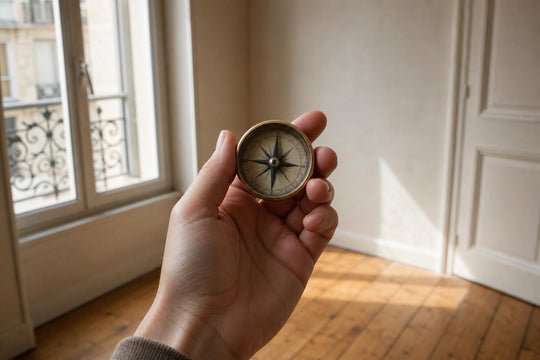
Before any placement makes sense, you need to know, actually, which way your front door and your main rooms face. A compass app on a phone will do it in under a minute, standing at your threshold. This single fact (north, not "roughly that way") is the foundation everything else in the practice rests on, and it is worth getting right before you rearrange a single object on its account.

Guidance commonly favours a main entrance that faces north, east or northeast, for the inflow of what the tradition describes as positive energy. If your door already faces one of those, you've inherited something useful and there is nothing to change. If it doesn't, the tradition doesn't ask you to move the door: it asks you to pay more attention to what happens at the threshold itself, since that is the part you can still shape.
Where should you place what you already own, room by room?
With your directions established, placement becomes a matter of matching what you own to the corners already associated with it, as far as your layout allows.
- The kitchen is commonly associated with the southeast and the fire element, with the stove ideally in that same corner; if your kitchen sits elsewhere, keeping the cooking area itself clean and well lit is the part you can still influence.
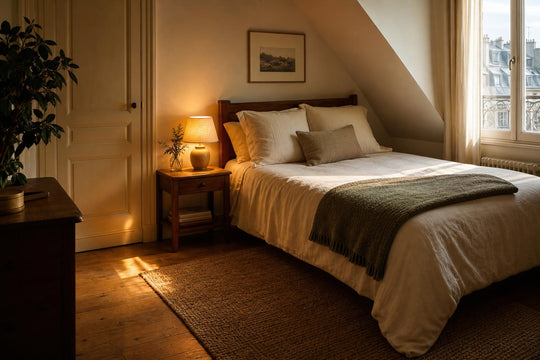
- The main bedroom is commonly placed in the southwest, said to bring stability, with west offered as an alternative; within that room, guidance favours sleeping with the head towards the south or east, and advises against the head pointing north.
- A pooja or altar space is traditionally linked to the northeast, though sources vary here more than almost anywhere else: some recommend the west, others the southwest of a south-facing home. Treat this as a direction to lean towards, not a rule to force on a room that cannot take it.
Where a room genuinely cannot move, the tradition itself holds that no direction is good or bad in isolation: how a room is actually used, and how freely you move through it, is said to matter as much as which way it faces. An entrance corner that feels heavy or stuck is often improved less by argument over compass points and more by simply tending it, which is where something like black tourmaline for the entrance corner earns its quiet place, as an object that marks the spot as cared for rather than a fix for the direction itself.
The one idea that matters more than any corner: the Brahmasthan
Of everything Vastu Shastra asks of a home, one idea does most of the work: the Brahmasthan, the centre of the house, treated as its energetic heart. Tradition holds this centre should be kept free of heavy structural loads, beams, pillars, wells, the kind of thing nobody renting or buying an existing flat can touch. But the same principle has a daily twin you can act on: keep that centre free of clutter too. You cannot move a load-bearing beam. You can decide not to let the middle of your flat become the place where boxes, shoes and unused furniture collect.
Clutter, especially at the centre and in corners, is said to block the circulation the entire system depends on, which is why the Brahmasthan is as much a daily habit as a fixed point on a floor plan. A northeast corner kept open for quiet practice, a kitchen that is simply clean, a centre kept clear of the things you mean to deal with "eventually": these daily habits keep the Brahmasthan doing its work, long after you've stopped thinking about compass points at all. Lighting a stick from natural incense sticks at the start of a day's work in that cleared space is less a Vastu rule and more a way of noticing you've kept it.
What ruins a Vastu-aligned home, and what won't the checklists tell you?
The honest failure mode is this: no single source online agrees with every other on every corner. The kitchen in the southeast and the main bedroom in the southwest are widely repeated, but secondary placements, especially the pooja room, genuinely vary between regional schools and even between articles from the same tradition. Treating any one list as the universal, non-negotiable rule, remedies and all, is the actual mistake, more than any direction you can't change.
What quietly undoes the practice in a real home is simpler than bad orientation: a cluttered centre, a northeast corner used for storage instead of stillness, a front door blocked by shoes and umbrellas so that nothing, including attention, moves through it easily. Commonly cited issues include a cluttered northeast, a desk sat with its back to the door, and mirrors facing the bed, though none of these are universal rules and regional sources vary on the specifics. No remedy fixes a room that is still full of things you don't use. A clear surface, kept that way, does more than any object placed on top of it. That said, something that gathers nothing and asks for nothing, a selenite round bowl left on an otherwise empty shelf, can mark a corner as deliberately kept open rather than simply forgotten.
Living with it, not just arranging it
My own northeast corner stays open for exactly this reason: not because the compass demands it absolutely, but because an open corner is one I actually use, week after week, in a way a perfectly placed object I looked at once never managed. That is closer to a daily practice than an interior design rule.
If you want to start somewhere concrete, the smudge sticks and other smudge sticks many people use to mark a room as freshly cleared, or the wider range of spiritual tools for the home built around exactly this kind of daily tending, sit well beside the idea without ever being the point of it. The point of it is simpler than any object: a home that is paid attention to, corner by corner, for as long as you live in it.


 Morocco

 India

 Mexico


 China