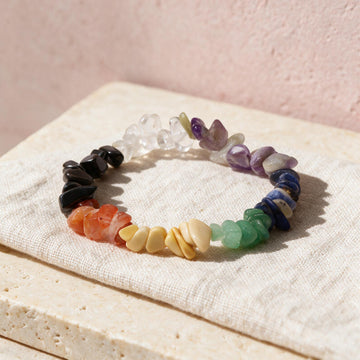
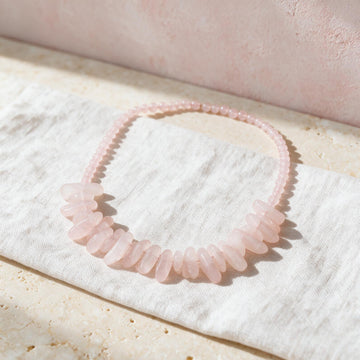
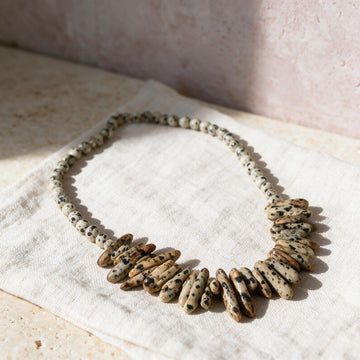
The one stone that handles daily wear without complaint, in almost any setting, is clear quartz, along with its family members amethyst and citrine. All three sit at 7 on the Mohs hardness scale, the ten-point system geologists use to rank how easily one material scratches another, and that number is the real dividing line between jewellery you can forget you're wearing and jewellery you have to baby. Household dust is not uniform grit: it contains, among other things, tiny fragments of quartz. Below 7, that dust will slowly scratch and dull a stone's surface over weeks of daily contact. At 7 and above, the same dust does nothing.
The dust test, and what counts as daily-wear hardness
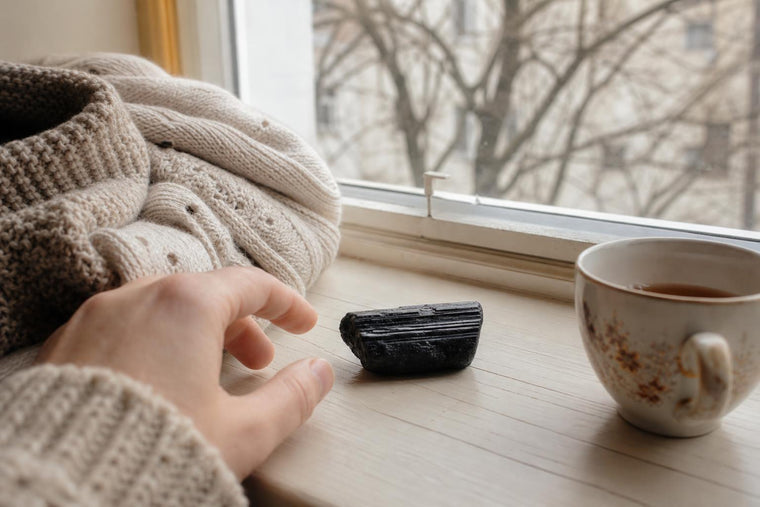
A stone softer than 7 is, in effect, being sanded very slowly by the air around it. That is why a piece can look perfect in the shop and visibly cloudy three months later: it's physics, not misfortune. Stick to Mohs 7 or above and you've solved most of the problem before it starts. That means the quartz family (clear quartz, amethyst, citrine, smoky quartz), black tourmaline at 7 to 7.5, and, if you're willing to spend more, topaz at 8 or corundum (ruby, sapphire) at 9. Garnet sits close to the line, varying from about 6.5 to 7.5 depending on the variety, so some garnets are daily-wear stones and some aren't. Below that threshold, softer favourites such as turquoise, opal, apatite or hematite, all around 5 to 5.5, are lovely but not built for constant contact. They suit earrings or pendants that rarely touch a surface, or pieces reserved for certain days instead of every day.
 Crystals1094 pieces
Open →
In this guide 5
Hardness is not the whole story. A well-cut stone in a secure setting outlasts a cracked one of higher rating, and how often you actually wear a piece changes its lifespan too. But hardness is the factor almost no seller mentions, and it's the one you can check before you buy instead of discovering afterwards.
Where that physics bites hardest depends on where the stone sits on your body. A ring meets more hard surfaces, more often, than any other piece, so this is where hardness matters most: clear quartz and amethyst, both Mohs 7, are the standard sensible choice, and black tourmaline (7 to 7.5) is a strong, darker alternative. Avoid turquoise, opal, apatite or anything near 5 to 5.5 in a ring specifically; they are genuinely beautiful stones, but a ring makes contact with something hard dozens of times a day. Bracelets take the heaviest abuse of all, catching on doorframes, desks and car doors in a way rings and pendants don't. Pendants and earrings are the gentlest setting of the three, rarely touching a hard surface, which opens the door to softer stones you'd never risk on your hand.
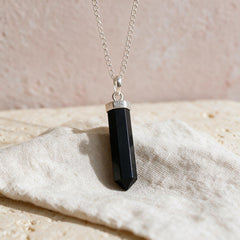
Best for a bracelet that knocks against everything

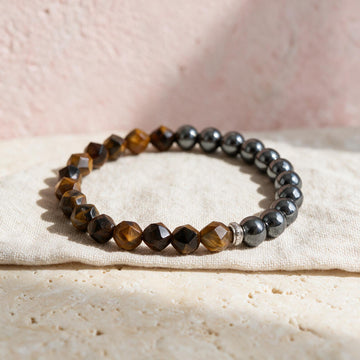
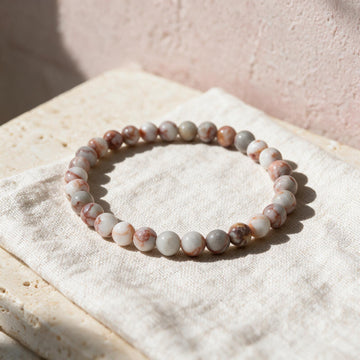
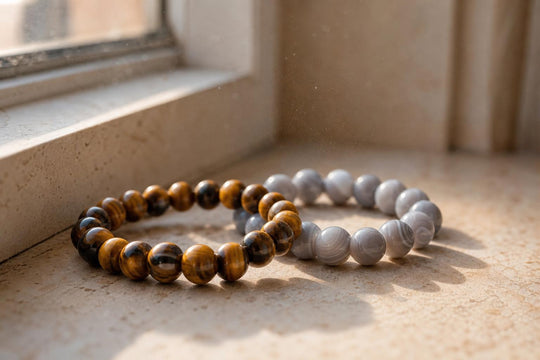
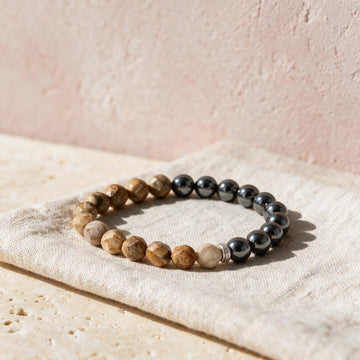
Tiger's eye earns its place here for a reason beyond its warm banding: it reads as a grounding, focus-steadying stone in many traditions, and its hardness (closer to the quartz family than to the soft end of the scale) means it shrugs off daily contact well. The Tiger Eye Stretch Bracelet is a fair example of the type: beads strung to be worn and handled, not admired from a shelf. Grey agate is the other practical choice. Agate is a banded form of chalcedony, generally hard enough for constant wear, and its muted colour hides the fine, inevitable marks of daily life better than a pale or translucent stone would; the Grey Agate Stretch Bracelet suits anyone who wants something understated enough for an office.
 Next: What Crystal Should You Sleep With?Crystals & Jewellery · 6 min read
Check the stringing too: a single elastic cord tends to snap within months of daily wear, while double-strung elastic or an adjustable cord holds its shape for considerably longer. A bracelet is the wrong choice for anyone who works with their hands in ways that mean frequent sharp knocks, building sites, kitchens, heavy manual work. In those cases, a pendant treats the stone more kindly.
Best for a pendant or earrings
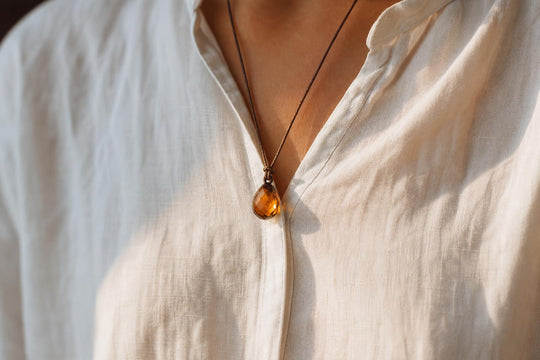
Turquoise, opal, apatite and rose quartz all make more sense worn close to the body, away from desks and door handles. A tiger's eye pendant still earns its place for the same reasons as the bracelet, with the benefit that the stone barely meets anything abrasive in a day. The Tiger Eye Crystal Pendant with Open Hands is worth a look if you want one piece that works equally well as a daily choice or a gift, since a pendant forgives a far wider range of stones than a ring ever will.

A word on opalite, and what to check before you buy it
Opalite is one of the most searched terms in this entire space, and also one of the most consistently misunderstood. It is not a mined crystal. It's a trade name for man-made opalescent glass, sometimes sold as "sea opal" or "opal moonstone", and any listing describing it as a natural gemstone is simply mislabelling the material. That doesn't make it worthless or dishonest to enjoy (glass jewellery has its own long and legitimate history), but it does mean the comparison people reach for, natural opal, is misleading on two counts.
First, it isn't opal. Natural opal is a hydrated silica mineraloid mined in places including Australia, Ethiopia and Mexico, generally rated around 5.5 to 6.5 on the Mohs scale. Second, opalite itself sits lower still, roughly 5 to 6, comparable to ordinary window glass and well under the 7 threshold that keeps household dust from scratching a surface. If you already own an opalite ring and it's lost its shine, that isn't a fault in the piece: it's exactly what the material's hardness predicts. The honest fix isn't to avoid opalite; it's to wear it where glass makes sense, in earrings or a pendant, and to know, going in, what you're actually buying.
Choosing for how you actually live
None of this is really about chasing the hardest stone you can find. It's about matching a stone to the particular wear your own life puts it through: the hand that's always reaching for door handles, the wrist that rests on a desk for eight hours, the neck that mostly just exists quietly under a collar. I keep returning to the idea that durability and meaning aren't in competition here. A tiger's eye chosen for steadiness holds its steadiness precisely because it can survive being worn every day without becoming something you have to protect.
If you're starting from nothing, it's worth taking the time to browse the full gemstone jewellery edit with hardness in mind rather than appearance alone. A piece that survives your actual week will always outlast one chosen for how it looked in a photograph.


 China