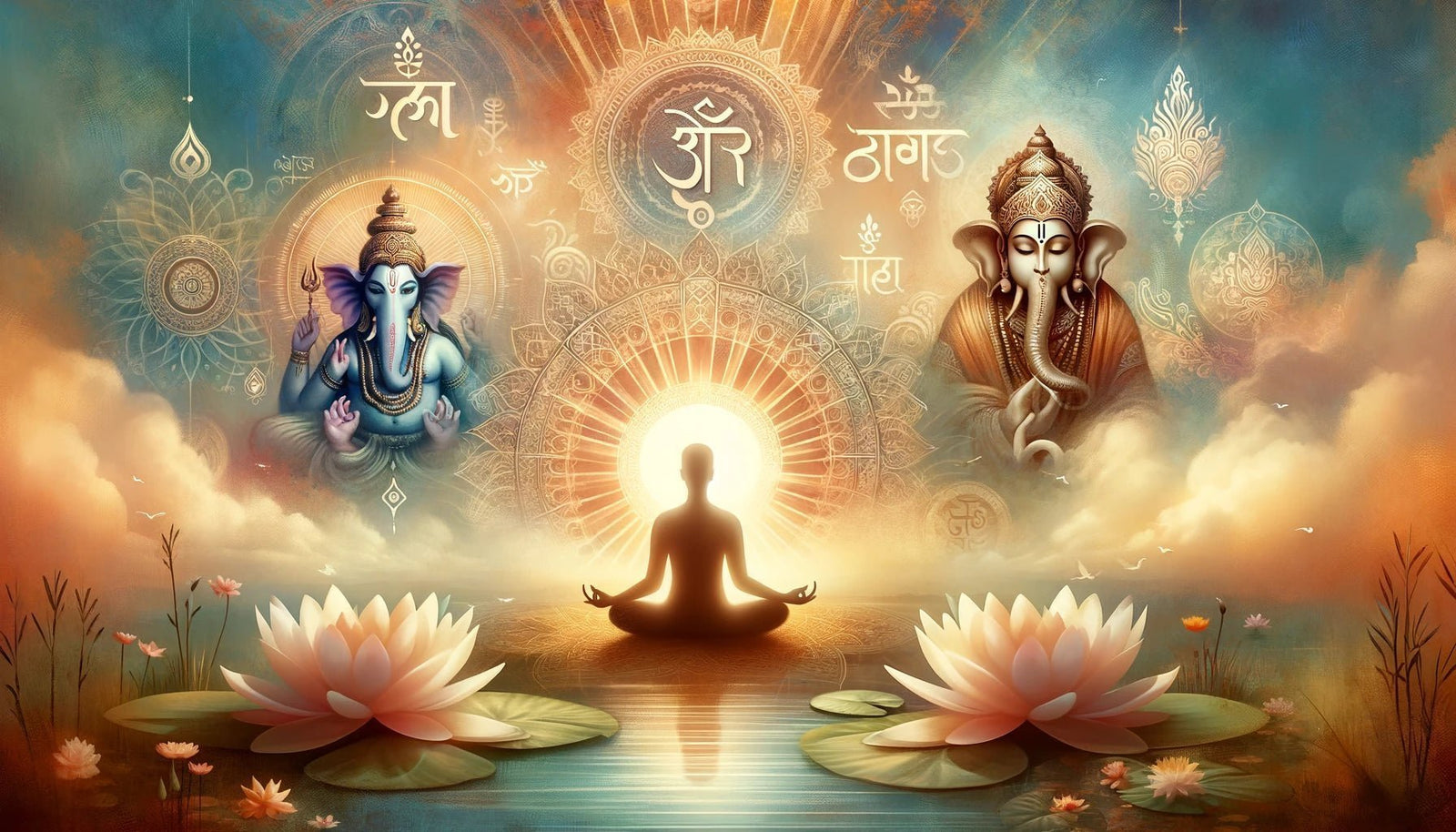
There is a particular kind of quiet that comes from repeating a single phrase, slowly, until the noise in the head begins to settle. This is the heart of mantra practice: not a magic spell, but a steadying daily ritual. The word does little on its own. The focus you bring to it — the breath, the repetition, the intention — is what does the work.
The ten chants gathered here are drawn from across the Hindu traditions of India. Some are old; one, the Maha Mrityunjaya Mantra, is genuinely Vedic, found in the Rig Veda and echoed through the later Yajur and Atharva Vedas. Others are Puranic, devotional or folk hymns that came much later. We have kept the precise label 'Vedic' for the one place it truly belongs, and present the rest as what they are: sacred sound, carried down through centuries of practice.
In this tradition, a mantra is understood as more than a string of words. It is a sound to rest the attention on — the syllable, the breath, the steady return to the same phrase, all gently gathering a scattered mind. We offer these as cultural and historical context, and as a tool you might choose to use, never as a doctrine to adopt. What follows is a short guide to each chant, the meaning behind its lines, and a simple way to begin a practice of your own.
Ganapati Mantra (गणपति मंत्र)

In the tradition, Ganesha is invoked first, as the deity who clears the way before any new beginning. This Puranic chant addresses him as the remover of obstacles, and devotees recite it to seek a smooth start — a gesture of humility before the work ahead, rather than a promise of success.
ॐ गन गणपतए नमो नमः
श्री सिद्धि विनायक नमो नमः
अष्टविनायक नमो नमः
गणपति बाप्पा मोरयाOm Gan Ganapataye Namo Namah
Shree Siddhi Vinayak Namo Namah
Ashtavinayak Namo Namah
Ganapati Bappa Moraya
This chant is addressed to Ganesha, who in Hindu tradition is honoured as the remover of obstacles and the deity of wisdom, prosperity and new ventures. Line by line, it reads as follows.
- 'Om Gan Ganapataye Namo Namah' — an invocation to Ganesha, naming him as 'Ganapati' and 'Ganapataye'. The repeated 'Namo Namah' means 'I bow, I bow' — reverence and surrender.
- 'Shree Siddhi Vinayak Namo Namah' — here he is hailed as 'Siddhi Vinayak', the one associated with accomplishment. 'Shree' signals auspiciousness and grace.
- 'Ashtavinayak Namo Namah' — a reference to the eight sacred Ashtavinayak temples of Maharashtra, clustered around Pune, each housing a distinct, self-manifested (swayambhu) form of Ganesha.
- 'Ganapati Bappa Moraya' — a much-loved phrase from festivals and prayers. 'Bappa' means father or lord; 'Moraya' is a term of reverence. Together it is a warm call to Ganesha's presence.
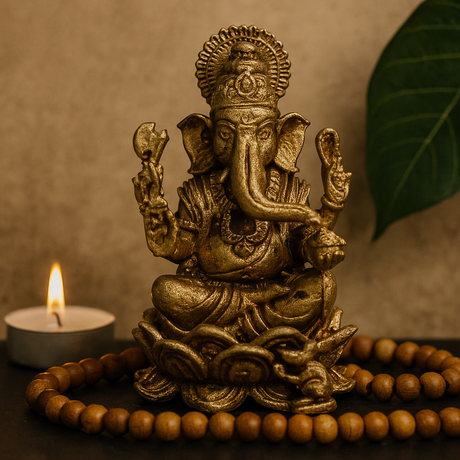
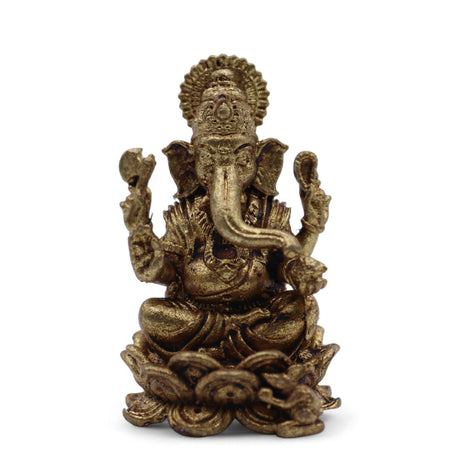
Devotees chant this at the opening of new undertakings, rituals and festive occasions. If you keep a small brass image of Ganesha nearby, it can serve as a simple focal point while you chant.
Maha Mrityunjaya Mantra (महा मृत्युंजय मंत्र)

ॐ त्र्यम्बकं यजामहे
सुगन्धिं पुष्टिवर्धनम् ।
उर्वारुकमिव बन्धनान्
मृत्योर्मुक्षीय मामृतात् ॥Aum Tryambakam Yajaamahe
Sugandhim Pushti-Vardhanam
Urvaarukamiva bandhanaan
Mrityor Muksheeya Mamritaat
This is the one genuinely Vedic chant in the set — it appears in the Rig Veda (7.59.12) and recurs in the Yajur and Atharva Vedas. It is addressed to Shiva, the deity associated in Hinduism with dissolution and renewal, and is traditionally recited for protection and inner steadiness.
- 'Aum Tryambakam Yajaamahe' — an invocation to Shiva. 'Tryambakam' names the three-eyed one; 'Yajaamahe' means 'we worship' or 'we meditate upon'.
- 'Sugandhim Pushti-Vardhanam' — 'Sugandhim' is fragrant or sweet-scented, an image of auspiciousness; 'Pushti-Vardhanam' speaks of nourishing and sustaining growth.
- 'Urvaarukamiva Bandhanaan' — a vivid simile. As a ripe cucumber loosens naturally from its stem, so the chant turns towards release from worldly attachment.
- 'Mrityor Muksheeya Mamritaat' — the closing line, a prayer for liberation (moksha) and for freedom from the fear of mortality.
Traditionally chanted for a sense of protection and calm, this is the verse many practitioners return to when they want something steady to hold on to.
Guru Mantra (गुरु मंत्र)

गुरुर्ब्रह्मा, गुरुर्विष्णु
गुरुर्देवो महेश्वर:
गुरुर्साक्षात् परब्रह्म
तस्मै श्री गुरुवे नमःGuru Brahma Gurur Vishnu
Guru Devo Maheshwaraha
Guru Saakshat Para Brahma
Tasmai Sri Gurave Namaha
This is a Sanskrit shloka that honours the Guru — the teacher or guide.
- 'Guru Brahma Gurur Vishnu' — the teacher is likened to Brahma, the creator, and Vishnu, the preserver: one who helps create and sustain a student's growth.
- 'Guru Devo Maheshwaraha' — and to Maheshwara, another name for Shiva, the principle of transformation: the guide who helps a student let an old self go.
- 'Guru Saakshat Para Brahma' — the teacher is named as a living link to Para Brahma, the absolute. A way of saying the guidance points beyond itself.
- 'Tasmai Sri Gurave Namaha' — the closing salutation, an offering of gratitude and respect to the teacher.
The shloka places the teacher at the centre of the path. In the tradition it is offered as a way of giving thanks for guidance received along the way.
Shiva Gayatri Mantra (शिव गायत्री मंत्र)

ॐ तत्पुरुषाय विद्महे
महादेवाय धीमहि
तन्नो रुद्रः प्रचोदयात्।Om Tatpurushaya Vidmahe
Mahadevaya Dhimahi
Tanno Rudrah Prachodayat
A chant addressed to Rudra, another name for Shiva, cast in the Gayatri metre. It is a post-Vedic adaptation in the classic Gayatri form, rather than a Vedic verse itself.
- 'Om Tatpurushaya Vidmahe' — it opens with 'Om', the syllable held in this tradition as the sound of creation. 'Tatpurushaya' names Shiva as the supreme one beyond form; 'Vidmahe' means 'let us know' or 'let us meditate upon'.
- 'Mahadevaya Dhimahi' — 'Mahadevaya', the great god; 'Dhimahi', we contemplate. An invitation to rest the mind on Shiva.
- 'Tanno Rudrah Prachodayat' — 'may Rudra inspire and guide us'. A line offered as a prayer for clarity rather than a guarantee of it.
Reverential and quiet, this chant is recited to seek a sense of guidance and inner steadiness.
Brahma Gayatri Mantra (ब्रह्मा गायत्री मंत्र)

ॐ वेदात्मनाय विद्महे
हिरण्यगर्भाय धीमहि
तन्नो ब्रह्मा प्रचोदयात्।Om Vedathmanaya Vidmahe
Hiranya Garbhaya Dheemahi
Tanno Brahma Prachodayat.
A chant addressed to Brahma, the creator deity in Hindu cosmology — again a Gayatri-format adaptation rather than a Vedic verse.
- 'Om Vedathmanaya Vidmahe' — it begins with 'Om'. 'Vedathmanaya' names Brahma as the embodiment of the Vedas; 'Vidmahe', let us know or meditate upon.
- 'Hiranya Garbhaya Dheemahi' — 'Hiranya Garbhaya' is the 'golden womb', an image of the cosmic source of creation; 'Dheemahi', we contemplate. A turn towards the idea of origin and making.
- 'Tanno Brahma Prachodayat' — 'may Brahma inspire and guide us', here in the sense of creative clarity and wisdom.
In the tradition this chant is associated with creativity, learning and fresh insight — a fitting one to sit with at the start of work that asks for a clear, open mind.
Govinda Jaya Jaya (गोविन्द जय जय)

गोविन्द जय जय गोपाल जय जय।
राधा रमण हरिबल हरिजय जय जय॥Govinda jaya jaya, Gopala jaya jaya
Radha-ramana Hari-bal Hari-jaya jaya
This is a short, popular devotional refrain — a bhajan or kirtan line, sung rather than the eight-verse classical Govindashtakam attributed to Adi Shankaracharya. It glorifies Lord Krishna, in his forms as Govinda and Gopala, alongside his consort Radha.
- 'Govinda jaya jaya, Gopala jaya jaya' — salutations to Krishna as Govinda, the one who gives delight to the senses, and Gopala, the protector of cattle, recalling his life as a cowherd. The repeated 'jaya jaya' is a joyful refrain of praise.
- 'Radha-ramana Hari-bal Hari-jaya jaya' — 'Radha-ramana', the delighter of Radha, names the bond between Krishna and Radha; 'Hari-bal' speaks of the strength of Hari. Again the 'jaya jaya' carries the chant's joy.
Light and repetitive, this is the kind of chant sung in groups, where the rhythm itself carries the devotion — a celebration of the bond between Radha and Krishna.
Shiva Mantra (शिव मंत्र)

ॐ नमो शिवाय गुरवे सच्चिदानन्द मूर्तये नमस्तस्यै नमस्तस्यै नमस्तस्यै नमो नमः