Lapis lazuli has been pulled from the same mountain valley for longer than writing has existed. Knowing where it comes from, and what it is made of, changes the way you choose it, and the way you hold it afterward.
The Oldest Address in Gemstone History
The Sar-e-Sang mines sit at roughly 2,700 metres in the Kokcha River valley, Badakhshan province, north-eastern Afghanistan. For part of the year the track in is passable only by mule. The stone that comes out has been travelling to the rest of the world for at least six millennia: archaeological evidence places lapis from this region in Mesopotamian and Egyptian contexts from at least 4,000 BCE, and the mine is still working today.
That continuity matters for authentication. When you understand that gem-grade lapis lazuli has one primary address on earth, geography becomes the first criterion you apply, not an afterthought. A dealer who cannot tell you where their stone originates is already at a disadvantage, not because origin is a guarantee, but because it is the frame inside which everything else makes sense.
The name itself carries the geography. Lapis is Latin for stone; lazuli traces back through medieval Latin and Arabic to the Persian lāzhward, the old name for the Badakhshan region. The stone and the place have been inseparable long enough to share a word.
What Lapis Lazuli Actually Is, and What Gets Sold Instead

Lapis lazuli is a rock, not a single mineral. It forms when limestone is transformed by intense heat and pressure deep in the earth, the same process that built the Hindu Kush. That origin explains both the stone's beauty and the vocabulary you need to assess it.
Three components define a genuine specimen:
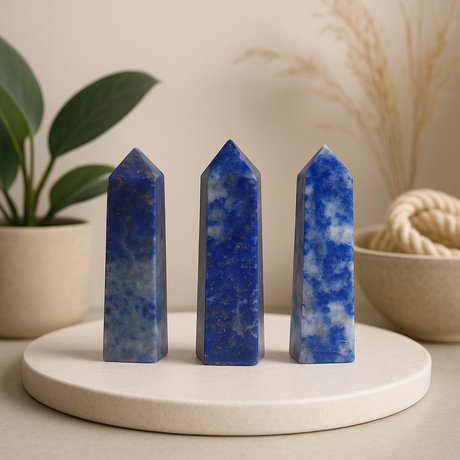
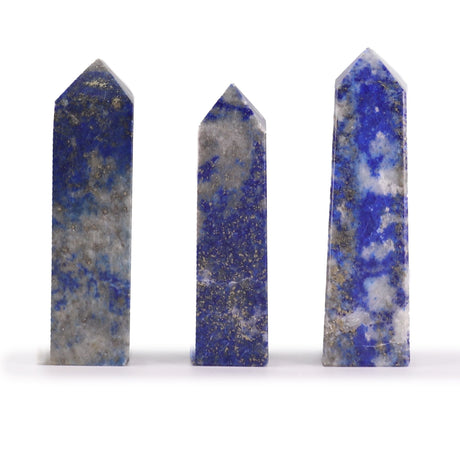
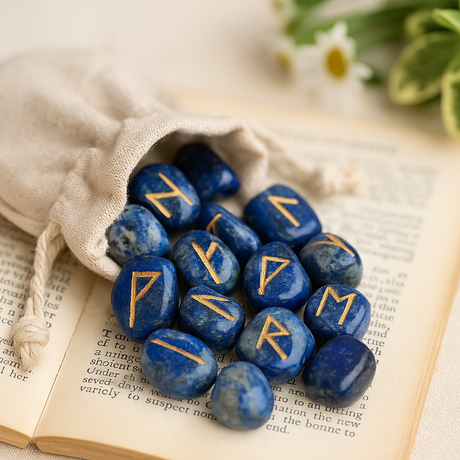
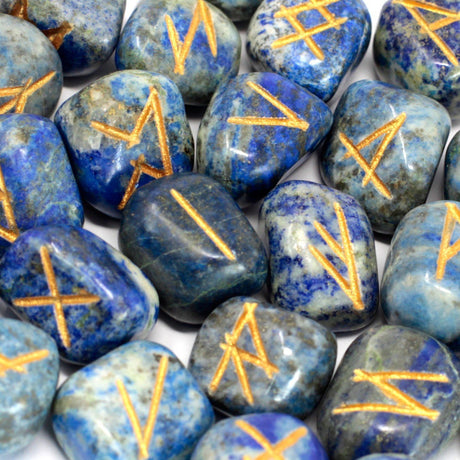
- Lazurite, the source of the blue. This mineral gives lapis its characteristic depth of colour. High-grade material typically contains between 25 and 40 per cent lazurite by composition. The blue is structural: it exists within the mineral itself rather than on the surface, which is why it cannot be wiped away.
- Pyrite, the gold. Those brassy flecks are iron sulphide, not gold, but their presence is a positive sign. In natural lapis, pyrite inclusions are three-dimensional and irregularly distributed; they catch light differently depending on the angle you hold the stone.
- Calcite, the white. Veining or patches of white calcium carbonate are normal and do not disqualify a stone. Heavy white dominance lowers grade and value, but some calcite is simply part of what lapis is.
Reading these three together is how trained dealers assess a piece. A stone with deep, even blue, well-distributed pyrite, and minimal white sits at the top of the trade hierarchy. A stone that is intensely, uniformly blue with no pyrite at all is worth a second look, and that second look has a name.
The most useful thing you can do before visiting a dealer or market stall is learn what is commonly sold in place of lapis.
Dyed howlite is the most common substitute. Howlite is a white, porous mineral that accepts blue dye readily and can be made to look convincingly lapis-like, complete with grey veining that mimics calcite. It is widely available and inexpensive.
Dyed magnesite works on the same principle, a white magnesium carbonate mineral with similar porosity, dyed blue and sometimes sold under the same misrepresentation as howlite fakes.
Sodalite is a different case. It is a genuine blue mineral, related to lazurite but distinct. Sodalite is not a fraud in itself, it is a real stone with its own character, but it is sometimes sold as lapis lazuli, which it is not. The tell is the colour: sodalite tends toward a slightly violet-toned, more uniform blue, and it typically lacks pyrite inclusions entirely. It also commands a lower price than quality lapis, so if the price seems right for sodalite, it may well be.
Reconstructed or synthetic lapis also exists: powdered lapis or related minerals compressed with a binder. It may pass a surface scratch test but typically shows too-uniform colour and no three-dimensional pyrite structure.
Four Practical Tests

You do not need laboratory equipment to make a reasonable assessment. These four observations, taken together, give you a working picture.
Colour consistency under angled light. Hold the stone at a low angle to a light source and look for colour pooling in surface cracks or pits. Dye sits on the surface and concentrates in any irregularity. Lazurite colour is structural and reads evenly regardless of surface texture.
Pyrite distribution. Real lapis has irregular, three-dimensional gold flecks that shift as you rotate the stone. Fakes sometimes use painted inclusions or foil that sits flat against the surface and does not catch light from multiple angles.
Temperature. Stone holds cold longer than resin, glass, or compressed powder. This is a supporting observation rather than a proof on its own, but a piece that warms immediately in the hand is worth further scrutiny.
The acetone wipe. This is the most reliable field test and, curiously, among the least mentioned in general guides. Apply a small amount of acetone (nail-polish remover) to a cotton bud and wipe a hidden spot, the base of a tumbled stone, for instance. Dyed howlite or magnesite will transfer blue colour to the cotton. Natural lapis lazuli colour is structural and does not bleed. If you are buying a significant piece, this test is worth asking the seller to permit.
One test to treat with caution: the pin or scratch test. Lapis has a Mohs hardness of 5 to 6, which means it can be scratched by a steel blade, but so can sodalite, and scratching a stone you may wish to buy is both destructive and inconclusive.
Grade and Origin: What the Trade Terms Mean
You will encounter a few terms in the trade that are worth understanding before you shop.
Persian grade is now used as a quality descriptor rather than a strict geographic label. It indicates deep, even blue with minimal calcite and well-distributed pyrite, the characteristics associated with the finest Afghan material.
Afghan grade or Afghan lapis refers to stone from the Badakhshan region. It is not automatically superior to all other lapis, but the best material in the trade typically originates here.
Chilean grade refers to lapis from the Atacama and Ovalle areas of Chile, a significant commercial source since the nineteenth century. Chilean lapis is genuine lapis lazuli, the same mineral composition, but it typically contains more calcite and less lazurite than top Afghan material, giving it a paler, more mottled appearance. It is not a fake; it is a different point on the quality spectrum, and it should be priced accordingly.
Russia's Lake Baikal region also produces lapis of variable quality, generally with more calcite and a slightly greener blue than Afghan material. Again, genuine stone, lower in the trade hierarchy.
Price is a signal, not a guarantee. A piece of deep, even, pyrite-rich Afghan lapis at a price that seems too good to be true usually is. A fair price for quality material reflects the difficulty of the source and the rarity of the grade.
The Stone as a Record of Place
The ultramarine pigment ground from Sar-e-Sang lapis appears in Tutankhamun's burial mask, in medieval European illuminated manuscripts, and in the blue robes painted by Vermeer and Fra Angelico. The same valley, the same mineral, across six thousand years of human making. That is not a marketing claim; it is the kind of continuity that changes what it means to hold the stone in your hand.