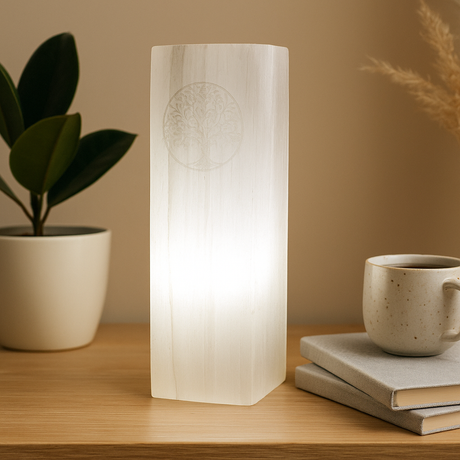
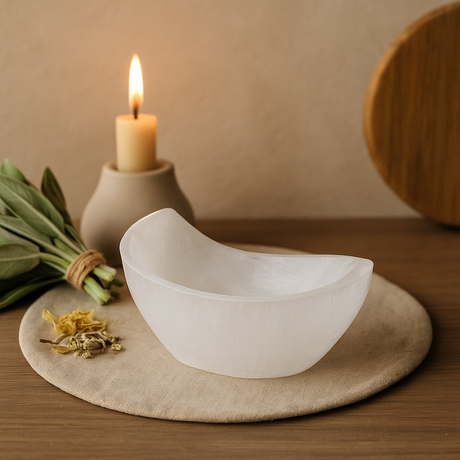
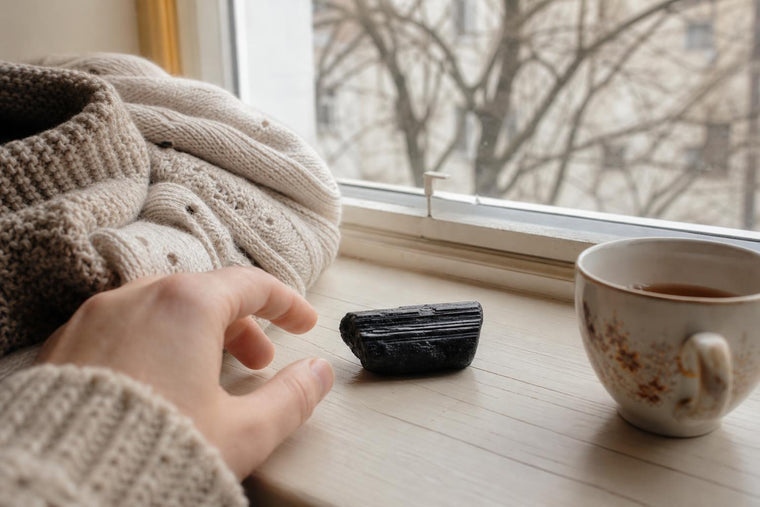
The lamp on your shelf began as an ocean. Not a metaphor: a literal inland sea that evaporated before complex animal life had yet appeared on earth, leaving behind a compressed mineral record that has been sitting in the foothills of Punjab for roughly half a billion years. Understanding what that salt actually is, and how it came to be carved into the object beside your reading chair, changes the quality of attention you bring to it.
A Mine With a History
The Khewra Salt Mine sits in the Salt Range, a low ridge of hills in Jhelum District, Punjab Province, Pakistan. Geologically distinct from, and south of, the high Himalayan range proper, it is nonetheless part of the broader Himalayan foreland system. By reserve, it is among the world's largest salt mines, precise rankings vary by methodology and source, but the scale is not in dispute. It has been worked for centuries. Local tradition holds that the deposit was first noticed by Alexander the Great's cavalry horses, who were observed licking the rocks around 326 BCE. A pleasing story, though one that belongs to folk memory rather than documented record.
What is documented is the mine's systematic development. Salt was traded from this region during the Mughal period, and in the 1840s British colonial administration formalised the extraction operation, with a British engineer recorded as H. Warth credited with organising the tunnel system that still forms the mine's structural backbone. Today the mine is operated by the Pakistan Mineral Development Corporation. Its tunnels reportedly extend across multiple levels, figures cited in Pakistani mineral development literature suggest a network of considerable scale, and it produces, according to various industry estimates, somewhere in the range of 300,000-350,000 tonnes of salt annually. These figures place it firmly in the category of active industrial infrastructure, not heritage relic.
Inside, there is a small mosque constructed from salt bricks, modelled on Lahore's Badshahi Mosque. It is one of the details that makes Khewra genuinely worth knowing about: a place of worship built from the same mineral being extracted around it, inside a mountain, lit by the warm glow of salt-filtered light. The mine is reportedly among Pakistan's most-visited heritage sites, though precise visitor numbers vary by year and are not consistently published by a single authority.
Why the Salt Is Pink
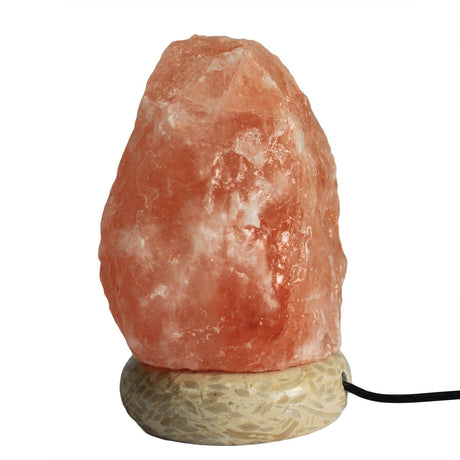
The colour is not a marketing invention, and it is not produced by a vague catch-all of "minerals." The base mineral is halite, sodium chloride, the same compound as ordinary table salt. What gives Khewra salt its characteristic gradient, from pale rose through salmon to deep terracotta, is the presence of iron-oxide inclusions within the halite crystal lattice: primarily haematite (Fe₂O₃) and goethite (FeO·OH).
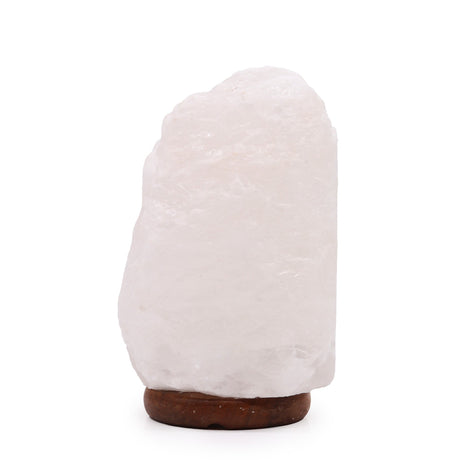
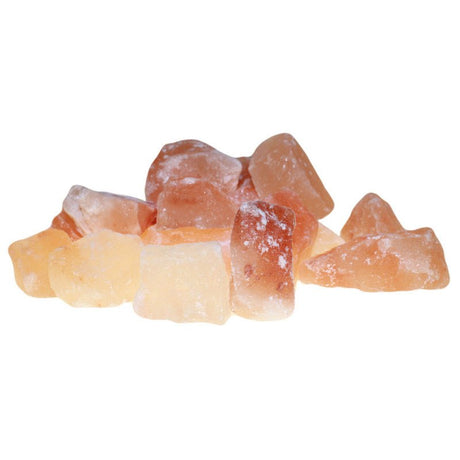
The intensity of the colour corresponds directly to the concentration of those inclusions. A pale, almost translucent block has minimal iron-oxide content; a deep brick-red piece has more. This is why two lamps carved from the same deposit can look quite different, and why a single block may shade from white at one edge to deep rose at another. The variation is geological, not cosmetic.
The deposit itself formed from a seabed that dried and was buried under sediment roughly 500-600 million years ago, a figure geologists treat as an estimate, since dating evaporite deposits of this age carries inherent uncertainty. The term "Himalayan" on a label is commercial and geographic shorthand. The Salt Range is not the high Himalaya; it sits south of the main range, in the Punjab plains. But it is part of the same vast tectonic system, and the name has become the trade standard for salt from this deposit. Worth knowing, not worth arguing about.
From Deposit to Object
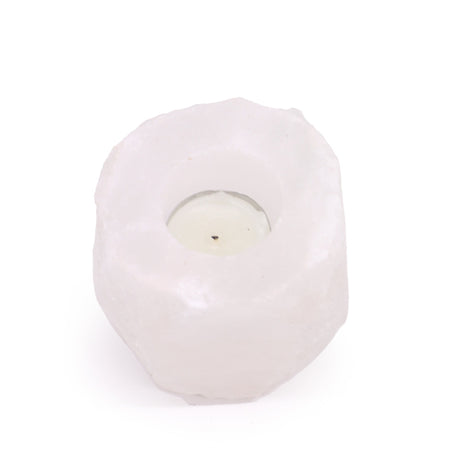
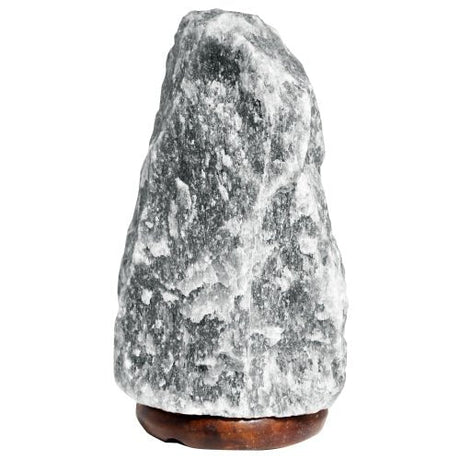
Salt extracted from Khewra is graded after it leaves the mine. Food-grade material goes through certification processes for human consumption. Lamp-grade material comes from the same geological deposit but follows a different grading path; it is shaped, drilled and fitted with a low-wattage bulb (typically around 15 watts) or hollowed to hold a candle. A Himalayan salt lamp in its most common form is simply a shaped block of this halite, warm-lit from within.
The shaping is done by hand or with simple tools; the irregular, organic forms that characterise most lamps are a direct result of the salt's natural cleavage planes. A salt brazier lamp, which holds loose chunks of the mineral around a central light source, makes the geological variety visible in a single object: pale and deep pieces sitting together, each with its own iron-oxide signature.
One practical note that follows directly from the mineralogy: halite is hygroscopic. It draws moisture from the surrounding air. In humid conditions, a lamp will sweat, beading on the surface and occasionally dripping. Keeping the bulb lit warms the salt enough to slow this process considerably. It is not a flaw in the object; it is the mineral behaving as minerals do.
The Lamp as an Attention Object
The scientific consensus is clear and worth stating plainly: a salt lamp does not meaningfully purify indoor air, and it does not produce therapeutic quantities of negative ions under normal room conditions. This is entirely compatible with finding the object genuinely useful.
What a lit salt lamp does, reliably, is change the quality of light in a room. The warm amber glow that passes through iron-oxide-tinted halite is different in character from overhead lighting or a screen. It is the kind of light that has historically accompanied the end of the working day, fire, candle, oil lamp, and across many traditions the deliberate lighting of a flame has served as a threshold marker: this moment is different from the one before it.
The practice worth recommending is simple. Light the lamp with some intention, not as a passive background appliance left running all day, but as a small, deliberate act that marks a shift in attention. The object does not do this work for you. It offers a cue; you decide whether to follow it. A Himalayan salt candle holder works on the same principle with an open flame, which carries its own quality of presence. A USB salt lamp brings the same warm light to a desk without requiring a mains socket, useful for the hours when you want to soften the quality of a workspace without changing rooms.
The tradition of fire and light as ritual markers runs through almost every culture that has left a record, from the lamps of Hindu puja to the Sabbath candles of Jewish tradition to the butter lamps of Tibetan Buddhism. The specific form varies; the underlying logic is consistent: a lit flame asks for a different quality of attention than an unlit room. The salt lamp sits in that lineage, modestly and without overclaiming its place in it.
What the Object Actually Asks of You
Roughly half a billion years of geological time, a colonial-era tunnel system, the specific chemistry of iron oxide in halite, the hands that shaped the block: all of this is present in the object, whether or not you think about it. Most of the time, you will not think about it. That is fine; that is how objects work.
But occasionally, knowing what a thing actually is changes how you hold it. The lamp is not a passive air-treatment device, and it is not a mystical artefact. It is a piece of an ancient seabed, warm-lit, sitting in your room. Light it deliberately, use it as a marker rather than a fixture, and it offers what warm light has always offered: an invitation to a slower kind of attention. What you do with that attention is, as always, entirely yours.
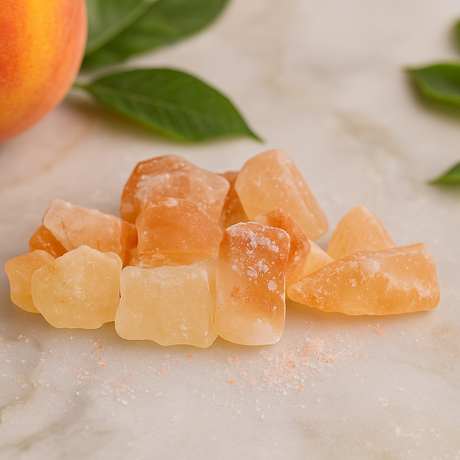
If you want to keep the mineral closer to hand in a different form, Himalayan pink salt chunks from the same deposit make the geology visible without the lamp format. The colour variation across a handful of pieces tells the same iron-oxide story in miniature.