A salt lamp is a strange kind of light. It does not throw a beam or fill a room the way a bulb usually does; it glows from somewhere inside the stone, the way a coal glows after the flame has gone. Most of what gets written about it argues over what that glow might do to the air around it. This is not that argument. This is the story of where the stone came from, who cut it, and what it actually asks of you once it sits on your shelf.
The stone on the shelf
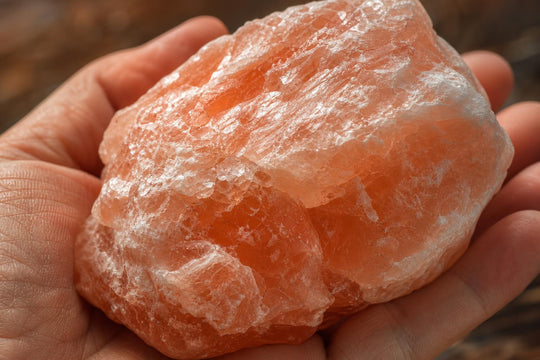
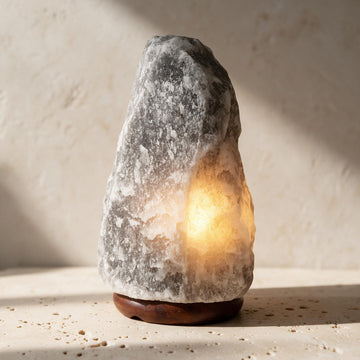
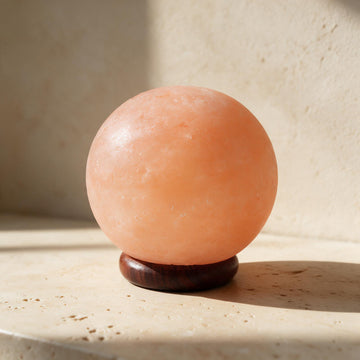
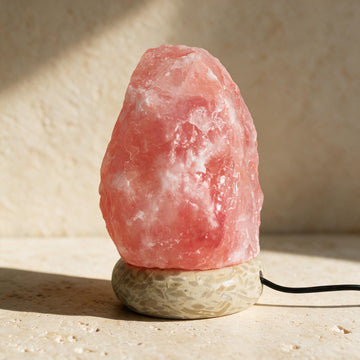
Held in the hand, a piece of rock salt is heavier than its size suggests, dense and slightly greasy to the touch, the surface pitted rather than polished. The colour runs from a pale blush to a deep, burnt orange, uneven in bands the way a slice of meat is uneven, because it is a mineral record rather than a decoration. Chemically it is still overwhelmingly sodium chloride, the same compound as table salt; the warmth of its colour comes from trace minerals, chiefly iron oxide, caught inside the crystal as it formed. Light does not pass through a Himalayan salt lamp the way it passes through glass. It sits inside the density of the rock and leaks out at the edges, which is why the effect is a pool rather than a beam.
 Himalayan Salt Lamps42 pieces
Open →
In this guide 5
A sea that became a mountain range
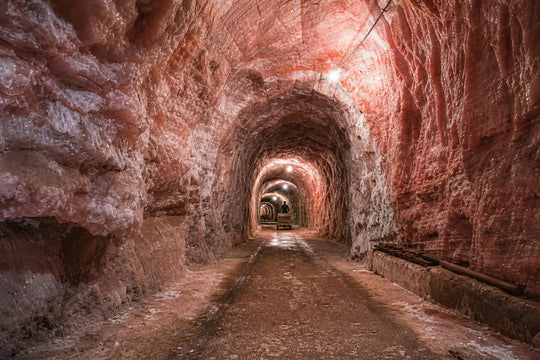
The salt is quarried at Khewra, a mine in Jhelum District, Punjab, in the low hills known as the Salt Range, which sit some way south of the Himalayas proper rather than among their high peaks. The deposit itself is old in a way that is hard to hold in the mind: evaporite beds commonly dated to hundreds of millions of years, laid down as an ancient sea dried and left its salt trapped in the earth. Khewra is widely cited as the second-largest salt mine in the world, and its human history has two competing openings. One is a legend: that the army of Alexander the Great, passing near the Jhelum river around 326 BC, noticed their horses licking the salty rocks. The other is a record: mining by the Janjua clan documented from the 13th century onward. Both are told locally, and there is no reason to pick a winner between a legend and a record; the mine's story simply holds both, a myth at one end and a paper trail at the other.
 Next: Khewra: What the Pink Salt in Your Lamp Actually IsHome · 7 min read
From rock to lamp
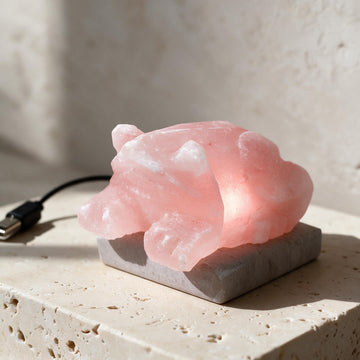
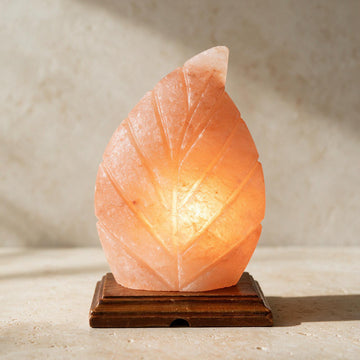
What runs today at Khewra is not a cottage trade of artisans chipping at a rock face by hand, however the shape of the finished lamp might suggest that image. Extraction is carried out by the Pakistan Mineral Development Corporation, a state-owned operation, working the mine's long galleries at industrial scale. The rough blocks that come out of the ground are only later carved and hollowed into lamp shapes, fitted with a socket for a small bulb. Because dense salt lets little light through, the fitting is deliberately modest: a low-wattage bulb suited to the size of the stone, giving the soft, localised glow the lamp is known for rather than lighting a whole room.
Living with it
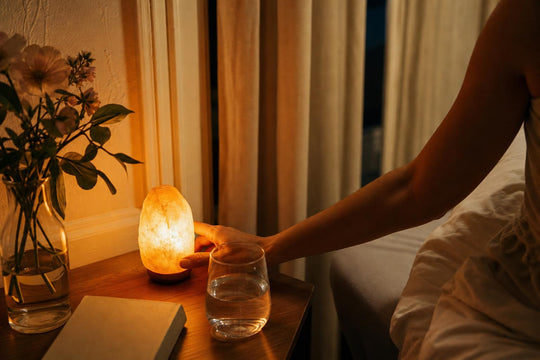
By the time a piece of this rock reaches a shelf, it has travelled a very long way from a mine in Punjab to a room that has nothing else in common with the Salt Range. What it keeps from that journey is its chemistry, and its chemistry is worth knowing before you place it. Halite is hygroscopic: it draws moisture out of the air, which is why a lamp left switched off in a damp bathroom or a steamy kitchen can start to feel wet, even weep a little at its base. Keeping it lit for a few hours in the evening warms the stone gently and helps keep that moisture from settling. Halite is also a soft mineral, easily marked and slowly dissolved by water, so the only correct care is a dry or barely damp cloth, never a wash or a soak. Size matters more than most buyers expect: a small stone gives a modest close glow well suited to a lamp built for a bedside table, while a room meant to feel lit rather than simply marked wants a larger stone for a living room.
The evening it asks for
None of this makes the lamp a device. It is a piece of very old geology, shaped by a state mining operation and a long supply chain, that happens to glow when you switch it on. What it is said to carry, in the traditions that reach for salt as a cleansing or grounding presence, is worth holding lightly rather than proving: an intention, not a guarantee. The part of the ritual that is entirely yours is smaller and plainer than any of that. It is remembering to switch it on before the room goes properly dark, noticing when the light has dimmed enough to warrant a spare bulb when the old one dims, wiping the stone down when it feels damp rather than leaving it be. I keep returning to the thought that this is most of what a good evening object ever asks: not belief, not a claim about the air, just a few seconds of attention repeated often enough that they become a habit worth keeping.


 Pakistan