There is a particular kind of quiet a person reaches for before something difficult: a hard conversation, an early start, a fear they would rather not name. Across India, one of the oldest ways of meeting that moment is to sit, breathe, and recite a few lines of Sanskrit, a pranama, an offering of respect. The Sri Narasimha Pranama is one of these. In the Vaishnava tradition it is offered to Narasimha, the half-man, half-lion form of Vishnu, and it is recited as an invocation of courage and steadiness, a way to settle the mind on fearlessness before stepping into the day.
What follows is not one single mantra but a sequence of three traditional verses commonly recited together as the Narasimha pranama. We share them here as living heritage, the legend, the Sanskrit, and what each line means, so you can read them with understanding and, if you wish, make a small conscious practice of them. The agency stays with you; the verses are a tool you return to.
Who Narasimha is
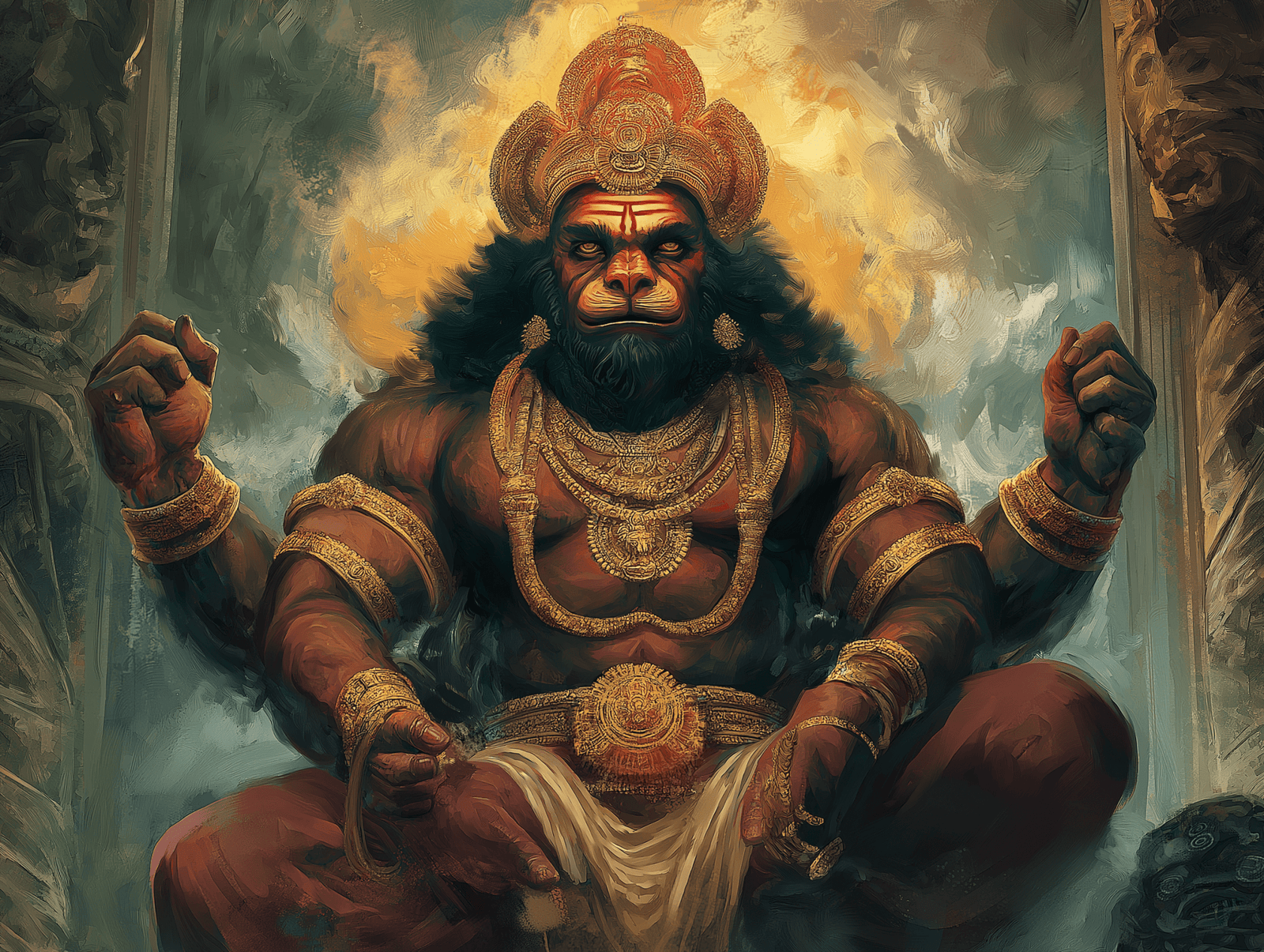
The story comes from the Bhagavata tradition. A king named Hiranyakashipu had grown so powerful, and so cruel, that he forbade the worship of Vishnu altogether, yet his own young son, Prahlada, remained devoted. The king's anger turned on the boy. In the legend, Narasimha appears at this point: neither man nor beast, neither inside nor outside, at neither day nor night, slipping past every condition the tyrant had arranged for his own protection. He defends the child and ends the king's reign.
Read as heritage rather than doctrine, the figure carries a clear meaning: a fierce face turned towards cruelty, and a tender one turned towards the devoted. That double nature, ferocity and gentleness held together, is what the verses below return to again and again.
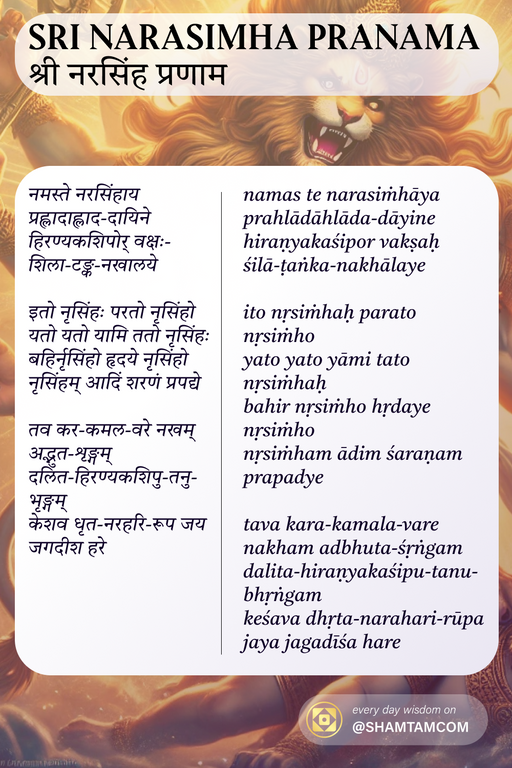
Verse 1, the pranama proper
नमस्ते नरसिंहाय
प्रह्लादाह्लाद-दायिने
हिरण्यकशिपोर् वक्षः-
शिला-टङ्क-नखालये
Transliteration
namas te narasiṁhāya
prahlādāhlāda-dāyine
hiraṇyakaśipor vakṣaḥ
śilā-ṭaṅka-nakhālaye
Translation
“I offer my respects to Narasimha, who brings joy to Prahlada and whose claws are like chisels on the stone-like chest of the demon Hiranyakashipu.”
What the lines hold
- Narasimha, the form of the divine as half-man (nara) and half-lion (simha).
- Prahlādāhlāda-dāyine, the one who brings happiness to the devotee Prahlada, symbolising protection and grace.
- Hiraṇyakaśipor vakṣaḥ-śilā-ṭaṅka-nakhālaye, claws compared to chisels that cut through the hard, stone-like chest of the king who set himself against dharma, or righteousness.
This first verse is the pranama itself: a simple bow. It names the protector of the faithful and the undoing of cruelty in the same breath, and it emphasises the claws, the fierce detail, as the means by which arrogance was broken.
Verse 2, present in every direction
इतो नृसिंहः परतो नृसिंहो
यतो यतो यामि ततो नृसिंहः
बहिर्नृसिंहो हृदये नृसिंहो
नृसिंहम् आदिं शरणं प्रपद्ये
Transliteration
ito nṛsiṁhaḥ parato nṛsiṁho
yato yato yāmi tato nṛsiṁhaḥ
bahir nṛsiṁho hṛdaye nṛsiṁho
nṛsiṁham ādim śaraṇam prapadye
Translation
“Narasimha is here, and Narasimha is there. Wherever I go, Narasimha is there. He is outside, and he is within my heart. I take refuge in Narasimha, the original source and my supreme refuge.”
What the lines hold
- ito nṛsiṁhaḥ parato nṛsiṁho, “here and there”, in the tradition, the divine understood as present in all directions.
- yato yato yāmi tato nṛsiṁhaḥ, “wherever I go, he is there”, the felt sense that protection is constant, whatever the place.
- bahir nṛsiṁho hṛdaye nṛsiṁho, “outside, and within the heart”, the divine held to be both external and inward.
- nṛsiṁham ādim śaraṇam prapadye, “I take refuge in Narasimha, the original source”, the line resolves in surrender.
Verse 2 is a separate, much-loved protection verse, often recited on its own, the single line ito nṛsiṁhaḥ parato nṛsiṁho is one many practitioners know by heart. In the tradition, devotees understand Narasimha as ever-present, within and without; the verse expresses that conviction and ends in letting go.
Verse 3, from Jayadeva's Dashavatara Stotra
तव कर-कमल-वरे नखम् अद्भुत-शृङ्गम्
दलित-हिरण्यकशिपु-तनु-भृङ्गम्
केशव धृत-नरहरि-रूप जय जगदीश हरे
Transliteration
tava kara-kamala-vare nakham adbhuta-śṛṅgam
dalita-hiraṇyakaśipu-tanu-bhṛṅgam
keśava dhṛta-narahari-rūpa jaya jagadīśa hare
Translation
“Your lotus hands hold nails like wonderful horns. With them you tore apart the body of the mighty Hiranyakashipu, like a wasp being crushed. O Keshava, who took the form of Narahari, half-man and half-lion, all glories to you, Lord of the universe!”
What the lines hold
- tava kara-kamala-vare nakham adbhuta-śṛṅgam, the divine nails, fierce yet part of lotus-like hands: destruction of cruelty and tenderness for the devoted, held in one image.
- dalita-hiraṇyakaśipu-tanu-bhṛṅgam, the king's body likened to a wasp, emphasising how small cruelty looks against that power.
- keśava dhṛta-narahari-rūpa jaya jagadīśa hare, praise to Keshava, a name of Vishnu, who took the form of Narahari to set the world right.
This third verse is in fact the fourth verse of the Dashavatara Stotra, Jayadeva Goswami's celebrated hymn to the ten avatars of Vishnu, from the twelfth-century Gita Govinda. Naming its source is part of reading it honestly: it is sung far beyond the Narasimha pranama, and its place in one of Sanskrit literature's most beloved poems is heritage worth knowing.
Reading the three together
Taken as a sequence, the three verses move through a clear arc. The first offers respect. The second opens into the felt sense of a protection that is everywhere, inside and out. The third resolves in glad surrender and praise. Running through all of them is that double nature, the ferocity turned towards cruelty, the gentleness turned towards the one who trusts.
In the tradition, devotees understand Narasimha as ever-present, and the verses express their reverence, their sense of being protected, and their wish to surrender. We share that as cultural and spiritual context, not as a claim the reader is asked to adopt, a description of a living devotion, told with respect.
The pranama as a conscious practice
You do not have to belong to the tradition to take something steadying from these lines. A pranama, recited slowly, works much like any focused practice: it gives the mind one thing to rest on, and the body a rhythm to follow. Said before a daunting moment, it is less a request to be rescued than a way of gathering your own courage and naming your intention, facing fear with attention rather than avoidance. A mantra is a practice, not a guarantee, and not a substitute for the practical steps a hard situation calls for. What repetition tends to cultivate is a calmer, less rattled mind. The work stays yours; the chant is the tool you keep coming back to.
If you would like to make a small practice of it, a few simple supports can help mark the time as your own:
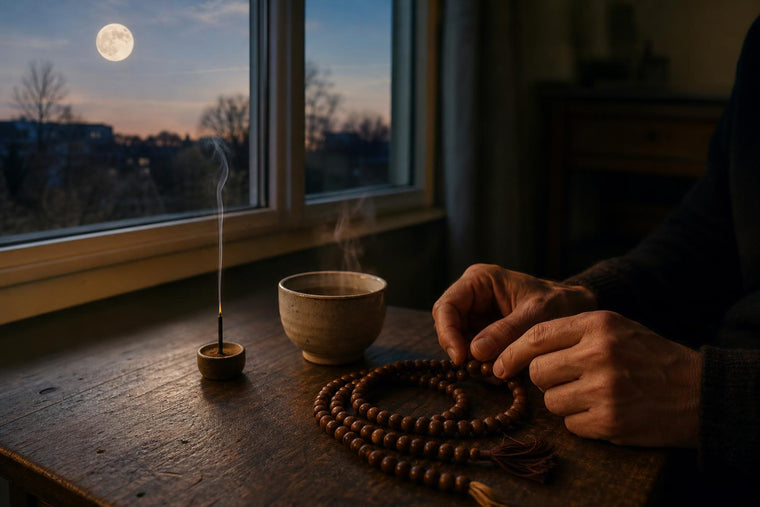
- Keep count. Reach for a japa mala of 108 beads, the classic tool for chanting. Move one bead per repetition, keeping count on the beads as you recite, so your attention can rest on the words rather than the number.
- Set the space. Some people light a lit stick of sandalwood incense before sitting; the warm, woody note of sandalwood has long been part of devotion across India. If you prefer oils, a ceramic oil burner to scent the room does the same gentle work.
- Mark a threshold. A clear tone, the resonance of a singing bowl to open and close practice, is a simple way to step into and out of a few quiet minutes.
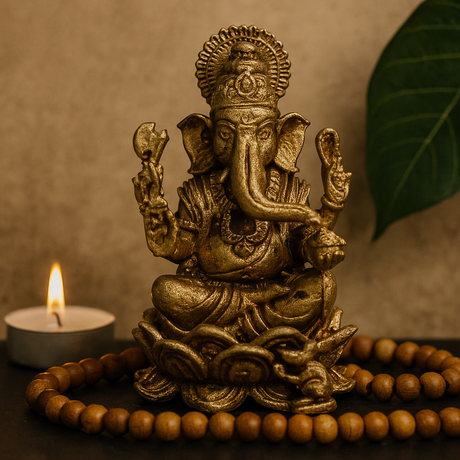
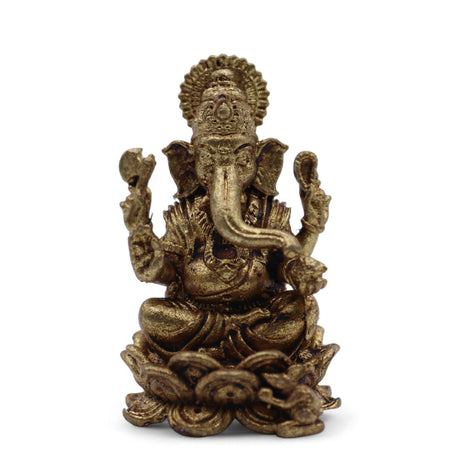
- Give it a focus. Many keep a small deity statue for your altar, a hand-carved figure to mark the space, simply as a point for the eye to settle on.
None of these are required, and none do the practice for you. They are quiet companions, ritual objects for a daily devotional practice, that help signal to body and mind that this is your time to sit, breathe, and return to the words. Set an intention as you begin, and let the practice hold the rest.
A few common questions
Do I need to be Hindu to read or chant it?
We share this as cultural and spiritual heritage, not as a doctrine anyone must adopt. Many people from outside the tradition are drawn to its rhythm and its theme of facing fear with courage. If you choose to chant it, do so respectfully and with attention to the meaning. Whether it becomes a regular practice or simply a beautiful text you have read once is entirely your own choice.
Will chanting it remove my problems?
Within the tradition it is recited for protection and the easing of fear, and that intention is its heart. We would offer it honestly, though: a mantra is a practice, not a magic fix, and not a replacement for the practical steps a situation needs. What it tends to build is a steadier mind and a clearer sense of purpose. The agency stays with you.
However you come to these verses, as devotion, as heritage, or simply as a few minutes of stillness before a hard day, may they meet you with the steadiness they have offered others for centuries.