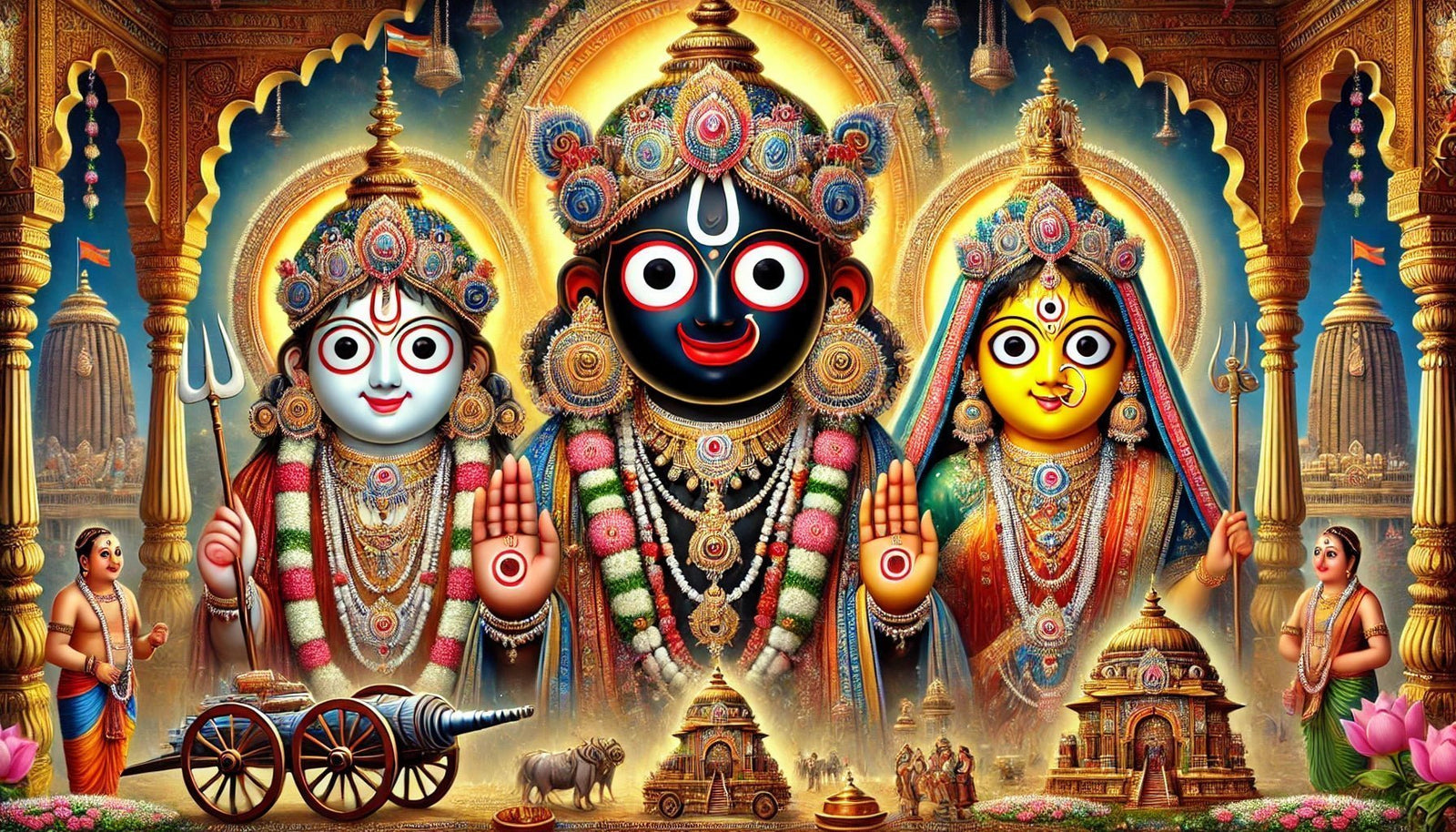
On the eastern coast of India, in the small temple town of Puri, three wooden figures with great round eyes have been worshipped for the best part of a thousand years. They are Jagannath, his elder brother Balabhadra, and their sister Subhadra, and once a year they leave their temple and are pulled through the streets on towering chariots, watched by hundreds of thousands of people.
This is the story of Jagannath: where the tradition comes from, what the temple at Puri has meant to the art and music of a whole region, and the rituals that still mark the calendar there. We tell it as cultural heritage and living legend, a window onto one of India's oldest devotional worlds, not a set of beliefs to adopt.
In this piece we look at:
- The signature legends behind Jagannath's wooden form
- The temple at Puri, Odisha, and the artisans who built it
- The triad of Jagannath, Balabhadra and Subhadra, and how it is read
- The Rath Yatra, the great chariot festival
- King Indradyumna and the Gajapati line
- The Vedic and Vaishnava threads in the worship
- The temple's key rituals, Nava Kalevara and Snana Purnima
The legends behind the wooden form
Jagannath is worshipped as a form of Vishnu, the preserver, and is closely linked with Krishna. What sets him apart is the form itself: not a finely carved human figure, but a stylised wooden image with large round eyes and stumps in place of fully formed arms. That unusual shape has its own well-known origin stories, told and retold across Odisha.
The oldest thread reaches back to the forest. In the most widely repeated legend, the deity was first worshipped as Nilamadhava, a blue stone form hidden in the woods and tended by a Savara tribal chief named Vishvavasu. Word of the secret reached King Indradyumna, who longed to find and enshrine the deity. After a long search, the story goes, the blue stone vanished, and a divine instruction came to carve the image instead from a sacred log that would wash ashore.
The carving has its own famous tale. The craftsman, identified in tradition as Vishvakarma, the celestial architect, agreed to work only behind closed doors, on the condition that no one disturb him until he was finished. When the doors were opened too soon, the work stopped, and so the figures were left with their unfinished arms. Whatever one makes of the legend, it gives a memorable explanation for a form that has puzzled visitors for centuries, and it threads the tribal, the royal and the divine into a single origin.
The temple at Puri
The Jagannath Temple stands in the holy city of Puri, in Odisha, and its history is woven tightly into the culture of the region.

A long history
The temple is sometimes called the 'White Pagoda'. The present structure was built in the early twelfth century under Anantavarman Chodaganga of the Eastern Ganga dynasty, though Puri had been a sacred site, Purushottama-kshetra, long before. Its scale and the legends gathered around it give the place a sense of deep age.
The craft of Kalinga
The building reflects the work of the Kalinga region, known for its detailed carving and tall, tapering spires. The main shrine carries a distinctive curved tower, and the stonework across the complex shows the skill of Kalinga artisans. It remains a standing record of the artistic legacy of the Kalinga rulers.
The triad: Jagannath, Balabhadra and Subhadra
Jagannath is rarely worshipped alone. He stands with his elder brother Balabhadra and his sister Subhadra, and together they form the sacred triad of Puri.
Balabhadra, the elder brother
Balabhadra, also known as Balarama, is the elder brother. He is shown as a fair-skinned figure of muscular build, holding a ploughshare and a mace, and is associated with strength and protection, the qualities that keep order.
Subhadra, the sister
Subhadra is the sister of Jagannath and Balabhadra. She is shown as a graceful figure of dark complexion, linked with compassion and devotion. In the triad she carries the feminine energy that balances her brothers.
The bond between the three is often offered as a quiet reminder of balance and harmony in our own relationships and actions, heritage and symbolism to sit with, not a rule to follow.
In one symbolic reading, the three siblings are linked to the cosmic rhythm of creation, preservation and dissolution, with Jagannath, as a form of Vishnu, holding the place of preservation. The images are worshipped together, and the triad appears in temples dedicated to Jagannath across India.
The Rath Yatra: the chariot festival
The Rath Yatra, or chariot festival, draws great crowds of devotees and visitors to Puri each year. It marks the journey of Jagannath, Balabhadra and Subhadra from their temple to the nearby Gundicha Temple, said to be their aunt's home.

The procession
Three tall wooden chariots, built fresh each year and decorated in bright cloth, carry the siblings through the streets of Puri. It is one of the few times the figures leave the temple, and the procession draws people of every background into the same crowd.
Why it matters
The festival commemorates the deities' annual visit to the Gundicha Temple. It is also, in cultural terms, a moment of unusual openness, a public celebration that gathers diverse communities into one shared occasion. It falls in the month of Ashadha, usually June or July in the Gregorian calendar.
King Indradyumna and the Gajapati line
The rediscovery of the images
King Indradyumna appears again here as the ruler credited, in legend, with finding and enshrining the sacred images of Jagannath, Balabhadra and Subhadra. The story of his long search and his role in establishing their place of worship has kept his name central to Jagannath lore.
The Gajapati kings
The Gajapati dynasty held a close relationship with the Jagannath tradition, supporting its rituals and ceremonies over generations. That patronage helped shape the devotional culture around the temple and secured Jagannath's place at the heart of the region's religious life.
Vedic and Vaishnava threads
The worship of Jagannath sits within the broader stream of Hindu ritual described in the scriptures, and it carries clear Vaishnava character.
Within the wider tradition
Jagannath is identified with Vishnu and Krishna, and the temple's rites draw on the long Vedic and scriptural background of Hindu worship. A small Vaishnava shrine at home often begins simply, many people keep a single cast-brass idol such as a small hand-carved statue, set in a quiet corner as a daily focus rather than a talisman.
A blend of traditions
Part of what makes the Jagannath tradition distinctive is how it brings together formal Vaishnava worship with older local and tribal practice, the Savara roots in the founding legend are one sign of that. The result is a worship that feels both classical and rooted in its own place.
The temple's key rituals
Puri's calendar turns on a series of ceremonies. Two of the most significant are Nava Kalevara and Snana Purnima.
Nava Kalevara: renewing the forms
This rare ceremony renews the wooden forms of Jagannath, Balabhadra, Subhadra and Sudarshana. It is performed in years with a second month of Ashadha (Adhika Masa), an interval that varies, typically 8, 12 or 19 years. During Nava Kalevara:
- New images are carved from a sacred neem tree, marking the renewal of the deities.
- The ritual speaks to the cycle of life, death and rebirth, the impermanence of the physical form set against an enduring presence.
Snana Purnima: the ceremonial bath
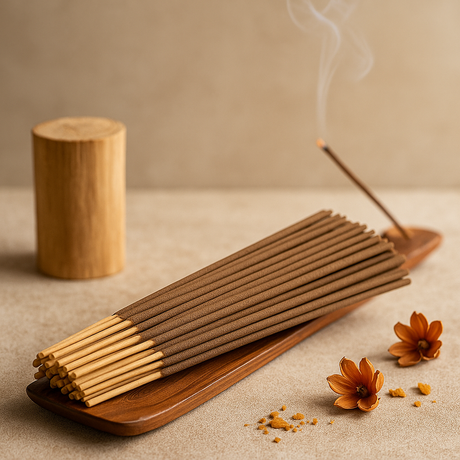
In this ritual the four figures are brought to a platform and bathed with 108 pitchers of aromatic water, amid the chanting of sacred hymns. In devotional tradition, the sacred bath is held to be deeply purifying, a moment of renewal for those who witness it. The note that carries through it all is sandalwood, the temple's signature scent. A simple stick of Indian incense at home can hold that same note; lit not as a cleansing claim but as a way to set an intention for a quiet morning.
Puri beyond the temple: art, music and letters
Puri is a major pilgrimage town, but it is also a centre of art, music and literature that has grown up around the Jagannath tradition.
Pattachitra painting
Puri is closely tied to a traditional cloth-based scroll painting called Pattachitra, known for its fine line work, natural pigments and warm, saturated colour. Many pieces depict episodes from the life of Jagannath and Krishna. It is one of the oldest living painting traditions in India, still practised by artisan families in villages around Puri.

That same heritage of bold line and warm colour is easy to bring into a living space, a piece of Odishan-inspired art on the wall carries a little of Puri's visual world home.
Odissi devotional music
The tradition has shaped a distinct genre of devotional music known as Odissi music, with soulful melodies and lyrical compositions written in reverence to Jagannath. The chariot festival in Puri brings performances of Odissi music and dance, threading sound through the celebration. For those drawn to that practice, a japa mala for mantra and devotion offers a steady counterpart at home, a tool for quiet repetition.
A literary cradle
Puri has a long tradition of poetry dedicated to Jagannath. The poet Jayadeva's masterpiece, the Gita Govinda, celebrates the love between Krishna and Radha, and is still recited within the temple precincts.
The Mukti Mandap
Within the temple complex stands the Mukti Mandap, a raised pavilion where the temple's learned brahmins traditionally gathered to rule on scriptural questions. Puri itself carries an old belief that those who die within the holy kshetra, the sacred zone around the temple, attain liberation; in tradition that belief attaches to the wider holy ground, not to this specific platform.
Puri as a place of devotion
For centuries, pilgrims have travelled to Puri from across India and beyond. The town gathers people of every background before the same three figures, and the experience is layered: the chant of hymns through the temple halls, the scent of incense in the air, the strong colour of the images and the carved walls where art and worship meet.
The temple's daily rites are carried out by hereditary priest communities, each ritual carrying its own meaning within the wider cycle of the year. Watching a tradition like this from the outside, what stays with most visitors is its sense of continuity, a set of practices kept alive, with care, for the best part of a thousand years.
You don't need to travel to Odisha to feel a thread of that atmosphere. Many people keep a corner for reflection at home, a small shelf or altar with an idol, a stick of incense, a piece of cloth. The point isn't to recreate a temple, but to mark a quiet space and return to it.
A living legacy
What gives the Jagannath tradition its lasting character is, above all, its openness. The cult is known for crossing social lines, and Jagannath carries the epithet patita-pavana, 'saviour of the fallen', a name that speaks to a tradition reaching beyond rank and caste. That inclusive quality is part of why the festival at Puri gathers such a broad crowd, and why the tradition has held its place in the region's cultural life.
Around it sits a whole world of music, painting and ritual sound, the layer the temple shares with the home. A note of sound and sacred chanting is one of the simplest ways to carry that atmosphere into a daily practice, whether through a bell to open a moment of stillness or a bowl rung at the start of the day.
Bringing the spirit home
Jagannath stands, in his own tradition, as a figure of unity and devotion whose story has shaped the art and life of a region for a thousand years. If the tradition draws you in, there are gentle ways to sit with it:
- Personal study: read into the legends, the festival and the scriptures connected with Jagannath and the wider Vaishnava world.
- A quiet practice: the temple's chanting has a domestic counterpart in japa, quiet repetition of a name or mantra. A japa mala for mantra and devotion gives the practice a simple shape, counted bead by bead, with the focus kept firmly in your own hands.
- A considered space: a shelf for reflection, the aromatic temple atmosphere of sandalwood and resin, and a few spiritual and ethno home pieces can hold a note of calm between visits.
Much of this tradition is crafted in India, the same heritage of brass-work, cloth and carving that fills the workshops around Puri. A piece from that world also makes a meaningful gift, something with a story behind it, given with a little care.