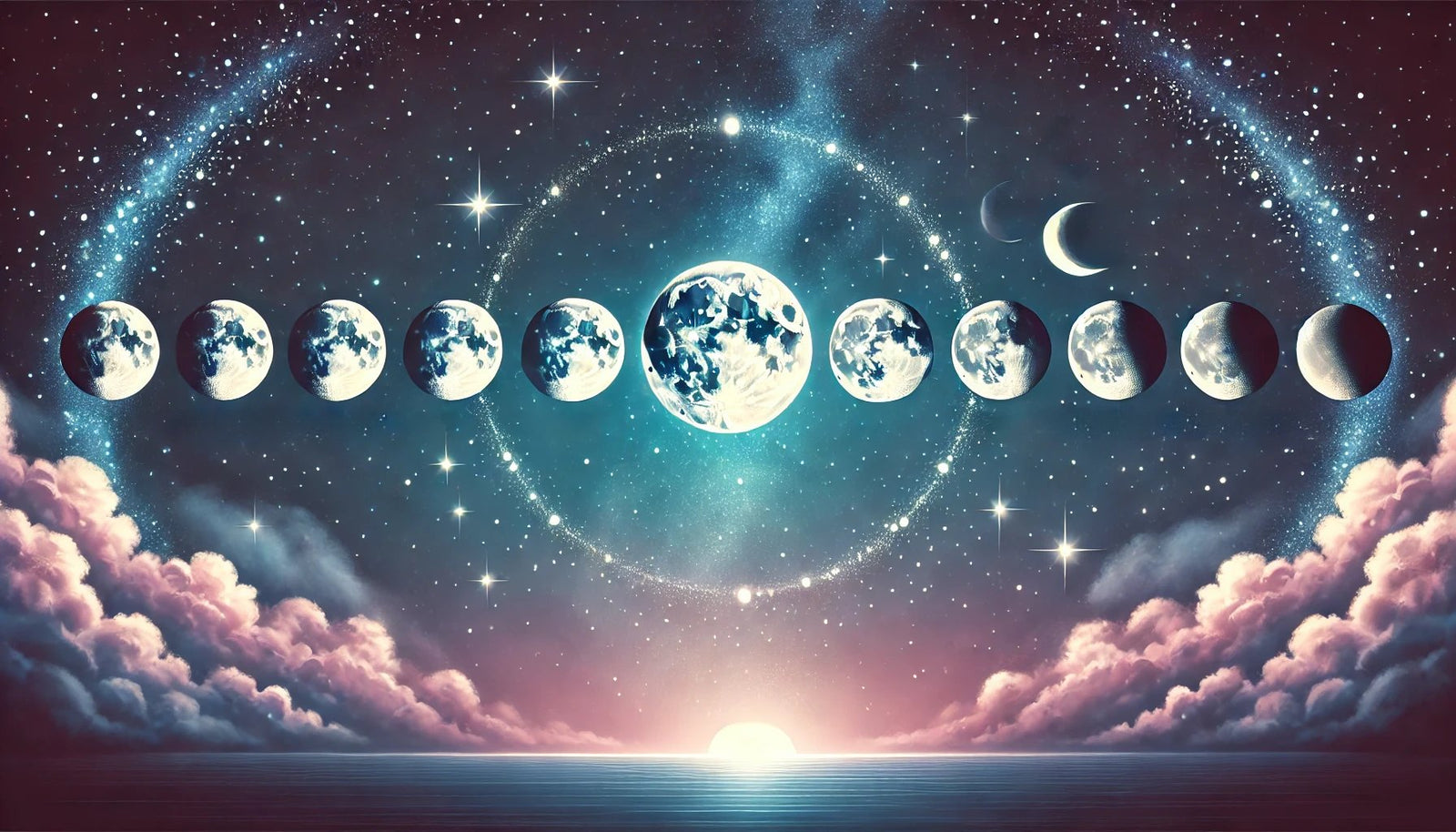
Few things have followed us as faithfully as the Moon. Its quiet passage across the night sky has marked time, guided sailors, and shaped festivals for as long as people have looked up. You don't need to believe the Moon does anything to you to find it useful. Watched gently, its cycle becomes a simple framework, a way to pace rest, reflection and small beginnings across the month. That is the spirit of this piece: the Moon as a rhythm to notice, not a force to obey.
On the largest scale, the Moon's gravity is real and well understood: it drives the ocean tides and helps steady the Earth's axial tilt, which in turn gives us our seasons. What it does not do is move the fluids in your body the way it moves the sea, a person is far too small for the Moon's pull to matter, and the very sleep research often quoted on this subject says as much. So we'll keep the astronomy honest and treat the human side for what it really is: cultural and experiential. Across countless traditions, people have long organised rhythm, rest and reflection around the lunar cycle. It is a framework for attention, and the agency always stays with you.
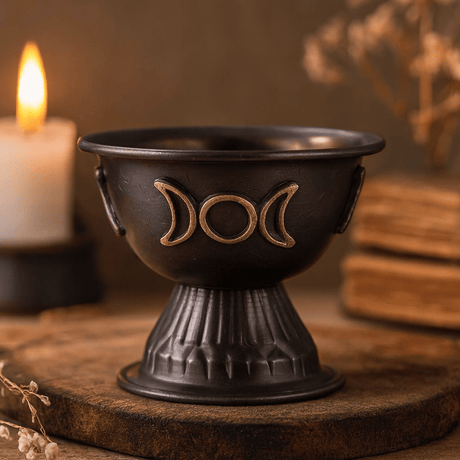
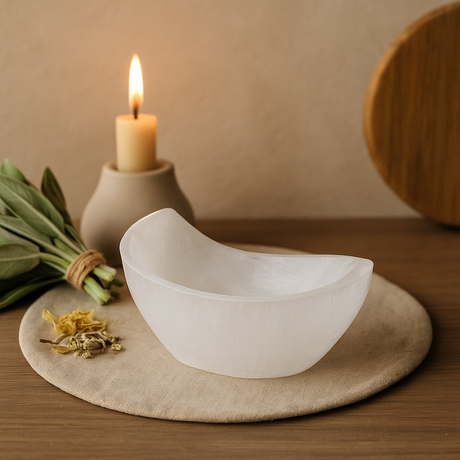
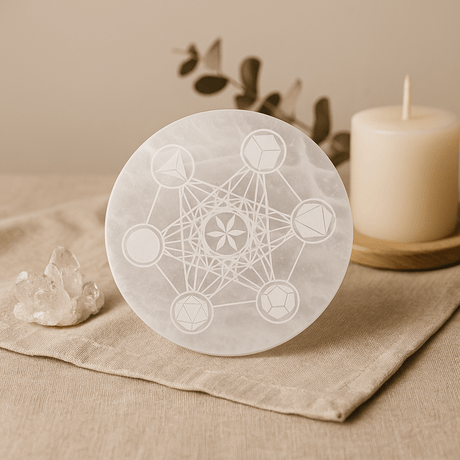
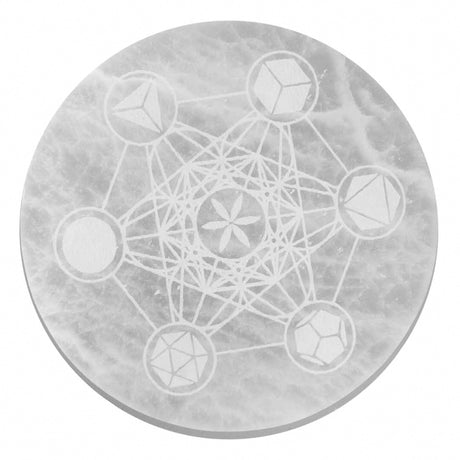
If it speaks to you, you might keep a moon-cycle charging plate or a piece of selenite on the windowsill, a small, tangible spot to set a stone or a written intention beneath the night sky. The object doesn't do the work; it simply keeps the note while you do.
The eight phases at a glance
The lunar cycle runs about 29.5 days from one new moon to the next, moving through eight recognisable phases. Here is a short map of how many people choose to use each one, gently, as a cue rather than a command.
- New Moon (0% illumination). A dark sky and a natural moment for new beginnings, setting intentions and planting seeds, both literally and figuratively. Many treat it as the quiet, slow start of the cycle: a good time for rest, reflection and inner work.
- Waxing Crescent (up to 49% illumination). A first sliver of light, and a fitting time to begin. Many use it as a cue to take the first small step, ease out of a comfort zone and build a little momentum.
- First Quarter (50% illumination). Half-lit and steady. A natural moment to push through an obstacle, make a decision and act with focus.
- Waxing Gibbous (51% to 99% illumination). Nearly full. Many use it as a prompt to nurture what they've started, connect with others and give creative endeavours a final tidy before they come to fruition.
- Full Moon (100% illumination). Fully bright, and for many a high point of the month. A widely used moment for releasing what no longer serves you and expressing gratitude.
- Waning Gibbous (99% to 51% illumination). The light begins to fade. A natural cue to complete, declutter and reflect, to clear the old before the next cycle.
- Third Quarter (50% illumination). Half-lit again. A fitting moment for re-evaluation: review what's working, let go of what isn't, and adjust.
- Waning Crescent (up to 49% illumination). A thin, fading sliver, a quieter, slower few days. Many use it for genuine rest and self-care, winding down before the cycle begins anew.

The Moon in cultures across the world
The Moon's significance reaches far beyond astronomy. For countless cultures throughout history, it has been a calendar, a compass and a presence in story and ceremony.
- Keeping time. Long before clocks and printed calendars, lunar cycles offered a reliable way to track the passing days. Hunters and gatherers read the Moon's phases to anticipate seasonal change and animal migrations. Many cultures, among them the Chinese, Hindu and Islamic civilisations, built their calendars on the lunar cycle, timing agriculture, festivals and religious observances by it.
- Finding the way. Sailors steered by the Moon and stars across vast oceans. The Polynesians, for example, read the Moon's predictable movements alongside star maps to cross the Pacific and bring their voyages safely home.
- Myth and ceremony. The Moon threads through ancient mythology. In Egypt, the moon god Thoth was linked with wisdom and writing; in Greece, the goddess Artemis with the hunt and the wild; among the Inca of South America, Mama Quilla, the moon goddess, was honoured as protector of women and keeper of the calendar. Many peoples, including the Maya and the Druids, held ceremonies aligned with the lunar moon-phase calendar. We share these as cultural and historical context, never as doctrine or a claim about how the world works.
How people connect the lunar calendar to daily life
Here it's worth being careful. Some of what's often said about the Moon and the body is folk belief; a little of it has been studied; very little is settled. What follows separates the two, and treats the lunar calendar as a personal framework rather than a force acting on you.
Sleep
There may be a small link between the lunar cycle and sleep. One small 2013 study in Current Biology observed that, around the full moon, participants took about five minutes longer to fall asleep and slept around twenty minutes less, with a measurable dip in deep sleep. It's a modest study that hasn't been firmly replicated, and the researchers themselves called the mechanism mysterious, so treat it as a curiosity, not a rule. Better still, treat it as a gentle invitation to notice your own sleep across the month and honour an earlier night when your body asks for one.
Mood
Despite a persistent folk belief in a full-moon 'lunar effect' on mood, large reviews of the evidence have found essentially no link to psychiatric admissions, crime or crisis calls. What many people do report is feeling a little more emotionally aware around the full moon. Whether that's the Moon or simply the bright sky drawing the eye, it makes a natural cue to check in with yourself, to journal, to wind down, or to name what you're carrying.
Cycles and rhythm
The average menstrual cycle (about 28 days) is close in length to the lunar cycle (about 29.5 days), and some people find it meaningful to track their own cycle alongside the Moon's. Modern research is mixed, any syncing is loose at best, and tends to fade with artificial light. Still, the lunar calendar can be a simple, personal way to notice your own rhythm. It governs nothing; it's just a calendar you can keep.
Meditation and ritual
Many contemplative traditions weave the Moon into meditation and yoga. The dark introspection of the new moon or the brightness of the full moon are often used as cues, for deeper focus, for letting go, for gratitude. New moon practices tend to centre on setting intentions; full moon ones on release or thanksgiving. A few quiet tools help: a candle, a singing bowl, or a drop of essential oils to mark the moment.
Gardening and the land
In biodynamic farming, a traditional practice popularised by Rudolf Steiner, growers time planting and harvesting to the lunar calendar, sowing root crops such as carrots and potatoes on the waning moon, for example. Controlled evidence for a yield effect is thin, but many gardeners enjoy it as a rhythm for the season, a way of keeping in step with the year.
Your own observation
In the end, this is a personal practice. Keep a simple lunar diary, a line each night on how you slept, your energy and your mood, and after a cycle or two you'll begin to see your own patterns. Those matter far more than any chart. Align a few activities with the phase if it suits you; ignore it on the days it doesn't. The point is attention, not obligation.

A closer look at each phase
The Moon's slow turn through its eight phases gives a quiet structure for self-awareness. None of it acts on you; each phase is simply a moment you can use. Here's a fuller look, with the agency kept where it belongs, with you.
New Moon (0% illumination)
The New Moon is widely used as a time of new beginnings and setting intentions. The dark sky invites introspection and offers a blank slate to start fresh, a natural moment for planting seeds (literal and figurative), naming goals and a small cleansing ritual if it appeals. Some people notice they settle earlier around the new moon's darkness; if your body asks for an earlier night, it's a good prompt to honour one. Many also feel drawn to declutter their space and their thoughts. Embracing the stillness, you can reconnect with yourself and clarify where you'd like the month to go, a gentle sense of hope and possibility, chosen rather than received.

Waxing Crescent (up to 49% illumination)
The Waxing Crescent is often used as a cue for initiation and first action. As the light begins to grow, many feel a natural lift in momentum, a fitting time to begin a project or step a little beyond a comfort zone. Take small, proactive steps towards what you named at the new moon. You might notice fresh motivation and a more optimistic outlook; it's a good moment to try a new idea and build on early progress. The crescent doesn't push you forward, it's simply a marker you can choose to move with.

First Quarter (50% illumination)
The First Quarter Moon is a natural moment to confront a challenge and push through an obstacle. With half the face lit, many use it as a cue to take decisive action, make an important decision and reaffirm their commitment to a path. You might find yourself more focused, more willing to assert what you need. Think of it as a checkpoint rather than a test set by the Moon, a fitting time to address whatever has come up and to steady your resolve.

Waxing Gibbous (51% to 99% illumination)
The Waxing Gibbous Moon is often used as a prompt for growth, nurturing and connection. As the Moon approaches fullness, many feel more sociable and open, a fitting time to collaborate, share creative endeavours and tend a project towards completion. It's a good moment to fine-tune plans and make sure things are on track. You might feel inclined to be generous, to involve others, to share what you have. The Moon offers the cue; the care and the doing are yours.

Full Moon (100% illumination)
The Full Moon is, for many, the high point of the cycle, a widely used moment for release and gratitude, for letting go of what no longer serves you and marking what you've accomplished. Many report heightened feeling and a desire for closure around this time. On sleep, one small study observed that people slept around twenty minutes less and saw deep sleep reduced by roughly 30% near the full moon, a single, unreplicated finding, so hold it lightly. Use the phase, if it suits you, as a considered pause: forgive, practise a little self-kindness, and acknowledge how far you've come. The completion is something you choose to recognise, not something the Moon delivers.

Waning Gibbous (99% to 51% illumination)
The Waning Gibbous Moon is often used as a phase of completion and letting go. As the light begins to fade, many turn more reflective, a natural time to organise, declutter and sit with their thoughts. You might want a little solitude, or a quiet review of how the month has gone. It's a fitting moment to give thanks and to share what you've learned. The waning light is simply a cue to clear the old and make room for what comes next.

Third Quarter (50% illumination)
The Third Quarter Moon is widely used for reflection and re-evaluation. With the face half-lit again, many find it a fitting time to review their goals, release what's become a burden and make the adjustments they've been putting off. You might notice a more critical, analytical eye, towards yourself and your plans. Treat it as a natural checkpoint: assess what has and hasn't worked, and refine accordingly. It's a moment for honest self-reflection, chosen rather than imposed.

Waning Crescent (up to 49% illumination)
The Waning Crescent Moon is a quieter, slower few days, for many, a natural close to the cycle and a cue for genuine rest. As the Moon returns to darkness, it's a fitting time for relaxation, self-care and dream work if that appeals. You might feel a real need to slow down and recharge before the next cycle. Retreat a little, meditate, and look after yourself. Rest is the practice here, and it's reason enough on its own.

Simple rituals for each phase
If you'd like to mark the cycle with a small practice, here are some gentle ideas. Treat each as a way to focus your own intention, the object holds the note; you do the work.
New Moon, planting seeds
Under the dark of the New Moon, light a candle and set your intentions for the month. Write your goals down and picture them taking shape, a simple act of attention that helps you return to what matters. The new moon's quiet also suits a small cleansing ritual: a relaxing bath with Epsom salts or a few lavender bath soaks, or marking a fresh start with a smudge stick of sage. You might keep a 'new moon jar', writing each wish on a slip of paper and revisiting them next cycle to see what has grown.
Waxing Crescent, taking action
As the crescent emerges, gather what you'll need to bring your intentions to life. A vision board or a short to-do list helps channel the phase's first-step energy, and it's a fitting moment to begin a new habit. Some people like to leave a jar of water out overnight as a small ritual marker, a way to set an intention for the day's actions, then use that water to tend a plant or pour into a bath as a mindful gesture. It's symbolic, not literal; the meaning is the one you give it.
First Quarter, meeting challenges
The First Quarter is often when obstacles appear. Mark it with a small ritual of resolve: light a candle, perhaps in a colour that means strength to you, and picture yourself moving steadily through whatever's ahead. You might make a 'courage charm' too, choose a small object such as a stone or a piece of crystals, name the determination you want to carry, and keep it with you as a reminder of your own strength. The charm doesn't grant courage; it holds the intention you've already set.
Waxing Gibbous, nurturing what's growing
As the Moon grows fuller, take a moment for gratitude, for the small things as much as the big. Gather loved ones for a shared meal, or pass some of your good fortune on by giving to a cause you care about. It's a natural time for generosity and connection. You might also make an 'abundance bowl', filling it with things that mean prosperity to you, coins, a few moonstone pieces, written affirmations, and keep it somewhere you'll see it as a daily prompt.
Full Moon, release and celebration
The Full Moon makes a fitting moment to let go. Write down a worry, a limiting belief or a habit you'd like to release, then safely burn or bin the paper as a symbolic gesture. It's also a time to mark what you've done: light a white candle and acknowledge something you're grateful for. If it helps you slow down, bring in sound, a singing bowl or a small drumming circle with friends, the rhythm carrying a shared sense of release. None of it is a magic switch; it's a considered pause you choose to take.
Waning Gibbous, reflection and sharing
During the Waning Gibbous, look back over your month and, if you like, share it. The phase suits quiet introspection and giving thanks. You might host a small gathering where each person names a recent win and a recent struggle, an honest, supportive exchange. A daily gratitude journal works well here too: a few lines on what you're thankful for, kept up across the phase.
Third Quarter, re-evaluation and letting go
The Third Quarter is a natural moment for re-evaluation. With the Moon half-lit again, many turn analytical, reviewing goals, releasing burdens, adjusting plans. You might notice a more critical eye towards yourself and your circumstances, and a wish to set something down. Consider writing a 'release letter' naming what you're ready to let go of, then safely burning or burying it as a symbolic close.
Waning Crescent, rest and restoration
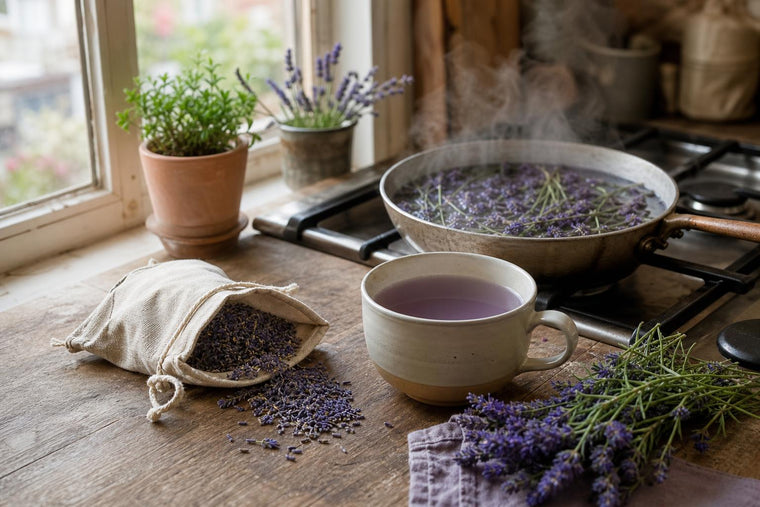
The Waning Crescent is for rest. As the Moon returns to darkness, let the days be quiet, relaxation, self-care and, if it appeals, a little dream work. You might feel a real pull to slow down and recharge before the cycle begins again. Honour it. A 'dream pillow' of calming herbs such as lavender and chamomile can make the evenings softer, and reflective tools like tarot and oracle cards offer a gentle prompt for journaling if you'd like one. Use the dimming light as permission to rest, nothing more is required of you.
In closing
Lived with gently, the lunar calendar is a quiet, useful rhythm, somewhere to set intentions at the new moon, to pause and give thanks at the full one. Pair it with a few small rituals if you like, and notice how your own sleep, mood and energy move across the month; those personal patterns are the real reward, far more than any rule. The Moon decides nothing for you. It simply offers a steady cycle to align with, and the choosing, always, stays in your hands. Use candle holders, a stone, a journal as anchors for the practice; they keep the note while you do the work.