Few objects in the Himalayan world keep their mystery quite like the Dzi bead. Slip one onto a cord, hold it up to the light, and you are looking at a small patterned stone that people have carried close for a very long time, for steadiness, for focus, for a quiet sense of being watched over. This is a gentle guide to what Dzi beads are, what the markings are traditionally said to mean, and how to wear and care for one as a personal talisman.
What a Dzi bead is
Dzi beads (pronounced 'zee') are among the most enigmatic objects in the Himalayan world. The etched agate craft behind them is genuinely ancient, comparable beads appear thousands of years ago, and their precise origin remains a mystery scholars still debate. They are most closely associated with Tibet and the wider Himalayan region, where they were prized and worn, while the older tradition of etching agate is usually traced back to ancient India.
The beads themselves are made from agate, a banded form of chalcedony, then etched and dyed to bring out their patterns. Each one carries its own markings, lines, waves, squares, and most famously the circular 'eye'. In Tibetan tradition the Dzi is carried as a protective amulet, historically associated with warding off the evil eye and misfortune, and is often passed down through families.
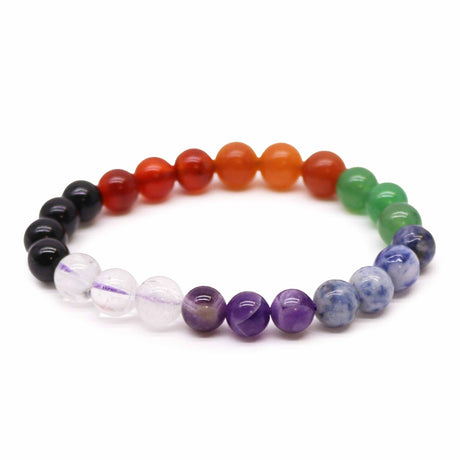
If the material itself is what draws you, it is worth getting to know agate, the stone most Dzi are cut from. Darker beads sit closest to the classic look, see black agate for the deep banded tone many people picture first. You will also find Dzi beads and other Tibetan bracelets worn the everyday way the tradition describes.
The 'eye' and what the markings mean
The most recognised Dzi pattern is the circular 'eye'. In Tibetan tradition the number of eyes carries a meaning, and many people choose the one that speaks to an intention they want to keep close. It helps to think of this as a framework for intention rather than a promise: the bead does not act on its own. You set the intention, wear the bead as a daily reminder, and let it keep the note.
The associations below are folk tradition, and they vary from one source to another, treat them as a starting point, not a rule. The single, three, six, nine and twelve-eye beads are the ones most consistently named.
Traditional associations of the Dzi 'eyes'
| Number of 'eyes' | Traditional association |
|---|---|
| One | Clarity, self-belief, a fresh start |
| Two | Harmony in love and a settled home |
| Three | Steadiness, long life, good fortune |
| Six | Focus on a goal, a clear mind, vitality and wellbeing |
| Nine | Wholeness, balance, a sense of luck |
| Twelve | Holding fast to an intention; renewed energy |
Many of these meanings circle around protection, steadiness and good fortune. If those are the qualities you want to keep in mind, you might also explore personal talismans worn for protection, or, for the prosperity end of the list, stones traditionally tied to prosperity and abundance.
The 'eye' motif is not unique to Dzi. The banded shimmer of tiger eye carries its own version of the watchful 'eye', and is an easy stone to recognise if you are new to all this. For a wider look at what is out there, browse our gemstone crystals to keep close.
How to wear and carry a Dzi bead
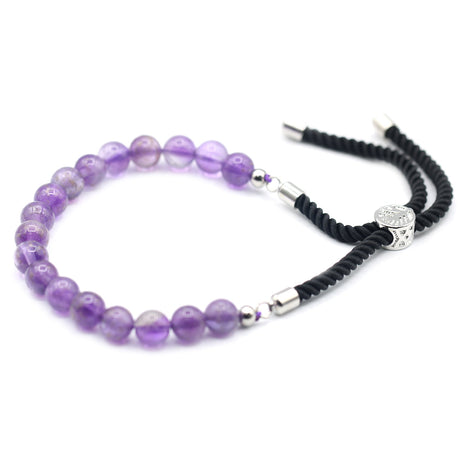
There is no single correct way to wear a Dzi. Most often it is strung on a bracelet or cord so it rests against the skin, but it works just as well threaded onto a necklace, kept in a wallet, or carried in a pocket. You can also wear it as a keyring or bag charm, so it stays with you and catches your eye through the day.
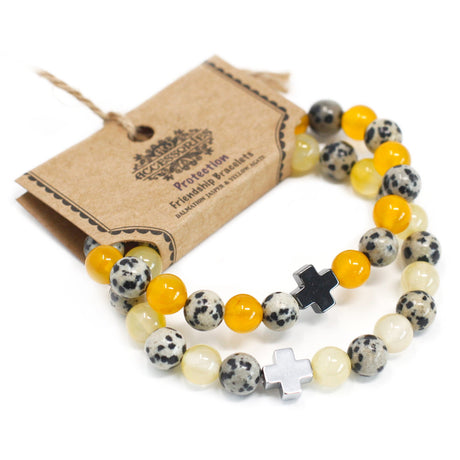
Because Dzi sit so naturally on the wrist, they belong to a wider family of intention-led pieces. If the prosperity and good-fortune associations appeal to you, you might enjoy our feng shui bracelets too. The point, whichever way you choose, is simply that the bead is close enough to notice, a small prompt to pause and return to what you intended.
Caring for and cleansing a Dzi bead
Many who wear Dzi like to cleanse the bead as a small ritual, a moment to reset their own intention, especially when a bead first arrives. None of this is about the stone gathering or shedding anything physical; it is a mindful pause you keep for yourself. People in the tradition tend to use one of these methods.
- Pass the bead briefly through candle smoke or incense.
- Rest it in the morning sun for a while.
- Rinse it gently under running water.
- A short soak in lightly salted water, then rinse and dry.
Agate is fairly hardy, but avoid harsh chemicals and long soaks in strong salt water, which can dull the polish over time. Many people cleanse a bead once when it arrives, then only now and again afterwards. If you like the smoke method, cleansing the bead in herb smoke is a familiar modern way to mark the moment. As you do it, name the intention you are setting and let the bead hold that note.
Living with a Dzi bead
A Dzi bead is a meaningful object to carry, a personal talisman and a reminder of something you want to keep close. The eye is a cultural symbol of watchfulness, the patterns are part of a long Himalayan story, and the practice is yours: choose the bead that speaks to you, wear it where you will see it, and let it keep the note while you do the work. Worn that way, it stays a quiet companion rather than a quick fix, and that is exactly the point.