A thread of red wool around the wrist is one of the smallest objects a person can wear, and one of the most loved. It asks for nothing, and it is easy to overlook. Yet across many cultures it has been tied on for centuries, a quiet marker of care, of intention, of a bond with whoever fastened it. This is a slow look at the red string: where the custom comes from, what the tradition holds, and how to wear one consciously, as a daily reminder rather than a promise. If you like the idea of a small thread you can set an intention on, our red string bracelets are a gentle place to begin.
The trend of the red string
You may have noticed a plain red thread on a famous wrist, Madonna, Demi Moore, Paris Hilton, Britney Spears, Victoria Beckham all wore one through the 2000s, when the Kabbalah Centre brought the custom into wider view. It is easy to read it as fashion. But the red string is older and quieter than any trend: a simple thread amulet worn, in the tradition, as a reminder of good intention and care.
The meanings behind it are layered, and most wearers never hear them. In the sections below we follow the thread back to its roots, and look at how people wear it today.
The evil eye, as a folk idea
Across many cultures, the idea of the “evil eye”, the notion that envy or ill will can unsettle us, has a long folk history. It appears around the Mediterranean, the Middle East, South Asia and beyond, in beads, hands and threads worn close to the skin. None of this is a claim about how the world works; it is cultural heritage, carried down through generations.
The red string sits within that tradition as a quiet reminder, not a guarantee. If the symbolism of protection against the evil eye speaks to you, it works best the way any anchor does: you tie it on, name one intention, and let it bring you back to that intention through the day. The agency stays with you.
Kabbalah, in brief
Much of the red-string custom in the West comes through Kabbalah, a tradition of Jewish mysticism. Its foundational texts emerged in medieval Spain and southern France, around the 12th, 13th centuries; the Zohar, its central work, is associated with 13th-century Spain. Over the centuries the tradition has been read and interpreted in many ways, and modern teachers have framed it variously, but at heart it is a contemplative, mystical tradition, presented here as cultural and historical context rather than as a set of truth claims.
Within that world, the red thread on the wrist became a small, visible sign of belonging and intention, a thread you carry, with meaning woven into it.
The origin of the red string
The Kabbalistic tradition
In the Kabbalistic story, the custom is tied to Rachel, the wife of Jacob. After the birth of her second child Rachel died and was buried, the tradition holds, on the road between Bethlehem and Jerusalem. She is remembered as a matriarch of the Jewish people, and her tomb became a place of pilgrimage.
In the tradition, Rachel embodies the physical world and a mother’s protective love, a figure of hope and homecoming. A ritual grew up around her tomb: a long red thread was wound around it, then cut into lengths and tied, with prayers, onto the wrists of family and loved ones. Wearers carry it as a reminder of that care, and as a thread to hold on to through life’s harder passages.
Who ties the thread
In the custom, the string is usually tied by someone close to you, a parent, sibling, partner or close friend, as a small act of care. The idea is that the thread carries the intention of the person who fastens it, so many feel that shared intention is part of what makes it meaningful. Wearing one given by someone who loves you turns a simple thread into a token of a bond.

If you would rather tie your own, you still can. The practice is yours to shape; there is no single correct way to do it.
How to tie the red string
The seven knots
Seven knots is part of the older custom, one knot for each intention as you tie. As you make each knot, the tradition invites you to pause and picture what you hope to draw into your life, and how it might feel once it is here. It is a way to make the act deliberate rather than decorative.
Some who tie the thread say a prayer alongside the knots, one line to each knot, asking for the wearer to be kept well. There are many such prayers in many languages; the words matter less than the moment of attention. The number seven is symbolic; the value lies in the pause it asks of you. Many wear the finished thread as a daily reminder to return to those seven intentions.
Why woollen thread
Tradition favours natural wool for the thread, soft against the skin and warm to wear. It is usually a single, fresh length of pure wool, not something repurposed, so that the thread you tie on is wholly its own. Red cotton and silk are widely used too, and a stone-and-cord bracelet can carry the same idea.
Wearing on the left wrist
In the Kabbalistic custom the thread is worn on the left wrist, the side traditionally thought of as the receiving side of the body. Worn there, it is taken as a gentle filter and a daily cue: a small thing you glance at and remember your intention by. Many wear it simply because they have seen others do so, without knowing the older meaning.

Worn consciously, it is less an object that acts on you and more a reminder you return to, tie it on, set one intention, and come back to it through the day.
Wearing on the right wrist
Some traditions tie it on the right wrist instead, a personal choice within the custom. There is no single correct answer; choose the side that feels right to you and let the thread be a quiet anchor rather than a rule.
What to do if the string breaks
A worn thread will eventually fray and break. In the tradition, a string that wears through is taken as a kind thought, a sign you carried it long enough that its work is done, or that something you were hoping for is close, rather than something to fret over. There is nothing to fix and nothing to fear.
Some choose to burn the old thread as a small closing gesture and then tie on a fresh one, setting a new intention as they go. It is a gentle way to mark a beginning, in the same spirit as the first knot.
Beyond the thread: stones and a wider practice
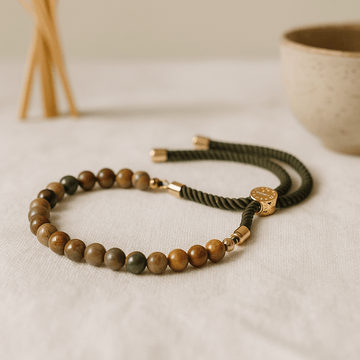
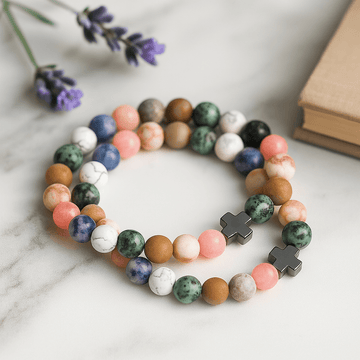
The red string sits naturally alongside the wider family of mindful jewellery. Some people like to pair it with a stone that matches your intention, a steadying red jasper, a warm carnelian, worn as a second small reminder on the wrist. Our gemstone bracelets carry the same thread-on-the-wrist idea in beaded form, and there is a bracelet aligned to the chakras for those who like to choose by energy centre.
The seven-knot habit, one intention at a time, returned to slowly, also echoes older counting practices. If that rhythm appeals, you might like mala beads for the same quiet ritual, or simply browse our gemstone jewellery for a piece that feels like yours. Whatever you choose, the principle is the same: the object holds the note; the practice is yours.

 China
China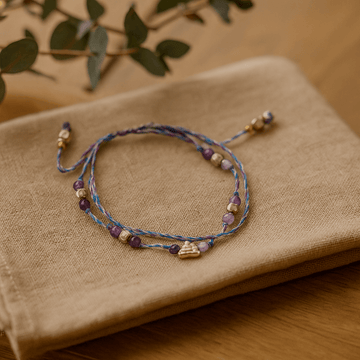
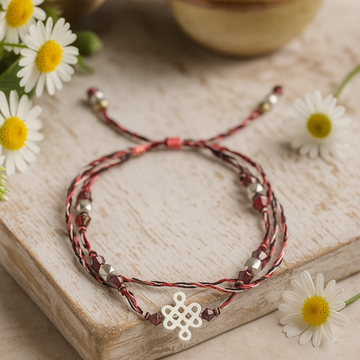
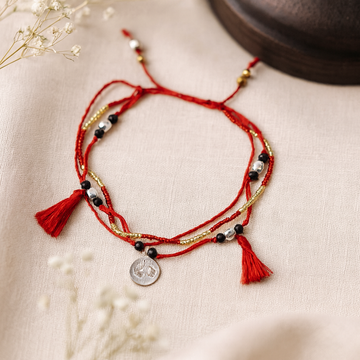




 Australia

 Mexico

 India
India